We read your photo as:

A house floorplan shows a rectangular garden with length 3.8 m and breadth 3.1 m. Calculate its area. Also, determine the percentage of the house area that the bedroom occupies. The bedroom is a squar

Mathematics

ScanSolve AI Answer

This answer stops before the end.

It was cut off when it was first written. Ask ScanSolve this question again for the full working.

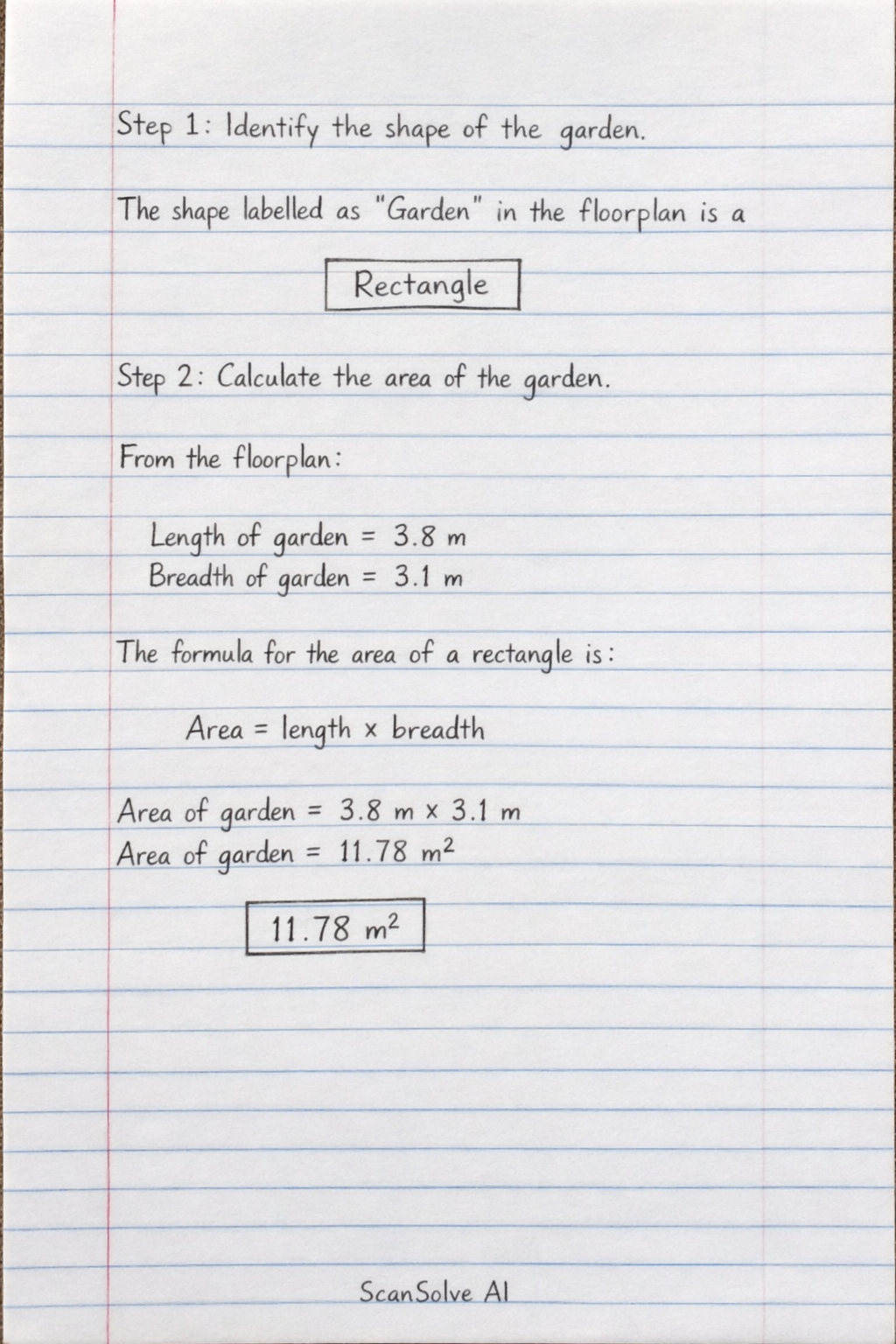
Step 1: Identify the shape of the garden.
The shape labelled as "Garden" in the floorplan is a rectangle.

Rectangle\boxed{\text{Rectangle}}

Step 2: Calculate the area of the garden.
From the floorplan:
Length of garden =3.8 m= 3.8 \text{ m}
Breadth of garden =3.1 m= 3.1 \text{ m}
The formula for the area of a rectangle is Area=length×breadth\text{Area} = \text{length} \times \text{breadth}.

Area of garden=3.8 m×3.1 m\text{Area of garden} = 3.8 \text{ m} \times 3.1 \text{ m} Area of garden=11.78 m2\text{Area of garden} = 11.78 \text{ m}^2 11.78 m2\boxed{11.78 \text{ m}^2}

Step 3: Calculate the percentage of the entire house made up of the bedroom.
First, calculate the area of each part of the house:

  • Area of Bedroom: Length =3.8 m= 3.8 \text{ m} Breadth =3.8 m= 3.8 \text{ m} Area of Bedroom=3.8 m×3.8 m=14.44 m2\text{Area of Bedroom} = 3.8 \text{ m} \times 3.8 \text{ m} = 14.44 \text{ m}^2
  • Area of Open-Plan (Lounge, Kitchen and Dining Area): Length =4.9 m= 4.9 \text{ m} Breadth =4.8 m= 4.8 \text{ m} Area of Open-Plan=4.9 m×4.8 m=23.52 m2\text{Area of Open-Plan} = 4.9 \text{ m} \times 4.8 \text{ m} = 23.52 \text{ m}^2
  • Area of Bathroom: Length =1.8 m= 1.8 \text{ m} The total width of the top section is 6 m6 \text{ m}. The width of the Open-Plan area is 4.8 m4.8 \text{ m}. Breadth of Bathroom =6 m−4.8 m=1.2 m= 6 \text{ m} - 4.8 \text{ m} = 1.2 \text{ m} Area of Bathroom=1.8 m×1.2 m=2.16 m2\text{Area of Bathroom} = 1.8 \text{ m} \times 1.2 \text{ m} = 2.16 \text{ m}^2

Next, calculate the total area of the house (excluding the garden, as it's typically not considered part of the "house" structure).

Total Area of house=Area of Bedroom+Area of Open-Plan+Area of Bathroom\text{Total Area of house} = \text{Area of Bedroom} + \text{Area of Open-Plan} + \text{Area of Bathroom} Total Area of house=14.44 m2+23.52 m2+2.16 m2\text{Total Area of house} = 14.44 \text{ m}^2 + 23.52 \text{ m}^2 + 2.16 \text{ m}^2 Total Area of house=40.12 m2\text{Total Area of house} = 40.12 \text{ m}^2

Finally, calculate the percentage of the house made up of the bedroom:

Percentage=(Area of BedroomTotal Area of house)×100%\text{Percentage} = \left(\frac{\text{Area of Bedroom}}{\text{Total Area of house}}\right) \times 100\% Percentage=(14.44 m240.12 m2)×100%\text{Percentage} = \left(\frac{14.44 \text{ m}^2}{40.12 \text{ m}^2}\right) \times 100\% Percentage≈0.3600×100%\text{Percentage} \approx 0.3600 \times 100\% Percentage≈36.00%\text{Percentage} \approx 36.00\% 36.00%\boxed{36.00\%}

Step 4: Convert 200 millimetres (mm) to metres (m).
Given that 1 m=1000 mm1 \text{ m} = 1000 \text{ mm}.

200 mm=200×1 m1000200 \text{ mm} = 200 \times \frac{1 \text{ m}}{1000} 200 mm=0.2 m200 \text{ mm} = 0.2 \text{ m} 0.2 m\boxed{0.2 \text{ m}}

Step 5: Calculate the area of one tile in m2^2.
Each tile is a square with a length and breadth of 200 mm200 \text{ mm}.
From Step 4, 200 mm=0.2 m200 \text{ mm} = 0.2 \text{ m}.
The formula for the area of a square is Area=side×side\text{Area} = \text{side} \times \text{side}.

Area of one tile=0.2 m×0.2 m\text{Area of one tile} = 0.2 \text{ m} \times 0.2 \text{ m} Area of one tile=0.04 m2\text{Area of one tile} = 0.04 \text{ m}^2 0.04 m2\boxed{0.04 \text{ m}^2}

Step 6: Calculate how many boxes of tiles are required to tile the bedroom if an additional 5% of tiles are required.

  • Area of the bedroom (from Step 3) =14.44 m2= 14.44 \text{ m}^2.
  • Area of one tile (from Step 5) =0.04 m2= 0.04 \text{ m}^2.
  • Number of tiles needed for the bedroom: Number of tiles=Area of BedroomArea of one tile\text{Number of tiles} = \frac{\text{Area of Bedroom}}{\text{Area of one tile}} Number of tiles=14.44 m20.04 m2\text{Number of tiles} = \frac{14.44 \text{ m}^2}{0.04 \text{ m}^2} Number of tiles=361 tiles\text{Number of tiles} = 361 \text{ tiles}
  • Add an additional 5% of tiles: Additional tiles=361×0.05=18.05 tiles\text{Additional tiles} = 361 \times 0.05 = 18.05 \text{ tiles} Total tiles required=361+18.05=379.05 tiles\text{Total tiles required} = 361 + 18.05 = 379.05 \text{ tiles}
  • Tiles are sold in boxes of 20. To find the number of boxes, divide the total tiles required by the number of tiles per box. Since you cannot buy a fraction of a box, round up to the next whole number. Number of boxes=379.0520\text{Number of boxes} = \frac{379.05}{20} Number of boxes=18.9525\text{Number of boxes} = 18.9525 Rounding up to the nearest whole number: Number of boxes=19 boxes\text{Number of boxes} = 19 \text{ boxes}
Was this helpful?

Still stuck on this one?

Ask a follow-up, and the answer starts from this question.

Got a different question?Ask your own question
Handwritten step-by-step solution preview

Handwritten Step-by-Step Solution

Get this as a handwritten image on WhatsApp — like a tutor wrote it for you.

Try on WhatsApp