
We read your photo as:
A rectangular garden has a perimeter of 72 m. The length is 4 m more than its width. Find the dimensions of the garden.
ScanSolve AI Answer
Step-by-step solution
10 stepsDefine variables and set up equations.
Let the length of the rectangular garden be meters and the width be meters.
The perimeter of a rectangle is .
Half the perimeter is given as 36 m, so:The length is 4 m more than its width:
Solve the system of equations.
Substitute equation into equation :
Subtract 4 from both sides:
Divide by 2:
Now substitute the value of back into equation to find :
The dimensions of the garden are length = 20 m and width = 16 m.
Compare with the given options.
The calculated dimensions are 20 m, 16 m. This matches option (3).
The final answer is .
Write down the given equations.
The two linear equations are:
Use the elimination method to solve for and .
Multiply equation by 3 and equation by 2 to make the coefficients of equal:
Subtract equation from equation :
Substitute into equation :
Subtract 42 from both sides:
Divide by 2:
Compare with the given options.
The solution is . This matches option (4).
The final answer is .
Identify the condition for real and distinct roots.
For a quadratic equation in the form , the roots are real and distinct if the discriminant is greater than 0.
Apply the condition to the given equation.
The given equation is .
Here, , , and .
Set the discriminant greater than 0:Solve the inequality for .
Add to both sides:
Divide by 4:
This can also be written as .
Compare with the given options.
The condition for real and distinct roots is . Based on the typical structure of such multiple-choice questions, option (3) would represent .
The final answer is .
Still stuck on this one?
Ask a follow-up, and the answer starts from this question.
More Mathematics Questions
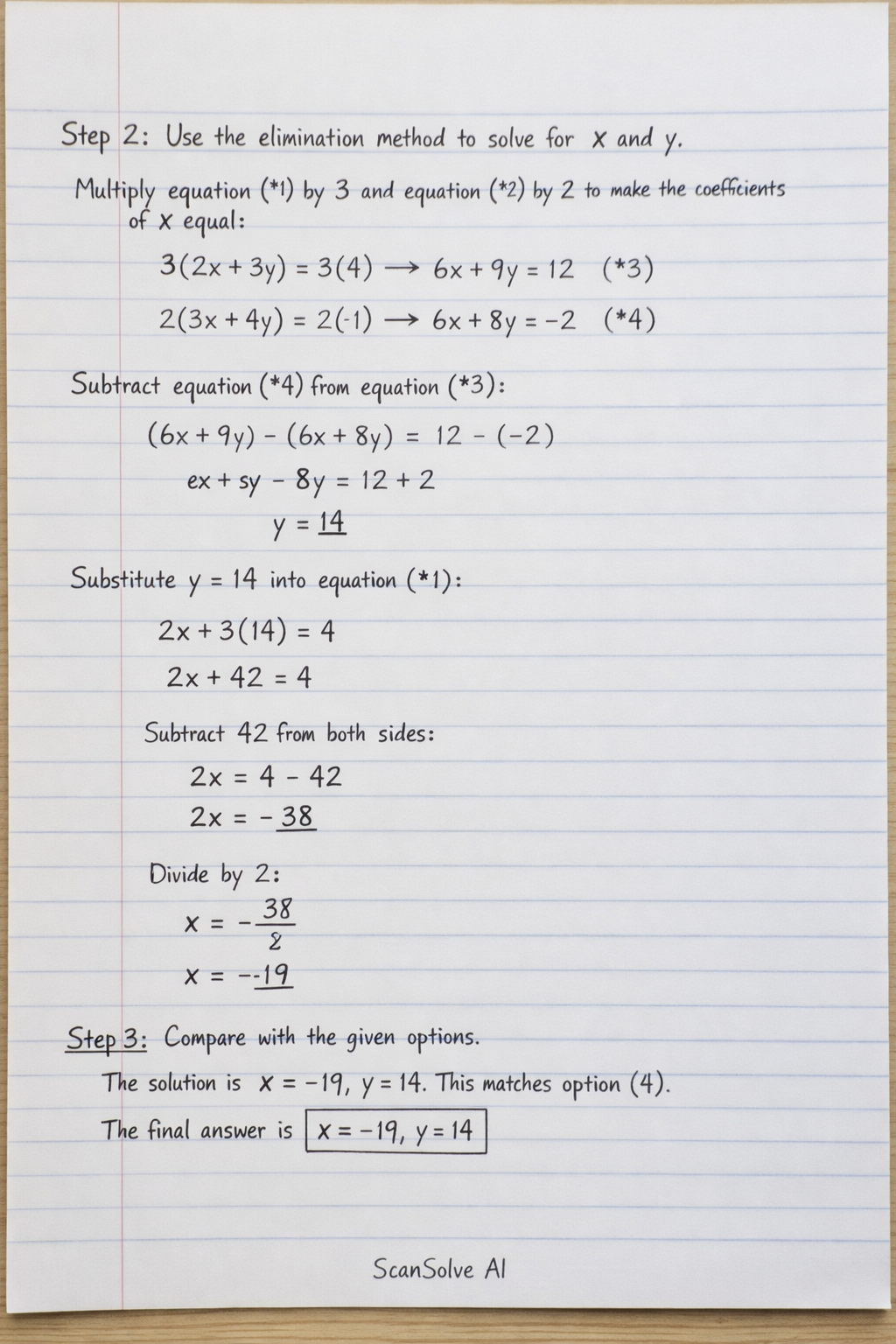
Handwritten Step-by-Step Solution
Get this as a handwritten image on WhatsApp — like a tutor wrote it for you.
Try on WhatsApp