
We read your photo as:
A rectangular garden is 18.6 m long and 12.4 m. A student measured the length as 18.2 m and the width as 12.7 m. Find the percentage error in the: i. Measured length ii. Calculated perimeter iii. Calculated area
Mathematics
ScanSolve AI Answer
Step-by-step solution
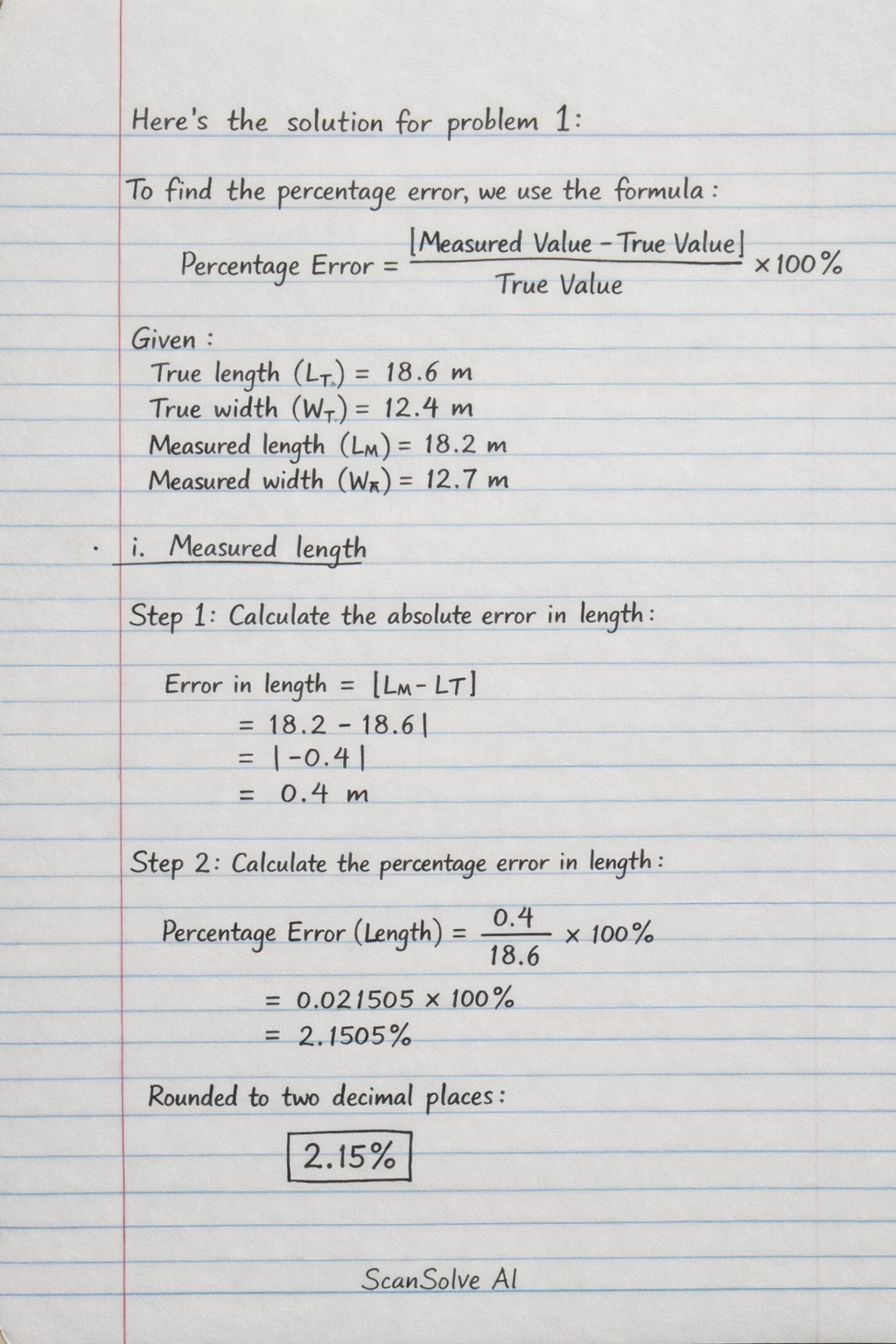
8 stepshere's the solution for :
To find the percentage error, we use the formula:
Given:
True length () = 18.6 m
True width () = 12.4 m
Measured length () = 18.2 m
Measured width () = 12.7 m
- i. Measured length
Calculate the absolute error in length.
$$ \text{Error in length} = |L_M - L_T| = |18.2 - 18.6| = |-0.4| = 0.4 \text{ m} $$Calculate the percentage error in length.
$$ \text{Percentage Error (Length)} = \frac{0.4}{18.6} \times 100\% \approx 2.1505\% $$ Rounded to two decimal places: $$ \boxed{\text{2.15%}} $$- ii. Calculated perimeter
Calculate the true perimeter and measured perimeter.
$$ P_T = 2(L_T + W_T) = 2(18.6 + 12.4) = 2(31.0) = 62.0 \text{ m} $$ $$ P_M = 2(L_M + W_M) = 2(18.2 + 12.7) = 2(30.9) = 61.8 \text{ m} $$Calculate the absolute error in perimeter.
$$ \text{Error in perimeter} = |P_M - P_T| = |61.8 - 62.0| = |-0.2| = 0.2 \text{ m} $$Calculate the percentage error in perimeter.
$$ \text{Percentage Error (Perimeter)} = \frac{0.2}{62.0} \times 100\% \approx 0.3226\% $$ Rounded to two decimal places: $$ \boxed{\text{0.32%}} $$- iii. Calculated area
Calculate the true area and measured area.
$$ A_T = L_T \times W_T = 18.6 \times 12.4 = 230.64 \text{ m}^2 $$ $$ A_M = L_M \times W_M = 18.2 \times 12.7 = 231.14 \text{ m}^2 $$Calculate the absolute error in area.
$$ \text{Error in area} = |A_M - A_T| = |231.14 - 230.64| = 0.50 \text{ m}^2 $$Calculate the percentage error in area.
$$
\text{Percentage Error (Area)} = \frac{0.50}{230.64} \times 100\% \approx 0.2168\%
$$
Rounded to two decimal places:
$$
\boxed{\text{0.22%}}
$$
Was this helpful?
Still stuck on this one?
Ask a follow-up, and the answer starts from this question.
Got a different question?Ask your own question
More Mathematics Questions
QThe length and breadth of a rectangular floor garden were measured and found to be 4.1m and 2.2m…QA rectangular garden has a perimeter of 72 m. The length is 4 m more than its width. Find the…QA rectangular room is 15 cm long and 12 cm wide. Each measurement has a 1.5% error. Calculate the…QA rectangular garden has a length that is 5 meters longer than its width. If the width is…QCalculate the perimeter of a rectangular garden with length 12m and width 7m.
Browse by topic:Geometry
Handwritten Step-by-Step Solution
Get this as a handwritten image on WhatsApp — like a tutor wrote it for you.
Try on WhatsApp