

This mathematics problem involves applying core mathematical principles and formulas. Below you will find a complete step-by-step solution with detailed explanations for each step, helping you understand not just the answer but the method behind it.
ScanSolve AI Answer
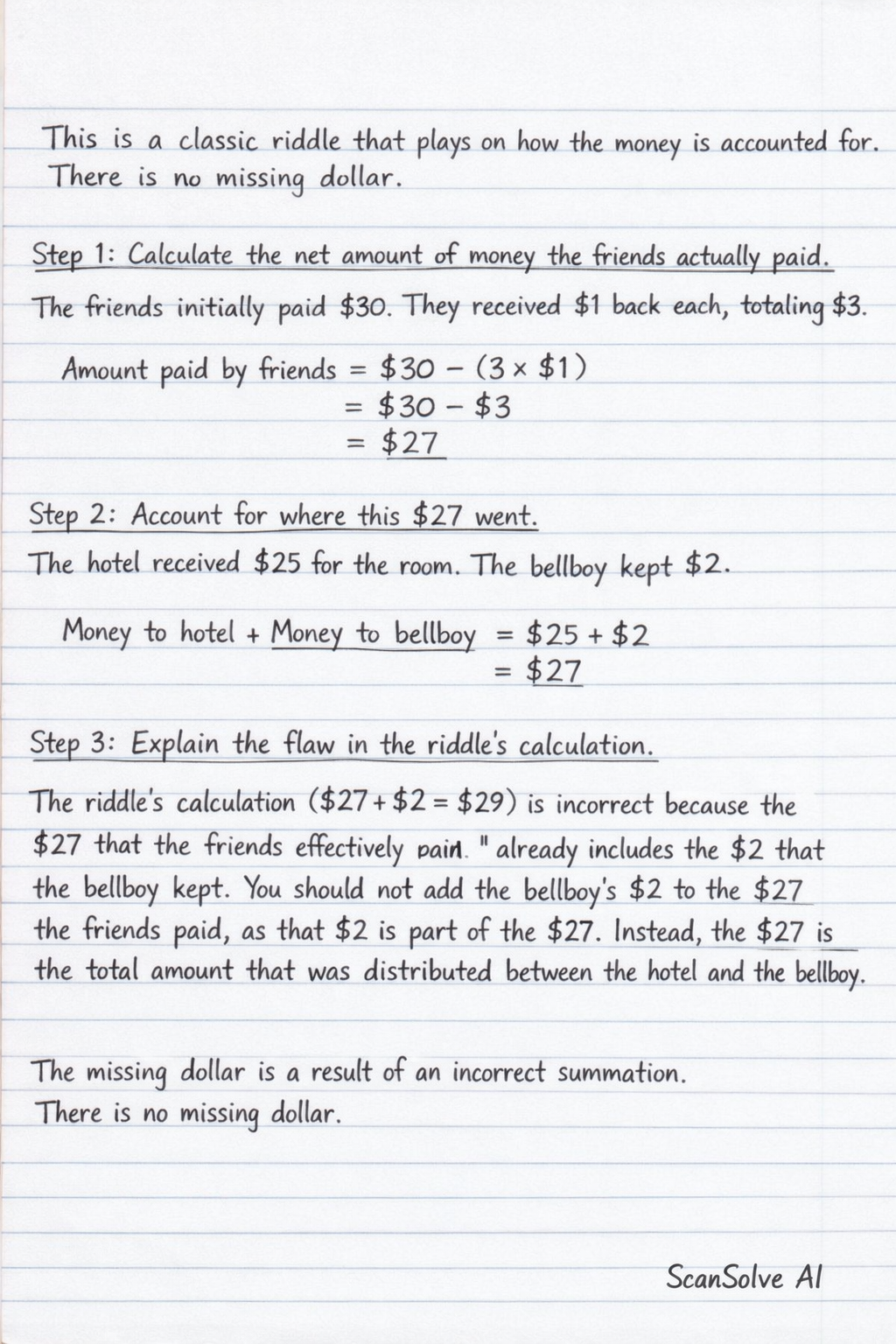
This is a classic riddle that plays on how the money is accounted for. There is no missing dollar. Step 1: Calculate the net amount of money the friends actually paid. The friends initially paid 30. They received 1 back each, totaling 3. Amount paid by friends = \30 - (3 × \1) = \30 - \3 = \27 Step 2: Account for where this 27 went. The hotel received 25 for the room. The bellboy kept 2. Money to hotel + Money to bellboy = \25 + \2 = \27 Step 3: Explain the flaw in the riddle's calculation. The riddle's calculation (27 + 2 = 29) is incorrect because the 27 that the friends effectively paid already includes the 2 that the bellboy kept. You should not add the bellboy's 2 to the 27 the friends paid, as that 2 is part of the 27. Instead, the 27 is the total amount that was distributed between the hotel and the bellboy. The missing dollar is a result of an incorrect summation. There is no missing dollar. What's next? Send 'em! 📸