
We read your photo as:
A) If Ksh. 1 = 0.007524, how many Kenyan shillings make 1? b) X c) The scale of a map is 1cm: 52500m. How many cm on the map represent 1m on the ground? d) Machine A can complete a task in 8 hours, Ma
ScanSolve AI Answer
Step-by-step solution
4 stepsSolve part a).
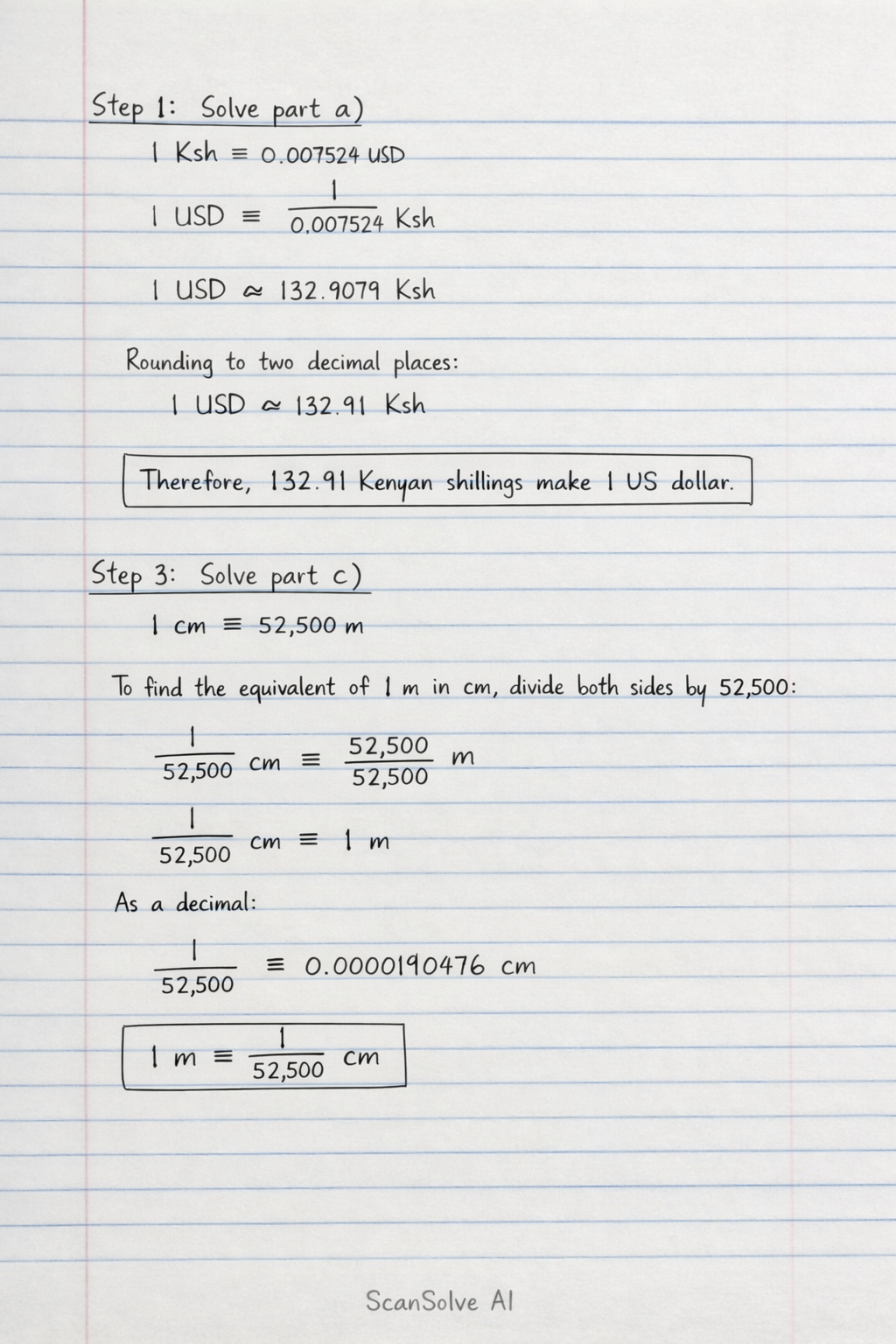
Given that Ksh. 1 is equal to 0.007524 US Dollars. To find how many Kenyan shillings make 1 US dollar, we need to find the reciprocal of the given rate.
Rounding to two decimal places:
Therefore, make 1 US dollar.
Part b) is missing from the provided image.
Solve part c) (scale conversion).
Given that 1 cm on the drawing represents 52500 m on the ground. We need to find how many cm are equivalent to 1 m.
The scale is:To find the equivalent of 1 m in cm, divide both sides by 52500:
As a decimal:
Rounding to a reasonable number of significant figures, or leaving as a fraction:
Solve part d) (work rate problem, labeled as (c) in the question).
Let the total task be 1 unit of work.
- Machine A takes 8 hours, so its work rate () is task/hour.
- Machine B takes 10 hours, so its work rate () is task/hour.
- Machine A and C working together take 5 hours, so their combined work rate () is task/hour.
First, find the work rate of Machine C ():
To subtract, find a common denominator, which is 40:
Next, find the combined work rate of Machine B and Machine C ():
To add, find a common denominator, which is 40:
Finally, determine the time it would take Machine B and Machine C working together ():
As a mixed number:
The time it would take Machine B and Machine C working together is or .
Still stuck on this one?
Ask a follow-up, and the answer starts from this question.
More Mathematics Questions
Handwritten Step-by-Step Solution
Get this as a handwritten image on WhatsApp — like a tutor wrote it for you.
Try on WhatsApp