We read your photo as:

Calculate map length given scale and actual distance: a) 1:100, 7 km b) 1 cm = 0.5 km, 8 km

Mathematics

ScanSolve AI Answer

Step-by-step solution

16 steps

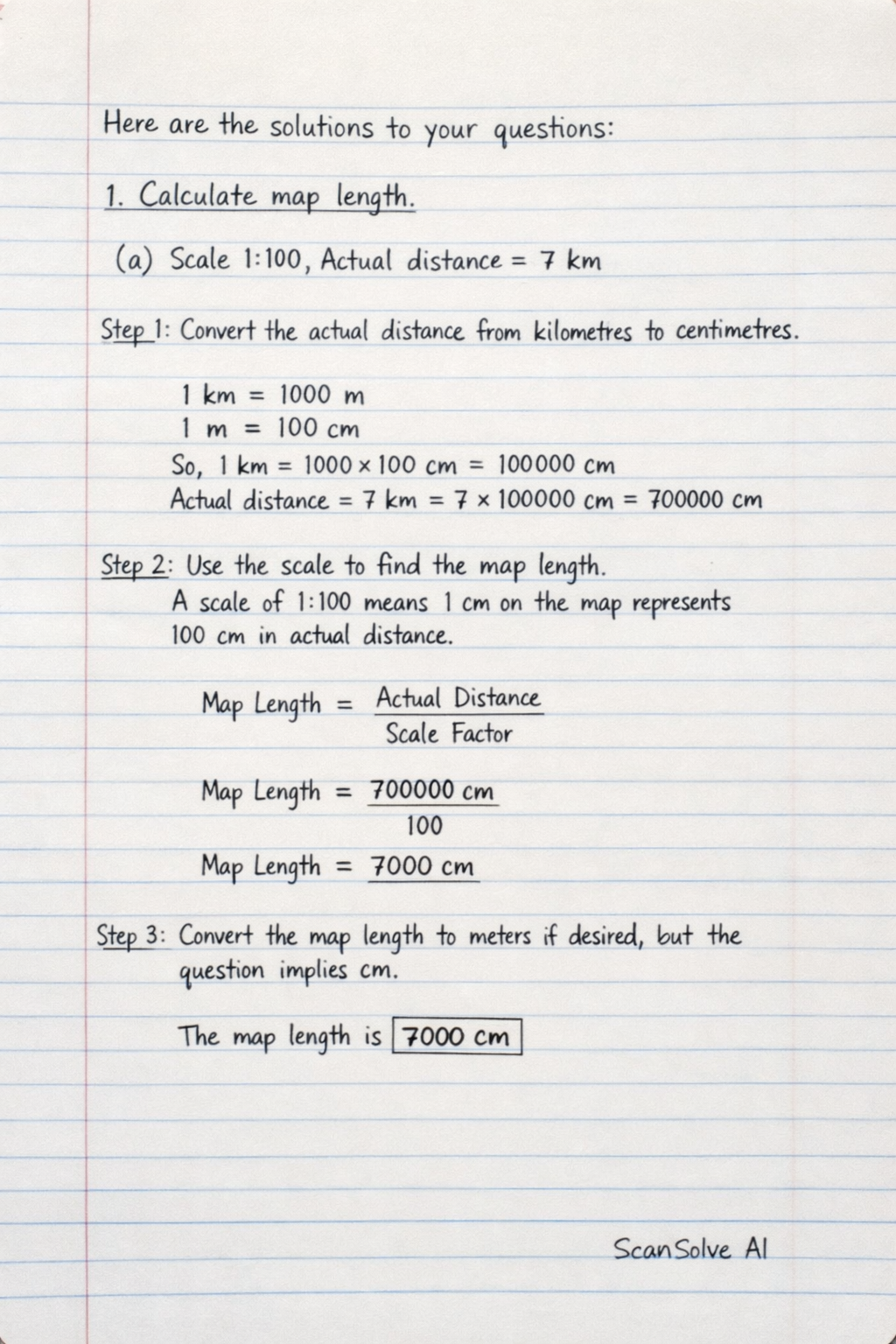
Here are the solutions to your questions:

1. Calculate map length

a) Scale 1:100, Actual distance = 7 km

  1. Convert the actual distance from kilometres to centimetres.

    1 km=1000 m1 \text{ km} = 1000 \text{ m}
    1 m=100 cm1 \text{ m} = 100 \text{ cm}
    So, 1 km=1000×100 cm=100000 cm1 \text{ km} = 1000 \times 100 \text{ cm} = 100000 \text{ cm}.
    Actual distance = 7 km=7×100000 cm=700000 cm7 \text{ km} = 7 \times 100000 \text{ cm} = 700000 \text{ cm}.

  2. Use the scale to find the map length.

    A scale of 1:1001:100 means 1 cm1 \text{ cm} on the map represents 100 cm100 \text{ cm} in actual distance.

    Map Length=Actual DistanceScale Factor\text{Map Length} = \frac{\text{Actual Distance}}{\text{Scale Factor}} Map Length=700000 cm100\text{Map Length} = \frac{700000 \text{ cm}}{100} Map Length=7000 cm\text{Map Length} = 7000 \text{ cm}
  3. Convert the map length to meters if desired, but the question implies cm.

    • The map length is 7000 cm\boxed{\text{7000 cm}}

    b) Scale 1 cm = 0.5 km, Actual distance = 8 km

  4. Use the given verbal scale.

    The scale states that 1 cm1 \text{ cm} on the map represents 0.5 km0.5 \text{ km} in actual distance.

  5. Determine how many 0.5 km0.5 \text{ km} segments are in 8 km8 \text{ km}.

    Number of segments=8 km0.5 km/cm\text{Number of segments} = \frac{8 \text{ km}}{0.5 \text{ km/cm}} Number of segments=16\text{Number of segments} = 16
  6. Multiply the number of segments by 1 cm1 \text{ cm} to find the map length.

    Map Length=16×1 cm\text{Map Length} = 16 \times 1 \text{ cm} Map Length=16 cm\text{Map Length} = 16 \text{ cm}
    • The map length is 16 cm\boxed{\text{16 cm}}

    3. Calculate the suitable scale

    a) Map length = 8 cm, Actual distance = 20 km

  7. Convert the actual distance from kilometres to centimetres.

    Actual distance = 20 km=20×100000 cm=2000000 cm20 \text{ km} = 20 \times 100000 \text{ cm} = 2000000 \text{ cm}.

  8. Set up the ratio of map length to actual distance.

    Scale=Map Length:Actual Distance\text{Scale} = \text{Map Length} : \text{Actual Distance} Scale=8 cm:2000000 cm\text{Scale} = 8 \text{ cm} : 2000000 \text{ cm}
  9. Simplify the ratio by dividing both sides by the map length (8 cm8 \text{ cm}) to get a 1:X1:X scale.

    Scale=88:20000008\text{Scale} = \frac{8}{8} : \frac{2000000}{8} Scale=1:250000\text{Scale} = 1 : 250000
    • The suitable scale is 1:250000\boxed{\text{1:250000}}

    b) Map length = 5.6 cm, Actual distance = 290 km

  10. Convert the actual distance from kilometres to centimetres.

    Actual distance = 290 km=290×100000 cm=29000000 cm290 \text{ km} = 290 \times 100000 \text{ cm} = 29000000 \text{ cm}.

  11. Set up the ratio of map length to actual distance.

    Scale=Map Length:Actual Distance\text{Scale} = \text{Map Length} : \text{Actual Distance} Scale=5.6 cm:29000000 cm\text{Scale} = 5.6 \text{ cm} : 29000000 \text{ cm}
  12. Simplify the ratio by dividing both sides by the map length (5.6 cm5.6 \text{ cm}).

    Scale=5.65.6:290000005.6\text{Scale} = \frac{5.6}{5.6} : \frac{29000000}{5.6} Scale=1:5178571.428...\text{Scale} = 1 : 5178571.428...
  13. Round the scale factor to a reasonable whole number, typically for map scales.

    Scale≈1:5178571\text{Scale} \approx 1 : 5178571
    • The suitable scale is 1:5178571\boxed{\text{1:5178571}}

    c) Map length = 4 cm, Actual distance = 2 km

  14. Convert the actual distance from kilometres to centimetres.

    Actual distance = 2 km=2×100000 cm=200000 cm2 \text{ km} = 2 \times 100000 \text{ cm} = 200000 \text{ cm}.

  15. Set up the ratio of map length to actual distance.

    Scale=Map Length:Actual Distance\text{Scale} = \text{Map Length} : \text{Actual Distance} Scale=4 cm:200000 cm\text{Scale} = 4 \text{ cm} : 200000 \text{ cm}
  16. Simplify the ratio by dividing both sides by the map length (4 cm4 \text{ cm}).

    Scale=44:2000004\text{Scale} = \frac{4}{4} : \frac{200000}{4} Scale=1:50000\text{Scale} = 1 : 50000
    • The suitable scale is 1:50000\boxed{\text{1:50000}}
Was this helpful?

Still stuck on this one?

Ask a follow-up, and the answer starts from this question.

Got a different question?Ask your own question
Handwritten step-by-step solution preview

Handwritten Step-by-Step Solution

Get this as a handwritten image on WhatsApp — like a tutor wrote it for you.

Try on WhatsApp