
We read your photo as:
A lorry and a pick-up truck travel 180 km. The pick-up truck travels 20 km/h faster than the lorry. The pick-up truck arrives 45 minutes earlier than the lorry. Find the speeds of the lorry and pick-u
ScanSolve AI Answer
Step-by-step solution
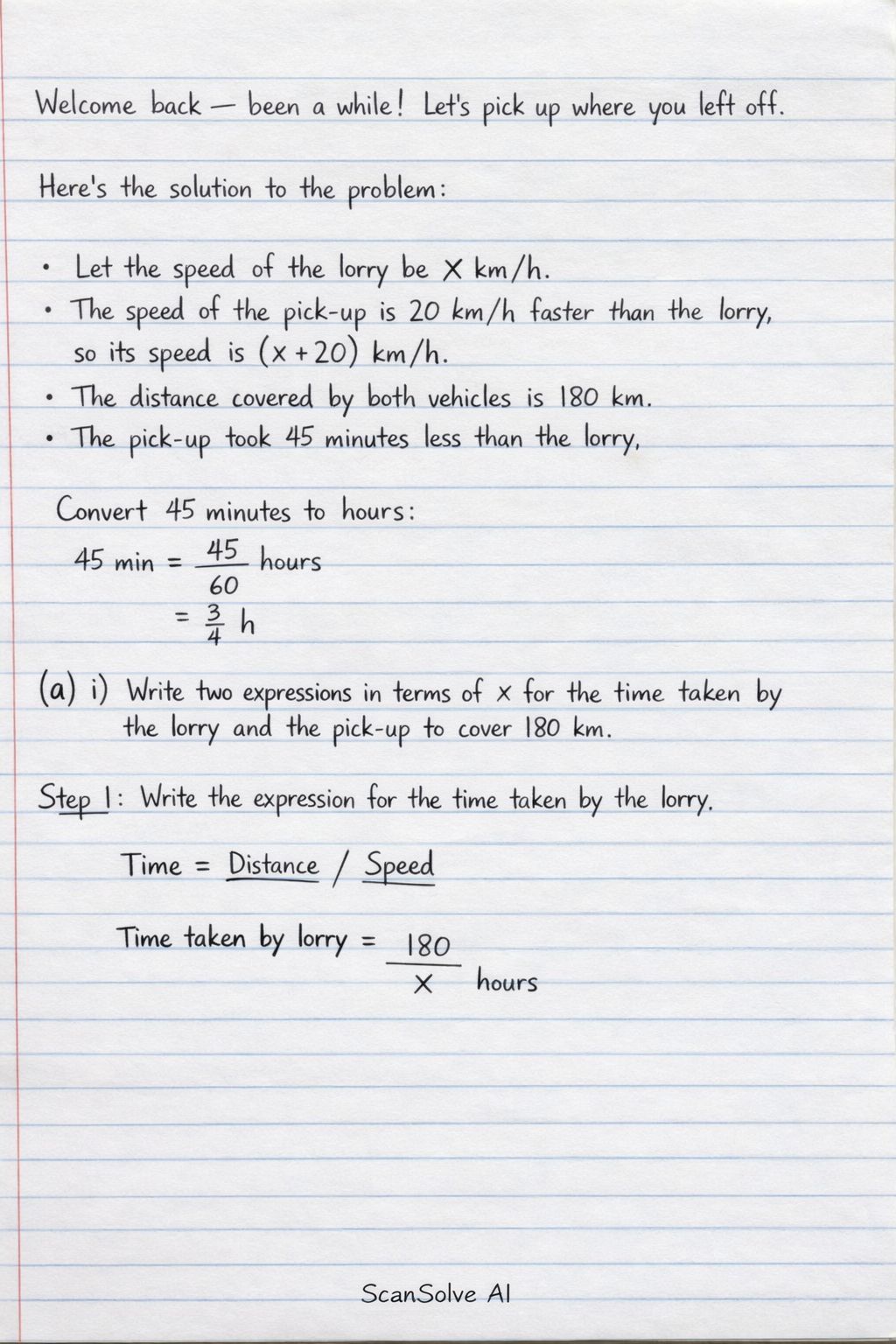
10 stepsHere's the solution to the problem:
- Let the speed of the lorry be .
- The speed of the pick-up is faster than the lorry, so the speed of the pick-up is .
- The distance covered by both vehicles is .
- The pick-up took less than the lorry. Convert to hours: .
a) i) Write two expressions in terms of for the time taken by the lorry and the pick-up respectively to cover a distance of .
Write the expression for the time taken by the lorry.
Time is calculated as .
Write the expression for the time taken by the pick-up.
The expressions are:
Time for lorry:
Time for pick-up:a) ii) Determine the speed of the lorry and that of the pick-up.
Set up the equation based on the time difference.
The pick-up took hours less than the lorry, so:
Find a common denominator and combine the terms on the left side.
Cross-multiply to eliminate the denominators.
Rearrange the equation into a standard quadratic form .
Divide the entire equation by 3 to simplify.
Solve the quadratic equation by factoring.
We need two numbers that multiply to and add to 20. These numbers are 80 and .
Find the possible values for .
Since speed cannot be negative, we discard .
Determine the speeds of the lorry and the pick-up.
Speed of the lorry ():
Speed of the pick-up ():The speed of the lorry is and the speed of the pick-up is .
Still stuck on this one?
Ask a follow-up, and the answer starts from this question.
More Mathematics Questions
Handwritten Step-by-Step Solution
Get this as a handwritten image on WhatsApp — like a tutor wrote it for you.
Try on WhatsApp