
We read your photo as:
A man walks 5 km due north and then 4 km due west. What is his bearing from the starting point?
ScanSolve AI Answer
Answer
Step-by-step solution
4 stepsSketch the path and identify the points.
Let point A be the starting point.
The man walks due north from A to an intermediate point, let's call it B.
From B, he walks due west to point C.
This movement forms a right-angled triangle , with the right angle at B.
The side AB represents the Northward movement ().
The side BC represents the Westward movement ().Calculate the angle at A.
We need to find the angle , which is the angle measured from the North line (AB) towards the West.
In the right-angled triangle :Calculate the value of the angle.
Determine the bearing of C from A.
Point C is located North-West of point A. Bearings are measured clockwise from the North line ().
The angle is the angle measured from the North line towards the West.
To find the bearing, we subtract this angle from (since it's in the North-West quadrant).Rounding to one decimal place, the bearing is .
Try one yourself
A new problem that tests the same skill.
Still stuck on this one?
Ask a follow-up, and the answer starts from this question.
More Mathematics Questions
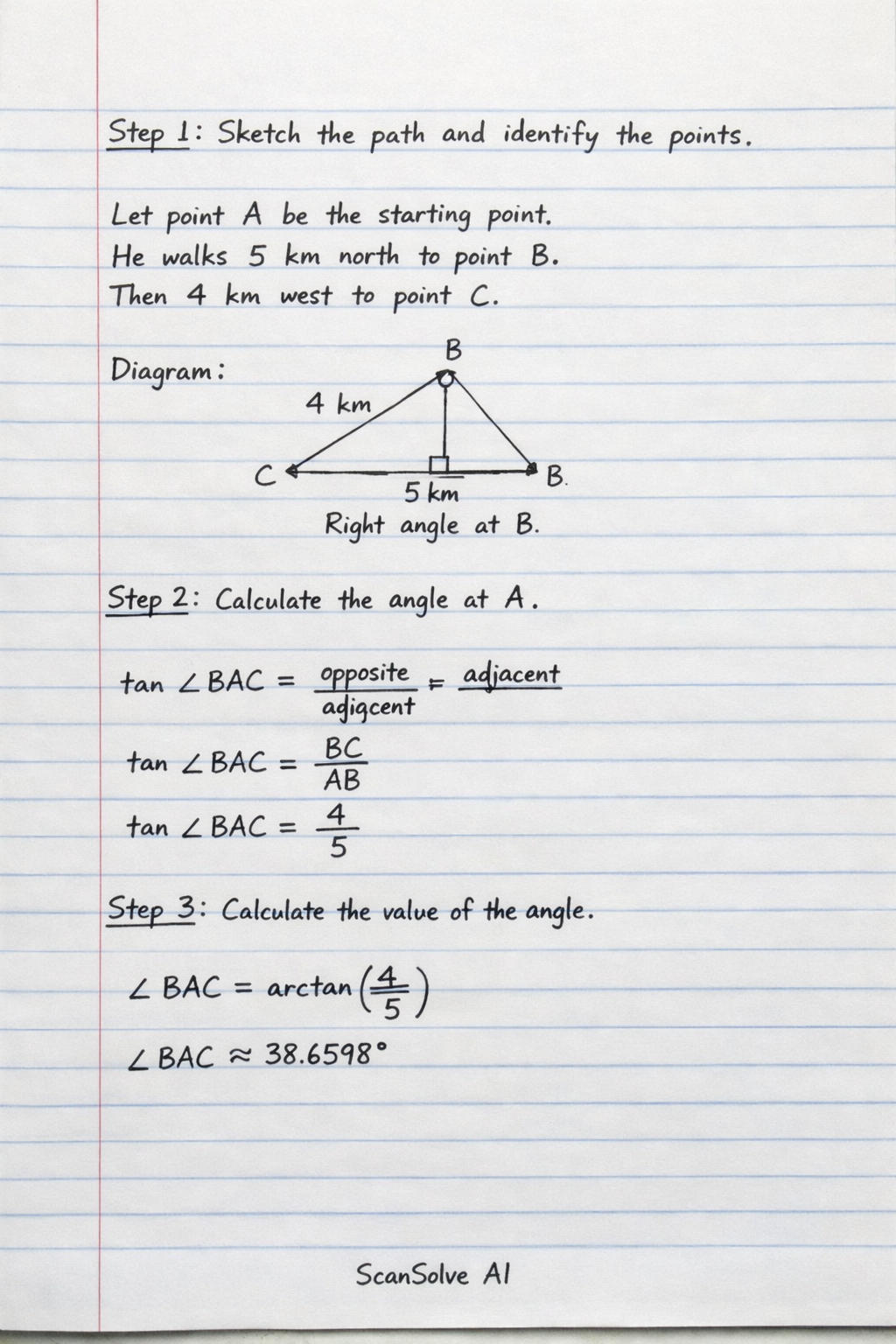
Handwritten Step-by-Step Solution
Get this as a handwritten image on WhatsApp — like a tutor wrote it for you.
Try on WhatsApp