

This mathematics problem involves applying core mathematical principles and formulas. Below you will find a complete step-by-step solution with detailed explanations for each step, helping you understand not just the answer but the method behind it.
ScanSolve AI Answer
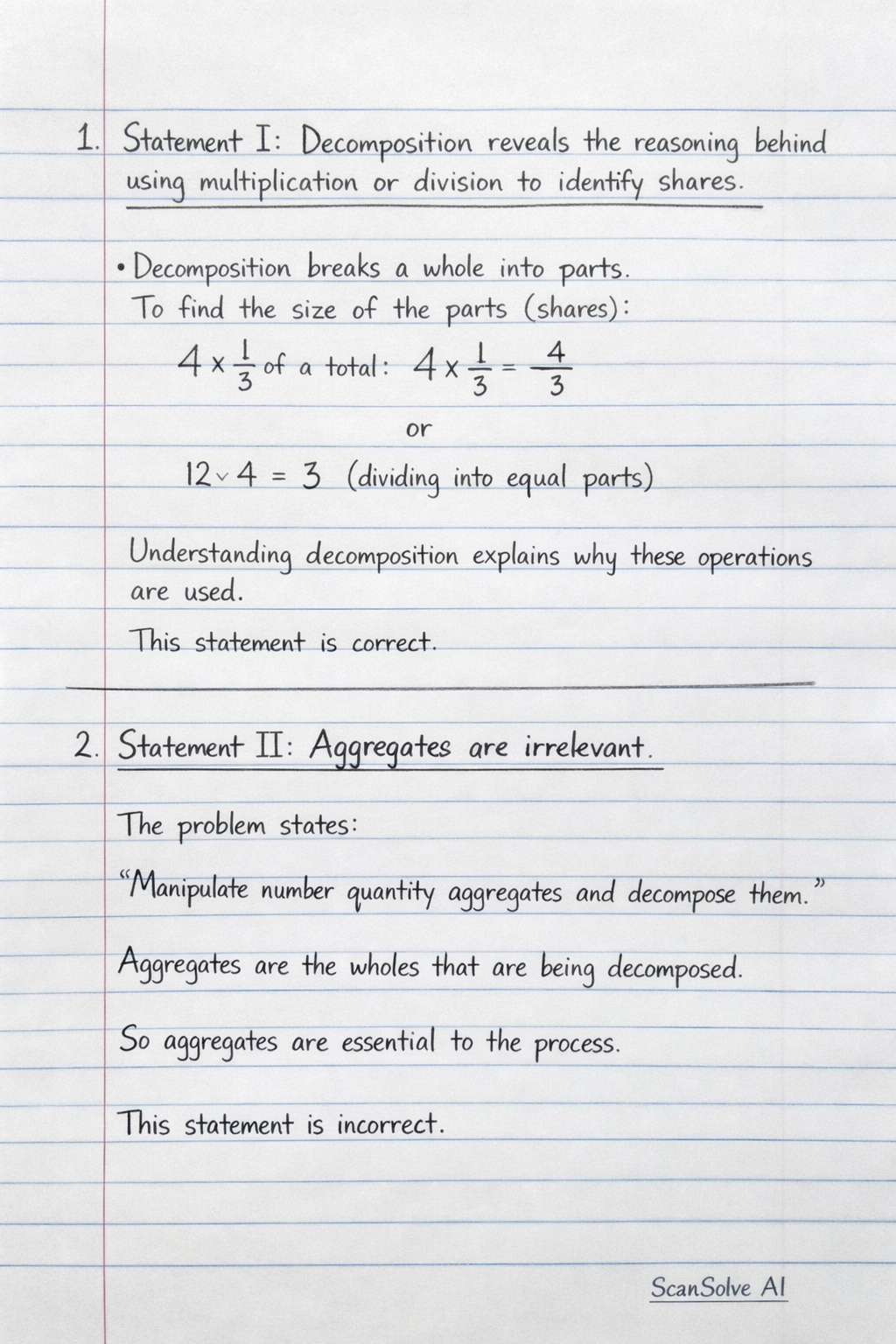
Here's an evaluation of each statement based on the concept of decomposing number quantity aggregates: Statement I: Decomposition reveals the reasoning behind using multiplication or division to identify shares. Decomposition involves breaking down a whole into parts. To find the size of these parts (shares), one often uses multiplication (e.g., finding a fraction of a total) or division (e.g., dividing a total into equal parts). Understanding decomposition clarifies why these operations are appropriate for determining shares. This statement is correct. Statement II: Aggregates are irrelevant. The problem context explicitly states that learners must "manipulate number quantity aggregates and decompose them." Aggregates are the wholes that are being decomposed, making them central and highly relevant to the process. This statement is incorrect. Statement III: Share ratios allow for the identification of constituent parts of a whole. Share ratios (e.g., 1:4) define the proportional relationship between the parts of a whole. By applying these ratios to the total aggregate, one can calculate the specific quantities of each constituent part. This statement is correct. Statement IV: Addition can be used to verify that the sum of parts equals the aggregate total. When an aggregate is decomposed into its constituent parts, the fundamental principle is that the sum of all the parts must equal the original aggregate. Addition is the operation used to perform this verification. This statement is correct. Statement V: Proportions maintain the relative relationship between quantities during decomposition. Proportions (or ratios) are used to describe how parts relate to each whole and to each other. During decomposition, these relative relationships are preserved, meaning the proportional size of each part remains consistent with the original aggregate. This statement is correct. Therefore, statements I, III, IV, and V are correct. The final answer is A. I, III, IV and V. 3 done, 2 left today. You're making progress.