We read your photo as:

A pie chart shows the distribution of animals on a farm. Goats are represented by 120 degrees, sheep by 90 degrees, and chickens by 60 degrees. If there were 15 more sheep than goats, how many more ca

Mathematics

ScanSolve AI Answer

Step-by-step solution

18 steps

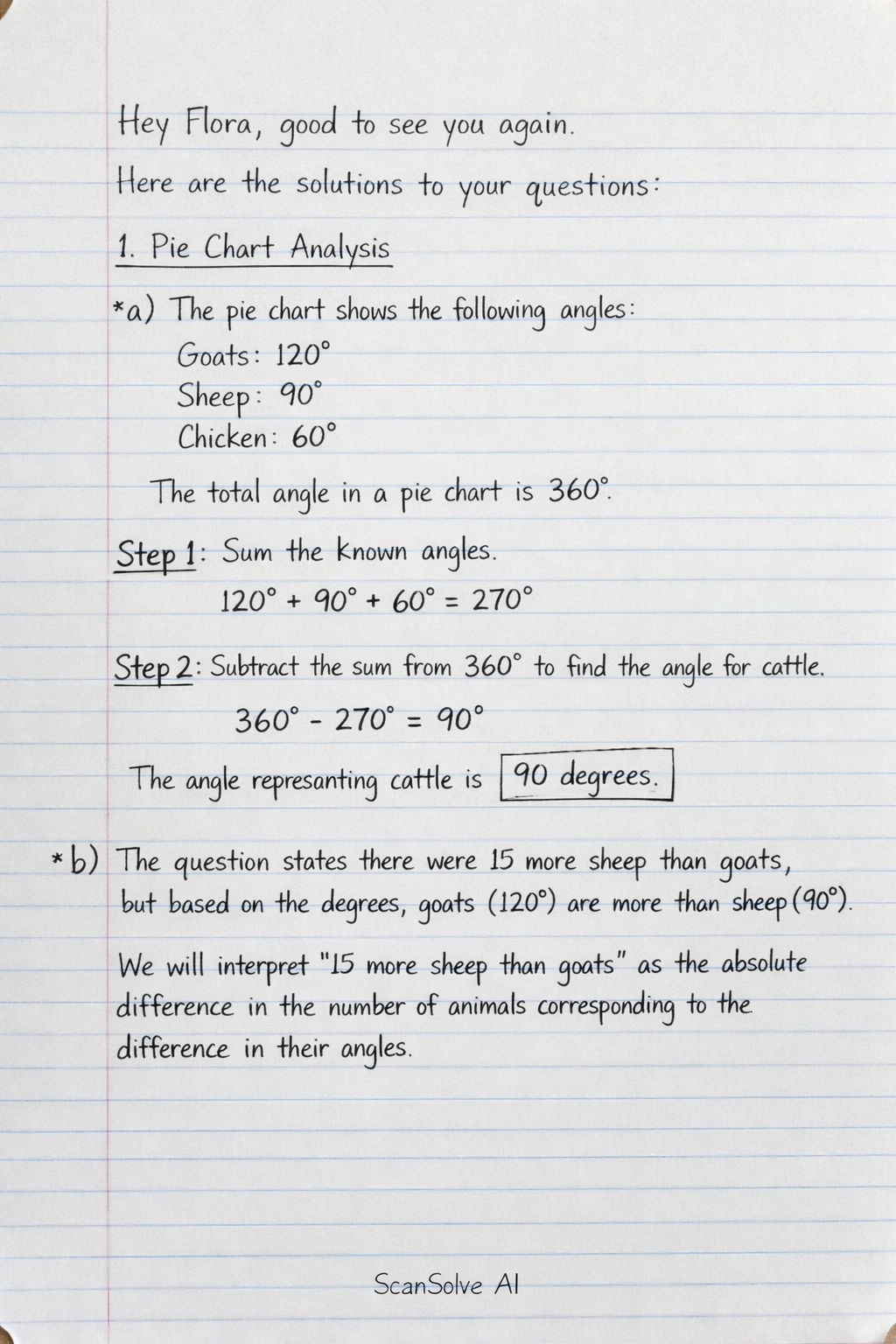
Here are the solutions to your questions:

1. Pie Chart Analysis

a) The pie chart shows the following angles:
Goats: 120∘120^\circ
Sheep: 90∘90^\circ
Chicken: 60∘60^\circ
The total angle in a pie chart is 360∘360^\circ.

  1. Sum the known angles.

    120∘+90∘+60∘=270∘120^\circ + 90^\circ + 60^\circ = 270^\circ
  2. Subtract the sum from 360∘360^\circ to find the angle for cattle.

    360∘−270∘=90∘360^\circ - 270^\circ = 90^\circ

    The angle representing cattle is 90 degrees\boxed{\text{90 degrees}}.

    b) The question states there were 15 more sheep than goats, but based on the degrees, goats (120∘120^\circ) are more than sheep (90∘90^\circ). We will interpret "15 more sheep than goat" as the absolute difference in the number of animals corresponding to the difference in their angles.

  3. Find the difference in degrees between goats and sheep.

    120∘(Goats)−90∘(Sheep)=30∘120^\circ (\text{Goats}) - 90^\circ (\text{Sheep}) = 30^\circ
  4. Determine the number of animals per degree.

    Since 30∘30^\circ corresponds to 15 animals,

    1∘=15 animals30∘=0.5 animals per degree1^\circ = \frac{15 \text{ animals}}{30^\circ} = 0.5 \text{ animals per degree}
  5. Calculate the number of cattle and chicken.

    Cattle: 90∘×0.5 animals/degree=45 animals90^\circ \times 0.5 \text{ animals/degree} = 45 \text{ animals}
    Chicken: 60∘×0.5 animals/degree=30 animals60^\circ \times 0.5 \text{ animals/degree} = 30 \text{ animals}

  6. Find how many more cattle than chicken.

    45 (Cattle)−30 (Chicken)=15 animals45 \text{ (Cattle)} - 30 \text{ (Chicken)} = 15 \text{ animals}

    There were 15 more cattle than chicken\boxed{\text{15 more cattle than chicken}}.

    2. Straight Line Equation
    The equation of a straight line is 2y=x+112y = x + 11. We need to find the value of xx when y=2y = 2.

  7. Substitute y=2y = 2 into the equation.

    2(2)=x+112(2) = x + 11
  8. Simplify and solve for xx.

    4=x+114 = x + 11 x=4−11x = 4 - 11 x=−7x = -7

    The value of xx when y=2y=2 is −7\boxed{-7}.

    3. Ratios
    Given a:b=4:3a:b = 4:3 and b:c=4:5b:c = 4:5. We need to find the ratio a:ca:c.

  9. Write the given ratios.

    a:b=4:3a:b = 4:3 b:c=4:5b:c = 4:5
  10. Find a common multiple for the 'b' terms (3 and 4).

    The least common multiple is 12.

  11. Adjust the ratios so that the 'b' term is 12 in both.

    For a:b=4:3a:b = 4:3, multiply both parts by 4:

    a:b=(4×4):(3×4)=16:12a:b = (4 \times 4) : (3 \times 4) = 16:12

    For b:c=4:5b:c = 4:5, multiply both parts by 3:

    b:c=(4×3):(5×3)=12:15b:c = (4 \times 3) : (5 \times 3) = 12:15
  12. Combine the ratios to find a:ca:c.

    Now we have a:b:c=16:12:15a:b:c = 16:12:15.
    Therefore, a:c=16:15a:c = 16:15.
    The ratio a:ca:c is 16:15\boxed{16:15}.

    4. Percentage Loss
    Juan sold a jacket for 1800 and made a 10% loss. We need to find the original cost price.

  13. Let the cost price be CC.

    The selling price (SS) is 1800.
    A 10% loss means the selling price is 100%−10%=90%100\% - 10\% = 90\% of the cost price.

    S=0.90×CS = 0.90 \times C
  14. Substitute the selling price and solve for CC.

    1800=0.90×C1800 = 0.90 \times C C=18000.90C = \frac{1800}{0.90} C=180009C = \frac{18000}{9} C=2000C = 2000

    Juan had bought the jacket for 2000\boxed{\text{2000}}.

    5. Length of Wire for Fencing
    The figure shows a sector of a circle with a radius of 140 m and an angle of 80∘80^\circ. The farm was fenced using two strands of wire.

  15. Calculate the length of the arc (LL) of the sector.

    The formula for arc length is L=θ360∘×2πrL = \frac{\theta}{360^\circ} \times 2\pi r.
    Given θ=80∘\theta = 80^\circ and r=140r = 140 m.

    L=80360×2×π×140L = \frac{80}{360} \times 2 \times \pi \times 140 L=29×280πL = \frac{2}{9} \times 280\pi L=560π9 mL = \frac{560\pi}{9} \text{ m}
  16. Calculate the perimeter of one strand of fence.

    The perimeter of the sector includes the two radii and the arc length.
    Perimeter (one strand) =2r+L= 2r + L

    P=2(140)+560π9P = 2(140) + \frac{560\pi}{9} P=280+560π9 mP = 280 + \frac{560\pi}{9} \text{ m}
  17. Calculate the total length of wire for two strands.

    Total length =2×P= 2 \times P

    Total length=2×(280+560π9)\text{Total length} = 2 \times \left(280 + \frac{560\pi}{9}\right) Total length=560+1120π9 m\text{Total length} = 560 + \frac{1120\pi}{9} \text{ m}
  18. Approximate the numerical value (using π≈3.142\pi \approx 3.142).

    Total length≈560+1120×3.1429\text{Total length} \approx 560 + \frac{1120 \times 3.142}{9} Total length≈560+3519.049\text{Total length} \approx 560 + \frac{3519.04}{9} Total length≈560+391.004\text{Total length} \approx 560 + 391.004 Total length≈951.004 m\text{Total length} \approx 951.004 \text{ m}

    The total length of wire that was used is approximately 951.0 m\boxed{\text{951.0 m}}.

Was this helpful?

Still stuck on this one?

Ask a follow-up, and the answer starts from this question.

Got a different question?Ask your own question
Handwritten step-by-step solution preview

Handwritten Step-by-Step Solution

Get this as a handwritten image on WhatsApp — like a tutor wrote it for you.

Try on WhatsApp