

This mathematics problem involves applying core mathematical principles and formulas. Below you will find a complete step-by-step solution with detailed explanations for each step, helping you understand not just the answer but the method behind it.
ScanSolve AI Answer
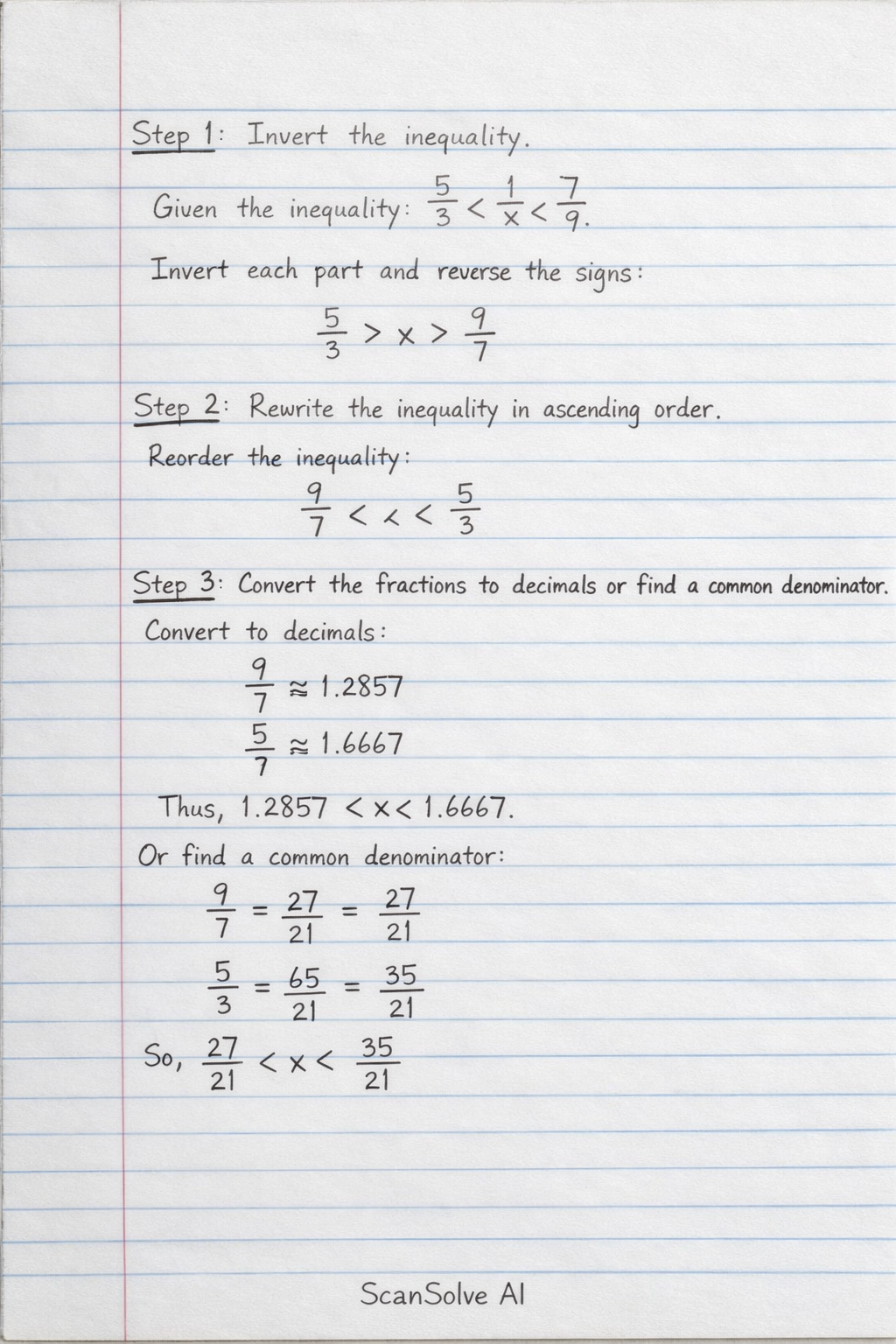
Step 1: Invert the inequality. Given the inequality (3)/(5) < (1)/(x) < (7)/(9). Since all parts of the inequality are positive, we can invert each fraction. When inverting, the inequality signs must be reversed. (5)/(3) > x > (9)/(7) Step 2: Rewrite the inequality in ascending order. It is standard to write inequalities with the smallest value on the left. (9)/(7) < x < (5)/(3) Step 3: Convert the fractions to decimals or find a common denominator to identify a value for x. To find a value for x, we can convert the fractions to decimals: (9)/(7) ≈ 1.2857 (5)/(3) ≈ 1.6667 So, we are looking for a value of x such that 1.2857 < x < 1.6667. Alternatively, find a common denominator for (9)/(7) and (5)/(3). The least common multiple of 7 and 3 is 21. (9)/(7) = (9 × 3)/(7 × 3) = (27)/(21) (5)/(3) = (5 × 7)/(3 × 7) = (35)/(21) So the inequality is: (27)/(21) < x < (35)/(21) Step 4: Identify a possible value for x. Any fraction between (27)/(21) and (35)/(21) (exclusive) is a possible value for x. For example, (28)/(21) is between these values. Simplifying (28)/(21): (28)/(21) = (4 × 7)/(3 × 7) = (4)/(3) Let's check this value: (9)/(7) ≈ 1.2857 (4)/(3) ≈ 1.3333 (5)/(3) ≈ 1.6667 Since 1.2857 < 1.3333 < 1.6667, (4)/(3) is a valid possible value for x. A possible value of x is (4)/(3). 3 done, 2 left today. You're making progress.