
We read your photo as:
A prime number is a natural number greater than 1 that has no positive divisors other than 1 and itself.
Mathematics
ScanSolve AI Answer
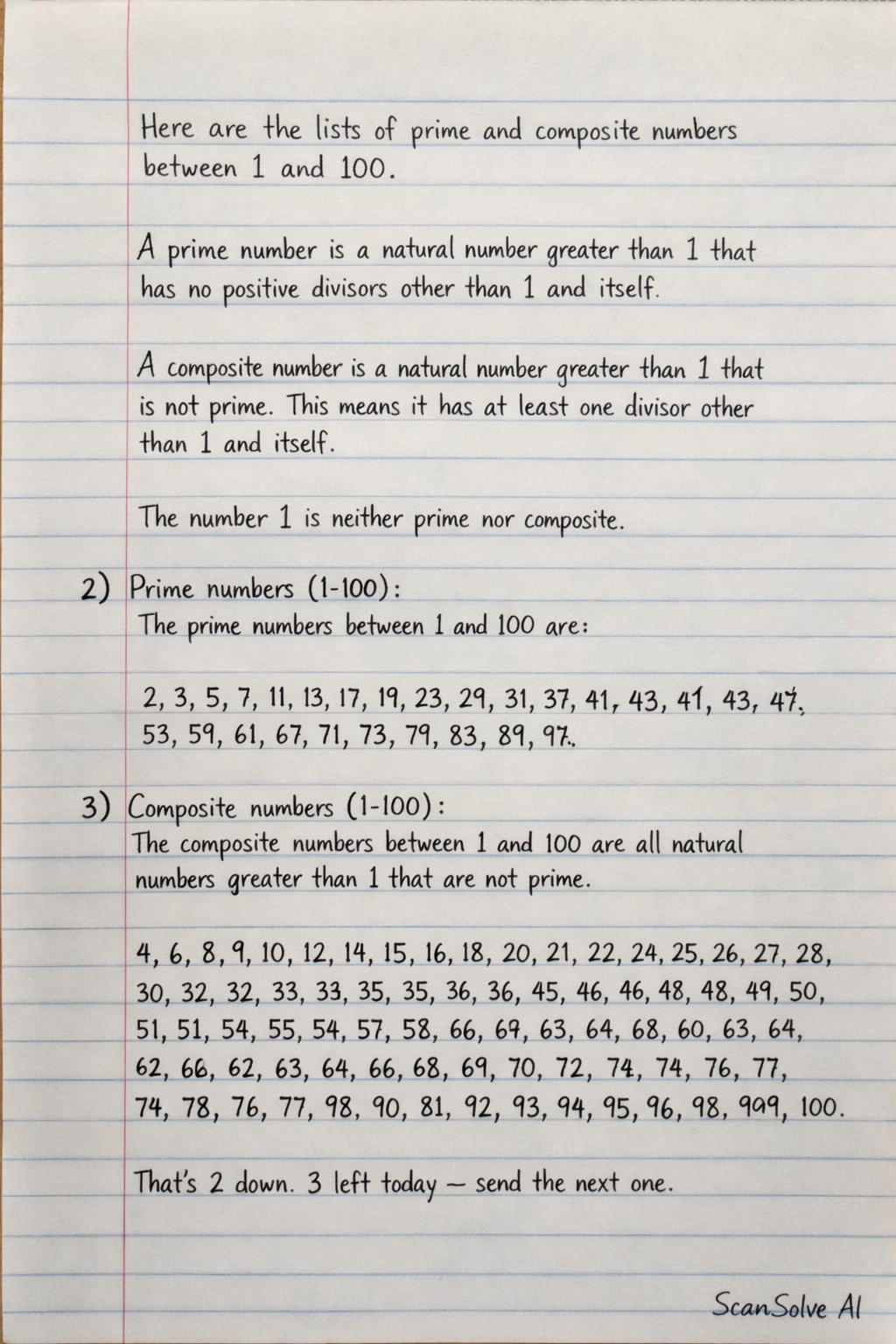
Here are the lists of prime and composite numbers between 1 and 100.
A prime number is a natural number greater than 1 that has no positive divisors other than 1 and itself.
A composite number is a natural number greater than 1 that is not prime. This means it has at least one divisor other than 1 and itself.
The number 1 is neither prime nor composite.
- Prime numbers (1-100): The prime numbers between 1 and 100 are:
- 2, 3, 5, 7, 11, 13, 17, 19, 23, 29, 31, 37, 41, 43, 47, 53, 59, 61, 67, 71, 73, 79, 83, 89, 97.
- Composite numbers (1-100): The composite numbers between 1 and 100 are all natural numbers greater than 1 that are not prime.
- 4, 6, 8, 9, 10, 12, 14, 15, 16, 18, 20, 21, 22, 24, 25, 26, 27, 28, 30, 32, 33, 34, 35, 36, 38, 39, 40, 42, 44, 45, 46, 48, 49, 50, 51, 52, 54, 55, 56, 57, 58, 60, 62, 63, 64, 65, 66, 68, 69, 70, 72, 74, 75, 76, 77, 78, 80, 81, 82, 84, 85, 86, 87, 88, 90, 91, 92, 93, 94, 95, 96, 98, 99, 100.
Was this helpful?
Still stuck on this one?
Ask a follow-up, and the answer starts from this question.
Got a different question?Ask your own question
More Mathematics Questions
QWhat are prime NumbersQIs one a prime numberQIs 1 a prime number?QFor each number, we will find its prime factorization and determine if it is a prime or composite…QQ1. A prime number is a number that have only one factors and its ~~ △ -is draw is known as. Ⓞ…
Browse by topic:Number Theory
Handwritten Step-by-Step Solution
Get this as a handwritten image on WhatsApp — like a tutor wrote it for you.
Try on WhatsApp