
We read your photo as:
Define the following: factor, odd number, even number, prime number
ScanSolve AI Answer
Let's define these mathematical terms.
-
Factor: A factor of a number is a whole number that divides exactly into that number without leaving a remainder. For example, the factors of 12 are 1, 2, 3, 4, 6, and 12.
-
Odd number: An odd number is an integer that cannot be divided exactly by 2. When an odd number is divided by 2, there is always a remainder of 1. Examples include 1, 3, 5, 7, 9.
-
Even number: An even number is an integer that is exactly divisible by 2. When an even number is divided by 2, there is no remainder. Examples include 2, 4, 6, 8, 10.
-
Prime number: A prime number is a natural number greater than 1 that has exactly two distinct positive divisors: 1 and itself. Your definition "prime number is a number that has exactly 1 and itself" is correct. It means it cannot be divided evenly by any other number apart from 1 and itself. Examples include 2, 3, 5, 7, 11, 13.
Still stuck on this one?
Ask a follow-up, and the answer starts from this question.
More Mathematics Questions
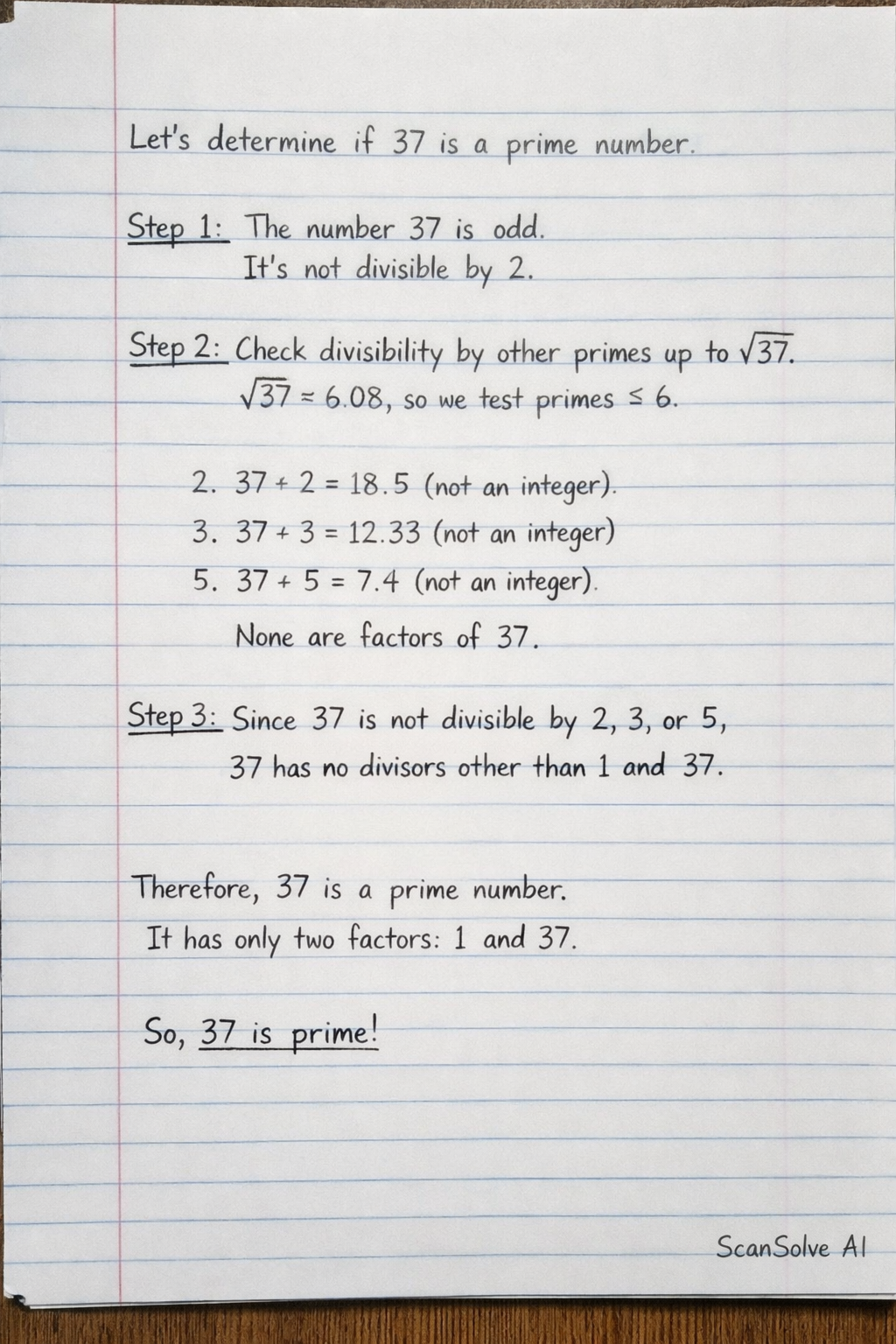
Handwritten Step-by-Step Solution
Get this as a handwritten image on WhatsApp — like a tutor wrote it for you.
Try on WhatsApp