We read your photo as:

A prism has a triangular base with a base of 12 cm and a height of 5 cm. The length of the prism is 25 cm. Calculate its volume and total surface area.

Mathematics

ScanSolve AI Answer

Step-by-step solution

11 steps

Here are the solutions to the problems.

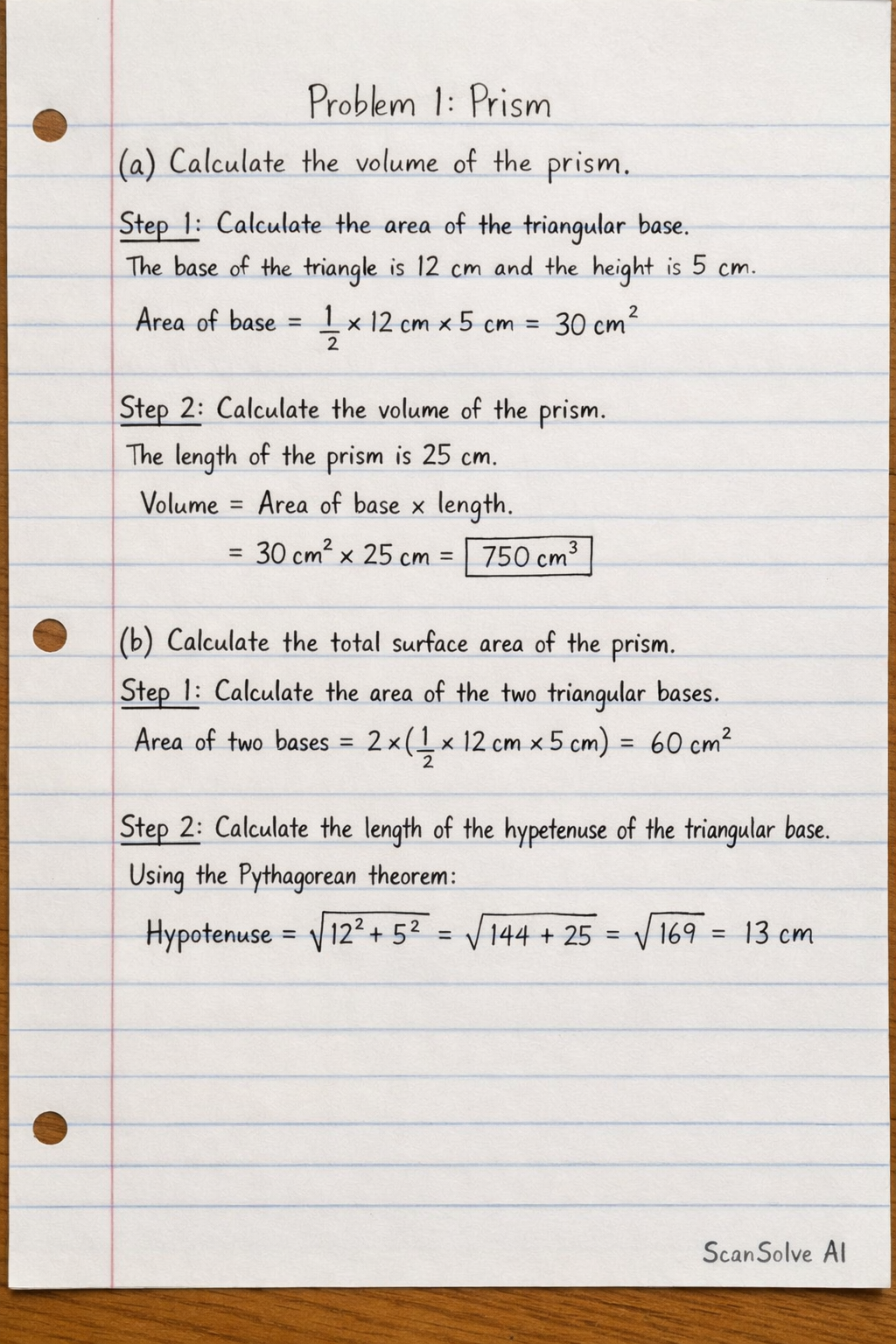
: Prism

a) Calculate the volume of the prism.

  1. Calculate the area of the triangular base.

    The base of the triangle is 12 cm12 \text{ cm} and the height is 5 cm5 \text{ cm}.

    Area of base=12×base×height=12×12 cm×5 cm=30 cm2\text{Area of base} = \frac{1}{2} \times \text{base} \times \text{height} = \frac{1}{2} \times 12 \text{ cm} \times 5 \text{ cm} = 30 \text{ cm}^2
  2. Calculate the volume of the prism.

    The length of the prism is 25 cm25 \text{ cm}.

    Volume=Area of base×length=30 cm2×25 cm=750 cm3\text{Volume} = \text{Area of base} \times \text{length} = 30 \text{ cm}^2 \times 25 \text{ cm} = \boxed{750 \text{ cm}^3}

    b) Calculate the total surface area of the prism.

  3. Calculate the area of the two triangular bases.

    Area of two bases=2×(12×12 cm×5 cm)=60 cm2\text{Area of two bases} = 2 \times (\frac{1}{2} \times 12 \text{ cm} \times 5 \text{ cm}) = 60 \text{ cm}^2
  4. Calculate the length of the hypotenuse of the triangular base.

    Using the Pythagorean theorem:

    Hypotenuse=122+52=144+25=169=13 cm\text{Hypotenuse} = \sqrt{12^2 + 5^2} = \sqrt{144 + 25} = \sqrt{169} = 13 \text{ cm}
  5. Calculate the area of the three rectangular faces.

    The length of the prism is 25 cm25 \text{ cm}.

    Area of rectangle 1=12 cm×25 cm=300 cm2\text{Area of rectangle 1} = 12 \text{ cm} \times 25 \text{ cm} = 300 \text{ cm}^2 Area of rectangle 2=5 cm×25 cm=125 cm2\text{Area of rectangle 2} = 5 \text{ cm} \times 25 \text{ cm} = 125 \text{ cm}^2 Area of rectangle 3=13 cm×25 cm=325 cm2\text{Area of rectangle 3} = 13 \text{ cm} \times 25 \text{ cm} = 325 \text{ cm}^2
  6. Calculate the total surface area.

    Total surface area=60 cm2+300 cm2+125 cm2+325 cm2=810 cm2\text{Total surface area} = 60 \text{ cm}^2 + 300 \text{ cm}^2 + 125 \text{ cm}^2 + 325 \text{ cm}^2 = \boxed{810 \text{ cm}^2}

    : Marks scored by 20 pupils
    The marks are: 10, 11, 12, 15, 8, 11, 16, 10, 12, 10, 11, 12, 8, 10, 16, 10, 8, 10, 8, 12.

    a) Complete the frequency table below.

  7. Count the frequency for each mark.

    • Mark 8: 4 times
    • Mark 10: 6 times
    • Mark 11: 3 times
    • Mark 12: 4 times
    • Mark 15: 1 time
    • Mark 16: 2 times
  8. Calculate f×xf \times x for each mark and find the totals.

    Marks, xFrequency, ff×x84321066011333124481511516232Total∑f=20∑(f×x)=220\begin{array}{|c|c|c|} \hline \text{Marks, } x & \text{Frequency, } f & f \times x \\ \hline 8 & 4 & 32 \\ 10 & 6 & 60 \\ 11 & 3 & 33 \\ 12 & 4 & 48 \\ 15 & 1 & 15 \\ 16 & 2 & 32 \\ \hline \text{Total} & \sum f = 20 & \sum (f \times x) = 220 \\ \hline \end{array}

    b) Find the mode mark.

  9. Identify the mark with the highest frequency.

    From the frequency table, the mark 10 has the highest frequency of 6.

    The mode mark=10\text{The mode mark} = \boxed{10}

    c) Calculate the mean mark.

  10. Use the formula for the mean of grouped data.

    Mean=∑(f×x)∑f\text{Mean} = \frac{\sum (f \times x)}{\sum f}
  11. Substitute the total values from the frequency table.

    Mean=22020=11\text{Mean} = \frac{220}{20} = \boxed{11}
Was this helpful?

Still stuck on this one?

Ask a follow-up, and the answer starts from this question.

Got a different question?Ask your own question
Handwritten step-by-step solution preview

Handwritten Step-by-Step Solution

Get this as a handwritten image on WhatsApp — like a tutor wrote it for you.

Try on WhatsApp