We read your photo as:

A quadrilateral has interior angles of 2(x-10), 4(x+5), 5(x+4), and (x-20) degrees. Find the measure of the exterior angles.

Mathematics

ScanSolve AI Answer

Answer

140∘,40∘,10∘,170∘140^\circ, 40^\circ, 10^\circ, 170^\circ

10 men10 \text{ men}

30 cm330 \text{ cm}^3

Step-by-step solution

10 steps
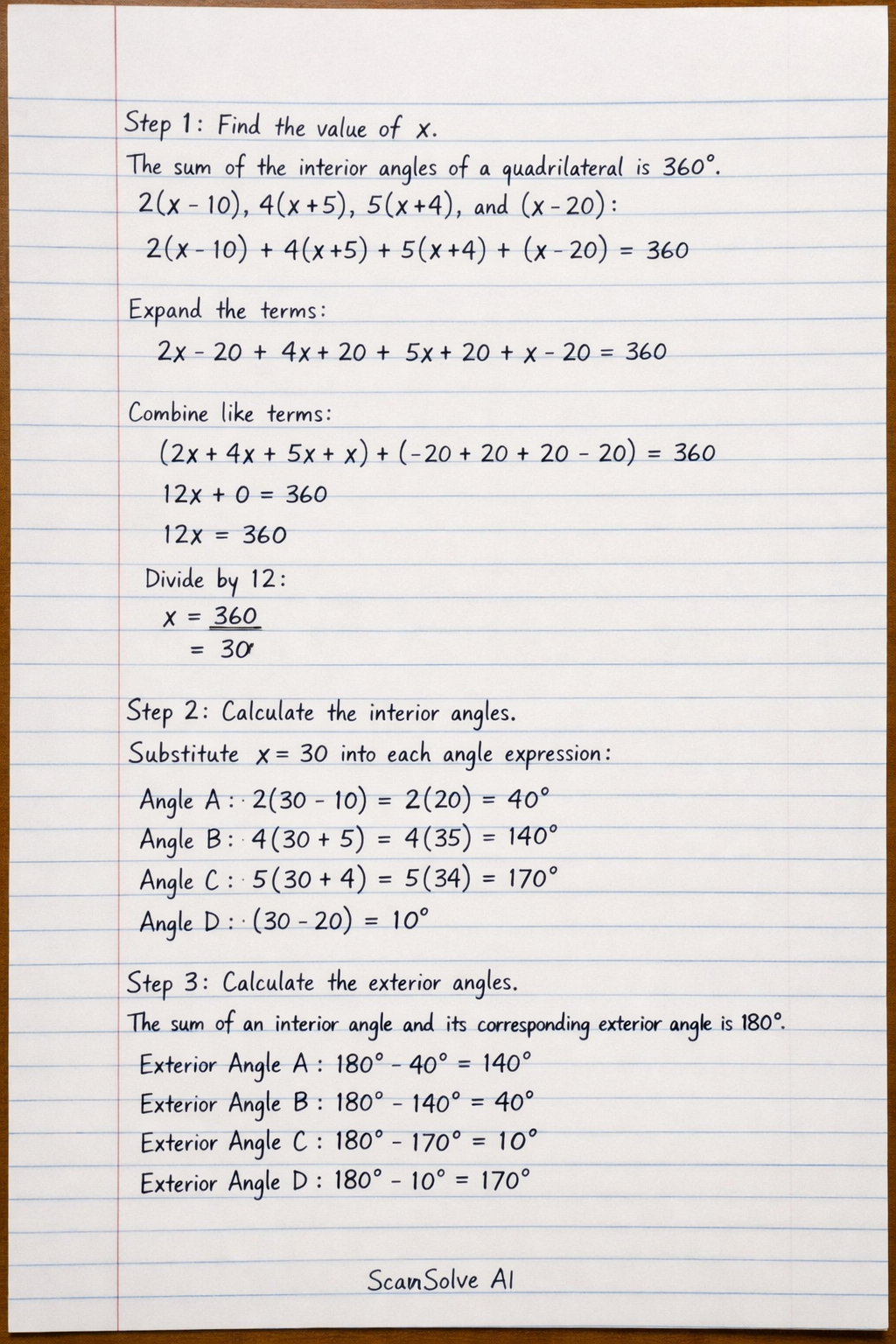
  1. Find the value of xx.

    The sum of the interior angles of a quadrilateral is 360∘360^\circ.
    The given angles are 2(x−10)2(x-10), 4(x+5)4(x+5), 5(x+4)5(x+4), and (x−20)(x-20).

    2(x−10)+4(x+5)+5(x+4)+(x−20)=3602(x-10) + 4(x+5) + 5(x+4) + (x-20) = 360

    Expand the terms:

    2x−20+4x+20+5x+20+x−20=3602x - 20 + 4x + 20 + 5x + 20 + x - 20 = 360

    Combine like terms:

    (2x+4x+5x+x)+(−20+20+20−20)=360(2x + 4x + 5x + x) + (-20 + 20 + 20 - 20) = 360 12x+0=36012x + 0 = 360 12x=36012x = 360

    Divide by 12:

    x=36012x = \frac{360}{12} x=30x = 30
  2. Calculate the interior angles.

    Substitute x=30x=30 into each angle expression:
    Angle A: 2(x−10)=2(30−10)=2(20)=40∘2(x-10) = 2(30-10) = 2(20) = 40^\circ
    Angle B: 4(x+5)=4(30+5)=4(35)=140∘4(x+5) = 4(30+5) = 4(35) = 140^\circ
    Angle C: 5(x+4)=5(30+4)=5(34)=170∘5(x+4) = 5(30+4) = 5(34) = 170^\circ
    Angle D: (x−20)=(30−20)=10∘(x-20) = (30-20) = 10^\circ

  3. Calculate the exterior angles.

    The sum of an interior angle and its corresponding exterior angle is 180∘180^\circ.
    Exterior Angle A: 180∘−40∘=140∘180^\circ - 40^\circ = 140^\circ
    Exterior Angle B: 180∘−140∘=40∘180^\circ - 140^\circ = 40^\circ
    Exterior Angle C: 180∘−170∘=10∘180^\circ - 170^\circ = 10^\circ
    Exterior Angle D: 180∘−10∘=170∘180^\circ - 10^\circ = 170^\circ

    The exterior angles of the quadrilateral are 140∘,40∘,10∘,170∘\boxed{140^\circ, 40^\circ, 10^\circ, 170^\circ}.

  4. Set up the work-rate relationship.

    This is a problem involving work, men, days, and hours. We can use the formula:

    WorkMen×Days×Hours=Constant Rate\frac{\text{Work}}{\text{Men} \times \text{Days} \times \text{Hours}} = \text{Constant Rate}

    Let M1,D1,H1,W1M_1, D_1, H_1, W_1 be the values for the first scenario and M2,D2,H2,W2M_2, D_2, H_2, W_2 for the second scenario.
    Given:
    M1=4M_1 = 4 men
    W1=2W_1 = 2 acres
    D1=3D_1 = 3 days
    H1=4H_1 = 4 hours/day

    M2=?M_2 = ? men
    W2=5W_2 = 5 acres
    D2=4D_2 = 4 days
    H2=3H_2 = 3 hours/day

  5. Formulate the equation.

    W1M1D1H1=W2M2D2H2\frac{W_1}{M_1 D_1 H_1} = \frac{W_2}{M_2 D_2 H_2}

    Substitute the given values:

    24×3×4=5M2×4×3\frac{2}{4 \times 3 \times 4} = \frac{5}{M_2 \times 4 \times 3}
  6. Solve for M2M_2.

    248=512M2\frac{2}{48} = \frac{5}{12 M_2}

    Simplify the left side:

    124=512M2\frac{1}{24} = \frac{5}{12 M_2}

    Cross-multiply:

    1×(12M2)=5×241 \times (12 M_2) = 5 \times 24 12M2=12012 M_2 = 120

    Divide by 12:

    M2=12012M_2 = \frac{120}{12} M2=10M_2 = 10

    Therefore, 10 men\boxed{10 \text{ men}} are required.

  7. Determine the ratio of surface areas.

    For similar solids, the ratio of their surface areas is equal to the square of the ratio of their corresponding linear dimensions.
    Let AsA_s be the surface area of the smaller bottle and ALA_L be the surface area of the larger bottle.
    As=12 cm2A_s = 12 \text{ cm}^2
    AL=108 cm2A_L = 108 \text{ cm}^2
    The ratio of surface areas is:

    AsAL=12108=19\frac{A_s}{A_L} = \frac{12}{108} = \frac{1}{9}
  8. Determine the ratio of linear dimensions.

    If the ratio of surface areas is k2k^2, then the ratio of linear dimensions is kk.

    k2=19k^2 = \frac{1}{9} k=19=13k = \sqrt{\frac{1}{9}} = \frac{1}{3}
  9. Determine the ratio of volumes.

    For similar solids, the ratio of their volumes is equal to the cube of the ratio of their corresponding linear dimensions.

    VsVL=k3\frac{V_s}{V_L} = k^3 VsVL=(13)3=1333=127\frac{V_s}{V_L} = \left(\frac{1}{3}\right)^3 = \frac{1^3}{3^3} = \frac{1}{27}
  10. Calculate the volume of the smaller bottle.

    We are given that the volume of the larger bottle (VLV_L) is 810 cm3810 \text{ cm}^3.

    Vs810 cm3=127\frac{V_s}{810 \text{ cm}^3} = \frac{1}{27}

    Multiply both sides by 810 cm3810 \text{ cm}^3:

    Vs=127×810 cm3V_s = \frac{1}{27} \times 810 \text{ cm}^3 Vs=81027 cm3V_s = \frac{810}{27} \text{ cm}^3 Vs=30 cm3V_s = 30 \text{ cm}^3

    The volume of the smaller bottle is 30 cm3\boxed{30 \text{ cm}^3}.

Was this helpful?

Try one yourself

A new problem that tests the same skill.

Still stuck on this one?

Ask a follow-up, and the answer starts from this question.

Got a different question?Ask your own question
Handwritten step-by-step solution preview

Handwritten Step-by-Step Solution

Get this as a handwritten image on WhatsApp — like a tutor wrote it for you.

Try on WhatsApp