

This mathematics problem involves applying core mathematical principles and formulas. Below you will find a complete step-by-step solution with detailed explanations for each step, helping you understand not just the answer but the method behind it.
ScanSolve AI Answer
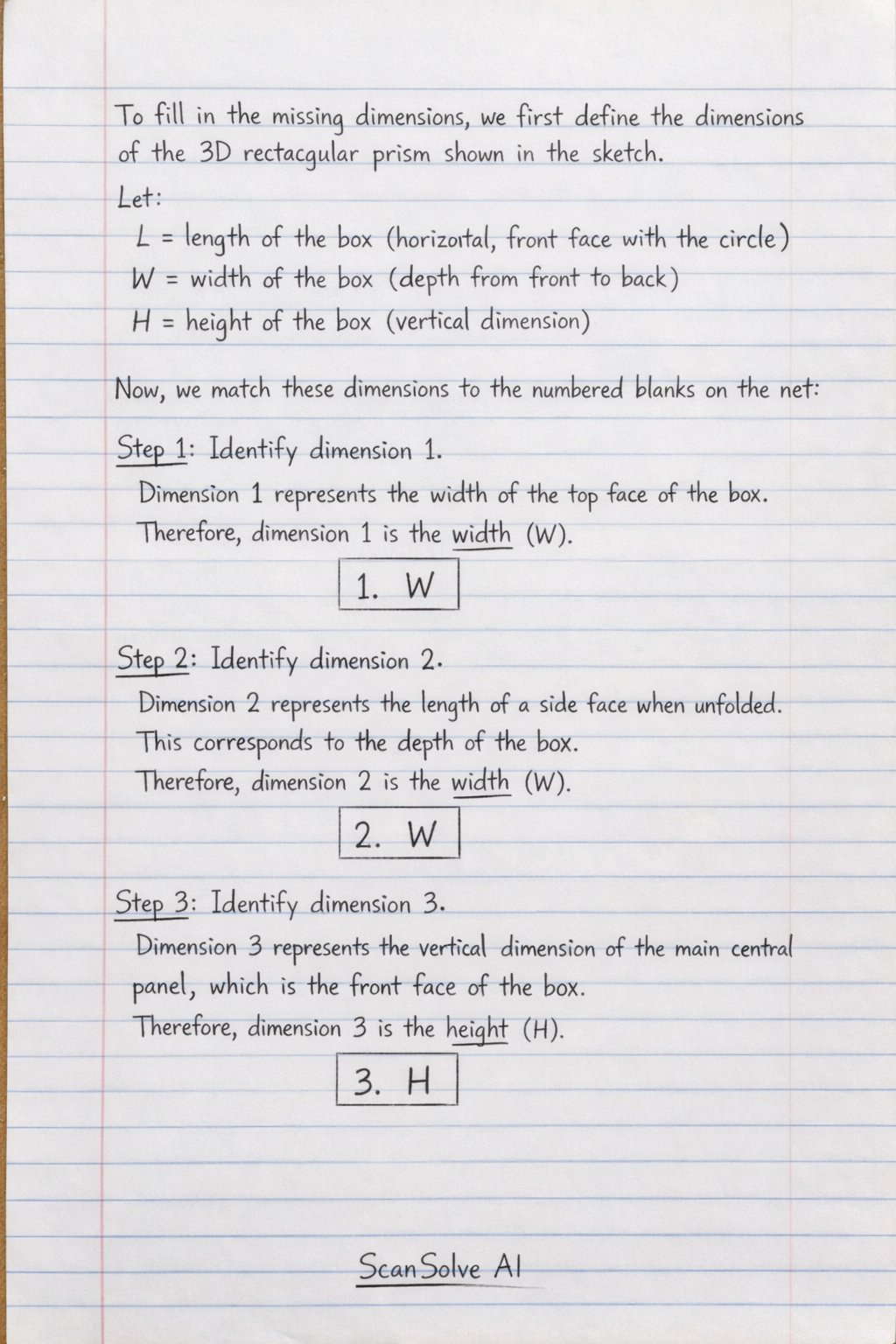
To fill in the missing dimensions, we first define the dimensions of the 3D rectangular prism shown in the sketch. Let: L be the length* of the box (the horizontal dimension of the front face, which has the circular hole). W be the width* of the box (the depth from front to back). H be the height* of the box (the vertical dimension). Now, we match these dimensions to the numbered blanks on the net: Step 1: Identify dimension 1. Dimension 1 represents the width of the top face of the box. Therefore, dimension 1 is the width (W). 1. \ W Step 2: Identify dimension 2. Dimension 2 represents the length of a side face when unfolded. This corresponds to the depth of the box. Therefore, dimension 2 is the width (W). 2. \ W Step 3: Identify dimension 3. Dimension 3 represents the vertical dimension of the main central panel, which is the front face of the box. Therefore, dimension 3 is the height (H). 3. \ H Step 4: Identify dimension 4. Dimension 4 represents the height of the small gluing flap at the end of the net. This flap's height must match the height of the box. Therefore, dimension 4 is the height (H). 4. \ H That's 2 down. 3 left today — send the next one.