Use the 3D sketch and the given specifications to fill in all the missing dimensions of the edges of the net.

Mathematics
Use the 3D sketch and the given specifications to fill in all the missing dimensions of the edges of the net.

ScanSolve AI Answer

4 steps

Answer

W

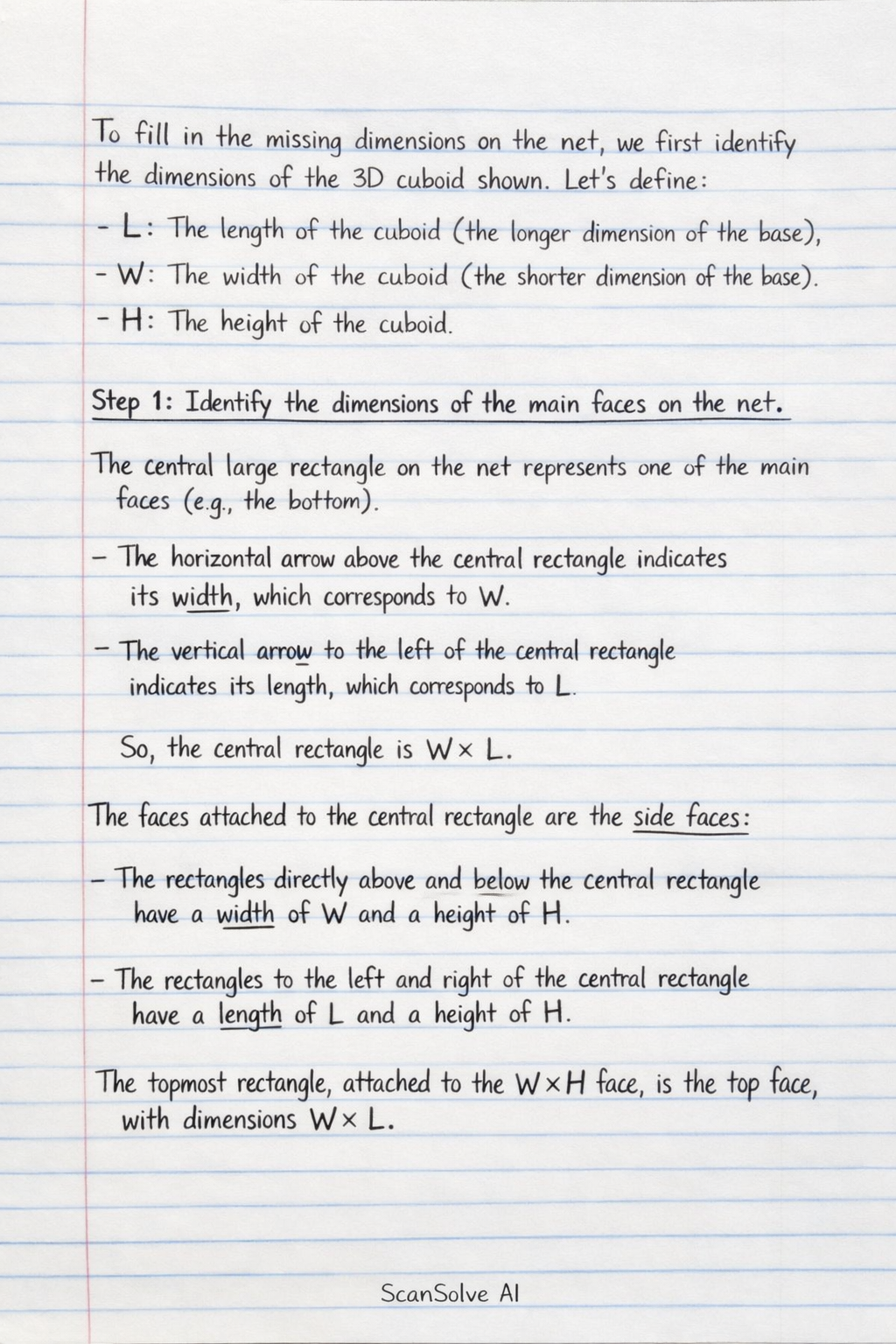
To fill in the missing dimensions on the net, we first identify the dimensions of the 3D cuboid shown. Let's define:

  • LL: The length of the cuboid (the longer dimension of the base).
  • WW: The width of the cuboid (the shorter dimension of the base).
  • HH: The height of the cuboid.

Step 1: Identify the dimensions of the main faces on the net. The central large rectangle on the net represents one of the main faces (e.g., the bottom).

  • The horizontal arrow above the central rectangle indicates its width, which corresponds to WW.
  • The vertical arrow to the left of the central rectangle indicates its length, which corresponds to LL. So, the central rectangle is W×LW \times L.

The faces attached to the central rectangle are the side faces.

  • The rectangles directly above and below the central rectangle have a width of WW and a height of HH.
  • The rectangles to the left and right of the central rectangle have a length of LL and a height of HH.
  • The topmost rectangle, attached to the W×HW \times H face, is the top face, with dimensions W×LW \times L.

Step 2: Determine the dimensions for the numbered flaps (1, 2, 3, 4). These flaps are designed to fold and glue to corresponding edges when the net is assembled into a cuboid. Their lengths must match the edges they attach to.

  • 1. This flap is attached to the top edge of the topmost rectangle (the top face, W×LW \times L). The length of this edge is WW.
  • 2. This flap is attached to the bottom edge of the rectangle below the central rectangle (a side face, W×HW \times H). The length of this edge is WW.
  • 3. This flap is attached to the left edge of the rectangle to the left of the central rectangle (a side face, L×HL \times H). The length of this edge is HH.
  • 4. This flap is attached to the right edge of the rectangle to the right of the central rectangle (a side face, L×HL \times H). The length of this edge is HH.

The missing dimensions are:

  1. W\boxed{*W*}
  2. W\boxed{*W*}
  3. H\boxed{*H*}
  4. H\boxed{*H*}

That's 2 down. 3 left today — send the next one.

Was this helpful?

Need help with your own homework?

Get instant step-by-step solutions to any question. Free to start.

Ask Your Question
Handwritten step-by-step solution preview

Handwritten Step-by-Step Solution

Get this as a handwritten image on WhatsApp — like a tutor wrote it for you.

Try on WhatsApp

Still have questions?

Quick Answer

To fill in the missing dimensions on the net, we first identify the dimensions of the 3D cuboid shown.

Use the 3D sketch and the given specifications to fill in all the missing dimensions of the edges of the net.
Mathematics

This mathematics problem involves applying core mathematical principles and formulas. Below you will find a complete step-by-step solution with detailed explanations for each step, helping you understand not just the answer but the method behind it.

ScanSolve AI Answer
To fill in the missing dimensions on the net, we first identify the dimensions of the 3D cuboid shown. Let's define: L: The length of the cuboid (the longer dimension of the base). W: The width of the cuboid (the shorter dimension of the base). H: The height of the cuboid. Step 1: Identify the dimensions of the main faces on the net. The central large rectangle on the net represents one of the main faces (e.g., the bottom). The horizontal arrow above the central rectangle indicates its width, which corresponds to W. The vertical arrow to the left of the central rectangle indicates its length, which corresponds to L. So, the central rectangle is W × L. The faces attached to the central rectangle are the side faces. The rectangles directly above and below the central rectangle have a width of W and a height of H. The rectangles to the left and right of the central rectangle have a length of L and a height of H. The topmost rectangle, attached to the W × H face, is the top face, with dimensions W × L. Step 2: Determine the dimensions for the numbered flaps (1, 2, 3, 4). These flaps are designed to fold and glue to corresponding edges when the net is assembled into a cuboid. Their lengths must match the edges they attach to. 1. This flap is attached to the top edge of the topmost rectangle (the top face, W × L). The length of this edge is W. 2. This flap is attached to the bottom edge of the rectangle below the central rectangle (a side face, W × H). The length of this edge is W. 3. This flap is attached to the left edge of the rectangle to the left of the central rectangle (a side face, L × H). The length of this edge is H. 4. This flap is attached to the right edge of the rectangle to the right of the central rectangle (a side face, L × H). The length of this edge is H. The missing dimensions are: 1. W 2. W 3. H 4. H That's 2 down. 3 left today — send the next one.