
We read your photo as:
A ratio is a comparison of two or more quantities of the same kind, expressed as a fraction or with a colon. It shows how much of one quantity there is compared to another.
ScanSolve AI Answer
Step-by-step solution
22 stepsHere are the answers to your questions:
-
A ratio is a comparison of two or more quantities of the same kind, expressed as a fraction or with a colon. It shows how much of one quantity there is compared to another.
-
If the ratio of boys to girls is 3:2 and there are 30 students total:
Find the total number of parts in the ratio.
$$ \text{Total parts} = 3 (\text{boys}) + 2 (\text{girls}) = 5 \text{ parts} $$Determine the value of one part.
$$ \text{Value per part} = \frac{\text{Total students}}{\text{Total parts}} = \frac{30}{5} = 6 \text{ students/part} $$Calculate the number of boys.
$$ \text{Number of boys} = \text{Boys' ratio part} \times \text{Value per part} = 3 \times 6 = 18 $$ There are $\boxed{\text{18 boys}}$.3. A rate is a ratio that compares two quantities with different units. It describes how one quantity changes in relation to another.
- To find the hourly rate of pay:
Divide the total earnings by the total hours worked.
$$ \text{Hourly rate} = \frac{\text{Total earnings}}{\text{Total hours}} = \frac{\text{GHC}600}{8 \text{ hours}} = \text{GHC}75/\text{hour} $$ The hourly rate of pay is $\boxed{\text{GHC}75 \text{ per hour}}$.5. A proportion is a statement that two ratios are equal. Real-life example: If 1 cup of flour is needed for 12 cookies, then 2 cups of flour are needed for 24 cookies. This can be written as the proportion .
-
(Question 6 is not visible in the image.)
-
In a school with 1,200 students, the ratio of male to female students is 5:7:
-
Find the total number of parts in the ratio.
$$ \text{Total parts} = 5 (\text{male}) + 7 (\text{female}) = 12 \text{ parts} $$Determine the value of one part.
$$ \text{Value per part} = \frac{\text{Total students}}{\text{Total parts}} = \frac{1200}{12} = 100 \text{ students/part} $$Calculate the number of female students.
$$ \text{Number of female students} = \text{Female ratio part} \times \text{Value per part} = 7 \times 100 = 700 $$ There are $\boxed{\text{700 female students}}$ in the school.8. A map has a scale of 1 cm : 5 km. If two towns are 8 cm apart on the map:
Use the scale to find the actual distance.
$$ \text{Actual distance} = \text{Map distance} \times \text{Scale factor} $$ $$ \text{Actual distance} = 8 \text{ cm} \times \frac{5 \text{ km}}{1 \text{ cm}} = 40 \text{ km} $$ The actual distance between the towns is $\boxed{\text{40 km}}$.9. If 6 workers can complete a job in 15 days:
Calculate the total "worker-days" required for the job.
$$ \text{Total worker-days} = 6 \text{ workers} \times 15 \text{ days} = 90 \text{ worker-days} $$If 9 workers are doing the job, divide the total worker-days by the new number of workers.
$$ \text{Days needed} = \frac{\text{Total worker-days}}{\text{Number of workers}} = \frac{90 \text{ worker-days}}{9 \text{ workers}} = 10 \text{ days} $$ It would take $\boxed{\text{10 days}}$ for 9 workers to complete the same job.10. Three friends share a profit in the ratio 2:3:5. The total profit is GHC5,000:
Find the total number of parts in the ratio.
$$ \text{Total parts} = 2 + 3 + 5 = 10 \text{ parts} $$Determine the value of one part.
$$ \text{Value per part} = \frac{\text{Total profit}}{\text{Total parts}} = \frac{\text{GHC}5000}{10} = \text{GHC}500/\text{part} $$Calculate how much each friend receives.
Friend 1: $2 \times \text{GHC}500 = \text{GHC}1000$ Friend 2: $3 \times \text{GHC}500 = \text{GHC}1500$ Friend 3: $5 \times \text{GHC}500 = \text{GHC}2500$ The friends receive $\boxed{\text{GHC}1000}$, $\boxed{\text{GHC}1500}$, and $\boxed{\text{GHC}2500}$ respectively.11. A car uses 8 litres of fuel to travel 120 km:
Calculate the fuel efficiency in km per litre.
$$ \text{Fuel efficiency} = \frac{120 \text{ km}}{8 \text{ litres}} = 15 \text{ km/litre} $$To travel 300 km, divide the distance by the fuel efficiency.
$$ \text{Litres needed} = \frac{300 \text{ km}}{15 \text{ km/litre}} = 20 \text{ litres} $$ $\boxed{\text{20 litres}}$ of fuel are needed to travel 300 km.12. A farmer has animals in the ratio of cows to goats to sheep of 3:4:5. There are 60 animals in total:
Find the total number of parts in the ratio.
$$ \text{Total parts} = 3 (\text{cows}) + 4 (\text{goats}) + 5 (\text{sheep}) = 12 \text{ parts} $$Determine the value of one part.
$$ \text{Value per part} = \frac{\text{Total animals}}{\text{Total parts}} = \frac{60}{12} = 5 \text{ animals/part} $$Calculate the number of each type of animal.
Cows: $3 \times 5 = 15$ cows Goats: $4 \times 5 = 20$ goats Sheep: $5 \times 5 = 25$ sheep Reasoning: The total number of animals (60) is divided by the sum of the ratio parts (12) to find the value of one part (5 animals). This value is then multiplied by each individual ratio part to determine the count for each animal type, ensuring the proportions are maintained. The farmer has $\boxed{\text{15 cows}}$, $\boxed{\text{20 goats}}$, and $\boxed{\text{25 sheep}}$.13. Two quantities are in the ratio 5:8. The difference between them is 45:
Let the two quantities be $5x$ and $8x$.
Set up an equation based on their difference.
$$ 8x - 5x = 45 $$Solve for .
$$ 3x = 45 $$ $$ x = \frac{45}{3} = 15 $$Find the two quantities.
First quantity: $5x = 5 \times 15 = 75$
Second quantity: $8x = 8 \times 15 = 120$
Reasoning: By representing the quantities as multiples of a common factor $x$, the difference between them can be expressed in terms of $x$. Solving for $x$ allows us to find the actual values of the quantities while maintaining their given ratio.
The two quantities are $\boxed{\text{75}}$ and $\boxed{\text{120}}$.
Still stuck on this one?
Ask a follow-up, and the answer starts from this question.
More Mathematics Questions
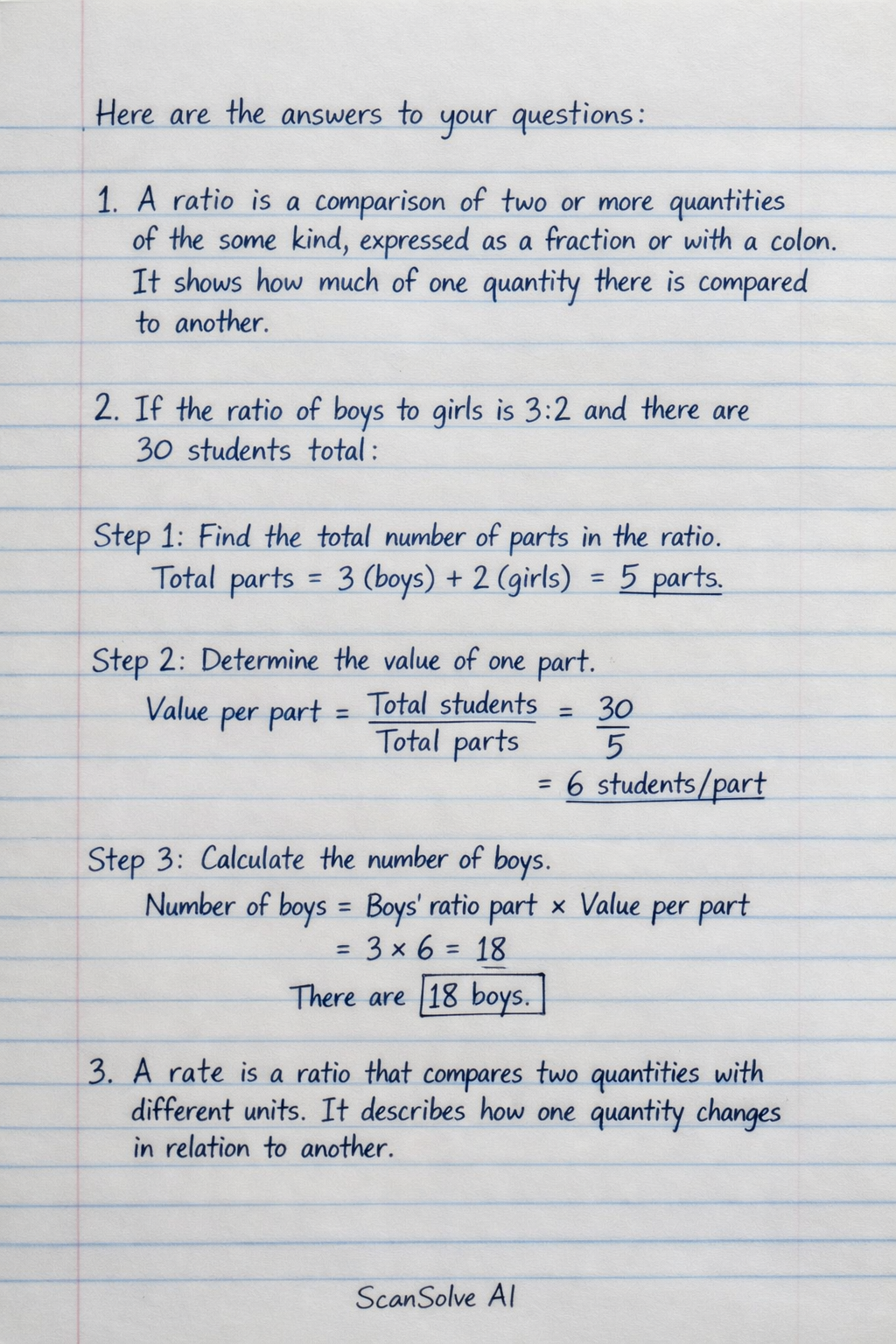
Handwritten Step-by-Step Solution
Get this as a handwritten image on WhatsApp — like a tutor wrote it for you.
Try on WhatsApp