
We read your photo as:
A rectangular lawn measuring 10m by 4m needs to be fenced on two smaller sides and one long side. A 1m gap is left for an entrance. How much fencing is needed? Additionally, if the side of a square is
ScanSolve AI Answer
Step-by-step solution
7 stepsHere are the solutions to your questions.
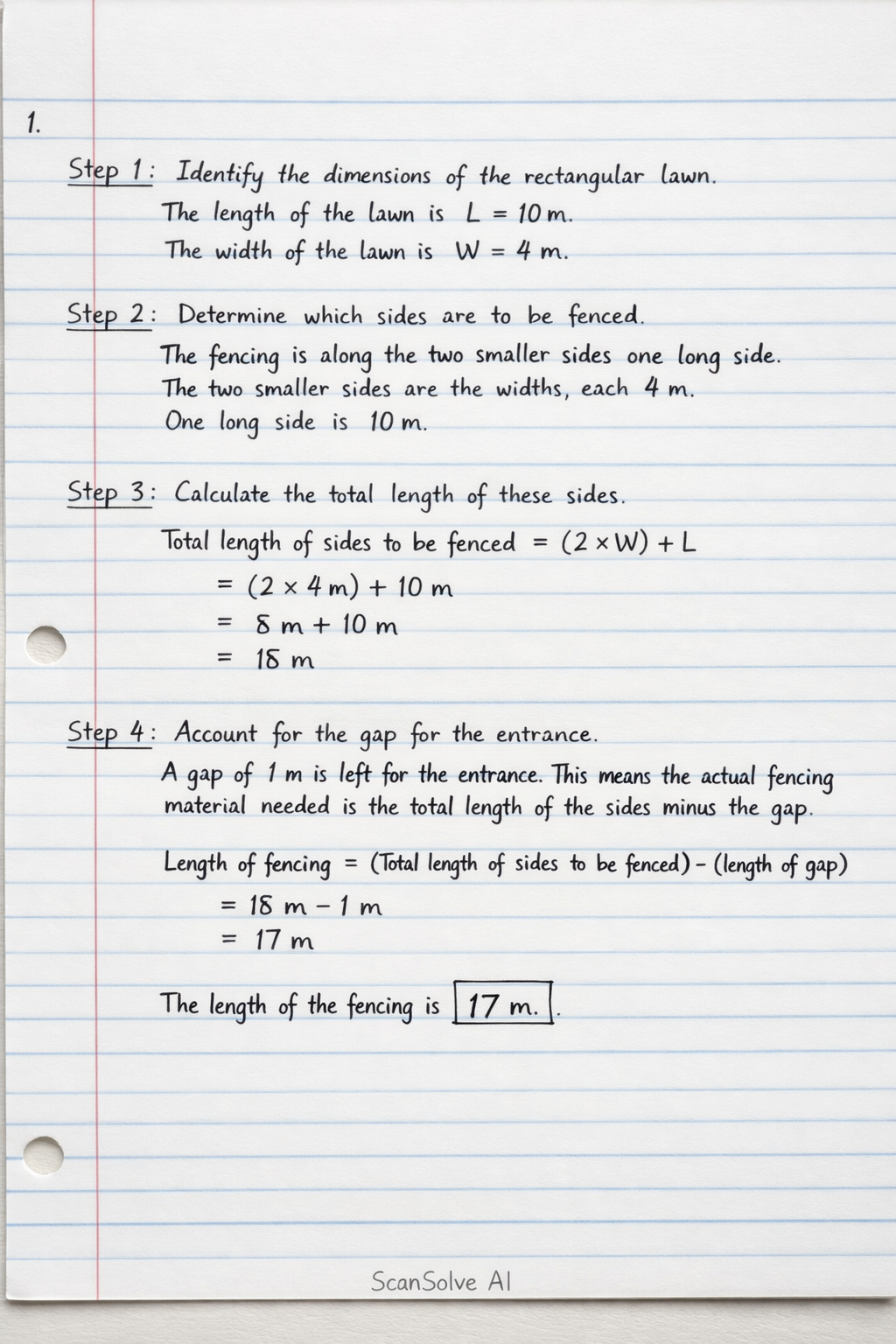
1.
Identify the dimensions of the rectangular lawn.
The length of the lawn is .
The width of the lawn is .Determine which sides are to be fenced.
The fencing is along the two smaller sides and one long side.
The two smaller sides are the widths, each .
One long side is .Calculate the total length of these sides.
Total length of sides to be fenced
Account for the gap for the entrance.
A gap of is left for the entrance. This means the actual fencing material needed is the total length of the sides minus the gap.
Length of fencingThe length of the fencing is .
2.
Calculate the original perimeter of the square.
The original side of the square is .
The formula for the perimeter of a square is .
Original perimeterCalculate the new side length and the new perimeter.
The side of the square is doubled, so the new side length .
The new perimeter
Determine how many times the new perimeter became compared to the original perimeter.
To find this, divide the new perimeter by the original perimeter.
RatioThe new perimeter will become the original perimeter.
Still stuck on this one?
Ask a follow-up, and the answer starts from this question.
More Mathematics Questions
Handwritten Step-by-Step Solution
Get this as a handwritten image on WhatsApp — like a tutor wrote it for you.
Try on WhatsApp