We read your photo as:

A rectangular plot of land is 4x + 10 m long and 2x - 20 m wide. Its perimeter is 160 m. Calculate the value of x and the plot's dimensions.

Mathematics

ScanSolve AI Answer

Answers

7 parts
a(i)

GH¢38,250\text{GH}\text{¢}38,250

a(ii)

GH¢6,375\text{GH}\text{¢}6,375

b(ii)

700 m2700 \text{ m}^2

c(i)

GH¢4,200\text{GH}\text{¢}4,200

c(ii)

GH¢630\text{GH}\text{¢}630

d
3

55+25\sqrt{5} + \sqrt{2}

Step-by-step solution

17 steps

Part a(i)· 3 steps

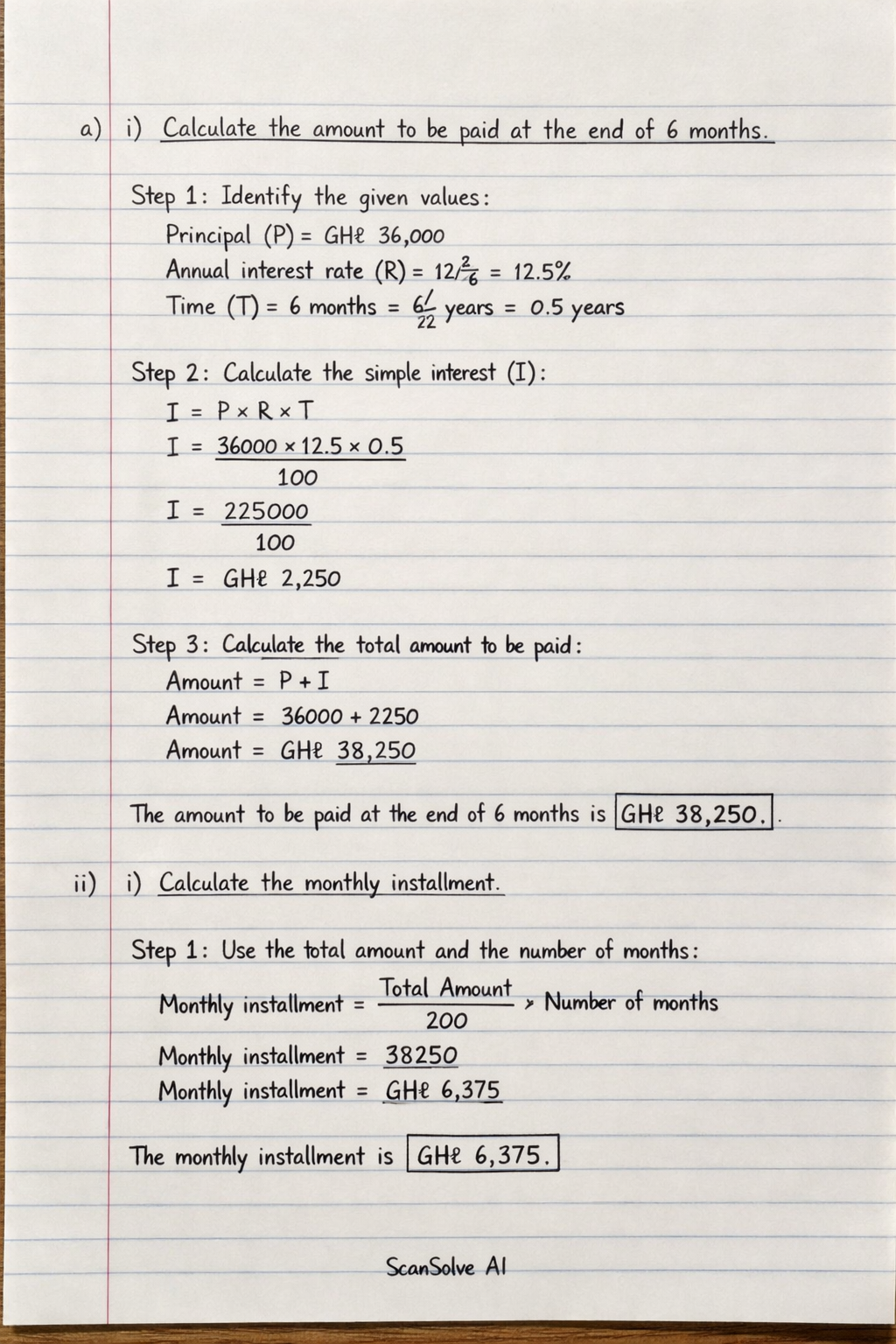
Calculate the amount to be paid at the end of the 6 months.

  1. Identify the given values.

    Principal (P)=GH¢36,000(P) = \text{GH}\text{¢}36,000
    Annual interest rate (R)=1212%=12.5%(R) = 12 \frac{1}{2}\% = 12.5\%
    Time (T)=6 months=612 years=0.5 years(T) = 6 \text{ months} = \frac{6}{12} \text{ years} = 0.5 \text{ years}

  2. Calculate the simple interest $(I)$.

    I=P×R×T100I = \frac{P \times R \times T}{100} I=36000×12.5×0.5100I = \frac{36000 \times 12.5 \times 0.5}{100} I=225000100I = \frac{225000}{100} I=GH¢2,250I = \text{GH}\text{¢}2,250
  3. Calculate the total amount to be paid.

    Amount=P+I\text{Amount} = P + I Amount=36000+2250\text{Amount} = 36000 + 2250 Amount=GH¢38,250\text{Amount} = \text{GH}\text{¢}38,250

    The amount to be paid at the end of 6 months is GH¢38,250\boxed{\text{GH}\text{¢}38,250}.

Part a(ii)

GH¢6,375\text{GH}\text{¢}6,375

Calculate the monthly installment.

  1. Use the total amount and the number of months.

    Monthly installment=Total AmountNumber of months\text{Monthly installment} = \frac{\text{Total Amount}}{\text{Number of months}} Monthly installment=382506\text{Monthly installment} = \frac{38250}{6} Monthly installment=GH¢6,375\text{Monthly installment} = \text{GH}\text{¢}6,375

    The monthly installment is GH¢6,375\boxed{\text{GH}\text{¢}6,375}.

Part b(i)15

Value of x

The perimeter of a rectangular plot of land whose length is (4x+10)(4x + 10)m and width (2x−20)(2x - 20)m is 160m. Find

  1. Write the formula for the perimeter of a rectangle.

    P=2(L+W)P = 2(L + W)

    Given P=160 mP = 160\text{ m}, L=(4x+10) mL = (4x + 10)\text{ m}, W=(2x−20) mW = (2x - 20)\text{ m}.

  2. Substitute the given values into the formula and solve for xx.

    160=2((4x+10)+(2x−20))160 = 2((4x + 10) + (2x - 20)) 160=2(4x+2x+10−20)160 = 2(4x + 2x + 10 - 20) 160=2(6x−10)160 = 2(6x - 10)

    Divide both sides by 2:

    80=6x−1080 = 6x - 10

    Add 10 to both sides:

    80+10=6x80 + 10 = 6x 90=6x90 = 6x x=906x = \frac{90}{6} x=15x = 15

    The value of xx is 15\boxed{15}.

Part b(ii)

700 m2700 \text{ m}^2

area of the plot.

  1. Calculate the length and width using the value of xx.

    L=4x+10=4(15)+10=60+10=70 mL = 4x + 10 = 4(15) + 10 = 60 + 10 = 70\text{ m} W=2x−20=2(15)−20=30−20=10 mW = 2x - 20 = 2(15) - 20 = 30 - 20 = 10\text{ m}
  2. Calculate the area of the plot.

    Area=L×W\text{Area} = L \times W Area=70 m×10 m\text{Area} = 70 \text{ m} \times 10 \text{ m} Area=700 m2\text{Area} = 700 \text{ m}^2

    The area of the plot is 700 m2\boxed{700 \text{ m}^2}.

Part c(i)

GH¢4,200\text{GH}\text{¢}4,200

actual cost of the machine.

A woman bought a washing machine for GH¢4,830.00 including VAT of 15%. Calculate for the

  1. Let the actual cost be CC.

    The total cost includes VAT.

    Total Cost=Actual Cost+VAT\text{Total Cost} = \text{Actual Cost} + \text{VAT} Total Cost=C+0.15C\text{Total Cost} = C + 0.15C Total Cost=1.15C\text{Total Cost} = 1.15C

    Given Total Cost = GH¢4,830.00.

  2. Solve for the actual cost CC.

    4830=1.15C4830 = 1.15C C=48301.15C = \frac{4830}{1.15} C=GH¢4,200C = \text{GH}\text{¢}4,200

    The actual cost of the machine is GH¢4,200\boxed{\text{GH}\text{¢}4,200}.

Part c(ii)

GH¢630\text{GH}\text{¢}630

VAT paid on the machine.

  1. Calculate the VAT paid.

    VAT Paid=Total Cost−Actual Cost\text{VAT Paid} = \text{Total Cost} - \text{Actual Cost} VAT Paid=4830−4200\text{VAT Paid} = 4830 - 4200 VAT Paid=GH¢630\text{VAT Paid} = \text{GH}\text{¢}630

    The VAT paid on the machine is GH¢630\boxed{\text{GH}\text{¢}630}.

Part d3

Find the value of xx in the diagram.

  1. Identify the sides of the right-angled triangle.

    The triangle PMN is a right-angled triangle with the right angle at M.
    Side PM = x+1x + 1
    Side MN = 3
    Hypotenuse PN = x+2x + 2

  2. Apply the Pythagorean theorem.

    PM2+MN2=PN2PM^2 + MN^2 = PN^2 (x+1)2+32=(x+2)2(x + 1)^2 + 3^2 = (x + 2)^2
  3. Expand and solve for xx.

    (x2+2x+1)+9=(x2+4x+4)(x^2 + 2x + 1) + 9 = (x^2 + 4x + 4) x2+2x+10=x2+4x+4x^2 + 2x + 10 = x^2 + 4x + 4

    Subtract x2x^2 from both sides:

    2x+10=4x+42x + 10 = 4x + 4

    Subtract 2x2x from both sides:

    10=2x+410 = 2x + 4

    Subtract 4 from both sides:

    10−4=2x10 - 4 = 2x 6=2x6 = 2x x=62x = \frac{6}{2} x=3x = 3

    The value of xx is 3\boxed{3}.

    Find the sum of (25−42)(2\sqrt{5} - 4\sqrt{2}) and (35+52)(3\sqrt{5} + 5\sqrt{2}).

  4. Write the expression for the sum.

    Sum=(25−42)+(35+52)\text{Sum} = (2\sqrt{5} - 4\sqrt{2}) + (3\sqrt{5} + 5\sqrt{2})
  5. Group like terms.

    Sum=(25+35)+(−42+52)\text{Sum} = (2\sqrt{5} + 3\sqrt{5}) + (-4\sqrt{2} + 5\sqrt{2})
  6. Combine the coefficients of the like terms.

    Sum=(2+3)5+(−4+5)2\text{Sum} = (2 + 3)\sqrt{5} + (-4 + 5)\sqrt{2} Sum=55+12\text{Sum} = 5\sqrt{5} + 1\sqrt{2} Sum=55+2\text{Sum} = 5\sqrt{5} + \sqrt{2}

    The sum is 55+2\boxed{5\sqrt{5} + \sqrt{2}}.

Was this helpful?

Try one yourself

A new problem that tests the same skill.

Still stuck on this one?

Ask a follow-up, and the answer starts from this question.

Got a different question?Ask your own question
Handwritten step-by-step solution preview

Handwritten Step-by-Step Solution

Get this as a handwritten image on WhatsApp — like a tutor wrote it for you.

Try on WhatsApp