
We read your photo as:
A rubrics cube measures 4.5 cm on each side. Find its volume. Using a four-figure mathematical table, evaluate sqrt(0.009441).
ScanSolve AI Answer
Step-by-step solution
22 stepsHere are the solutions to the problems:
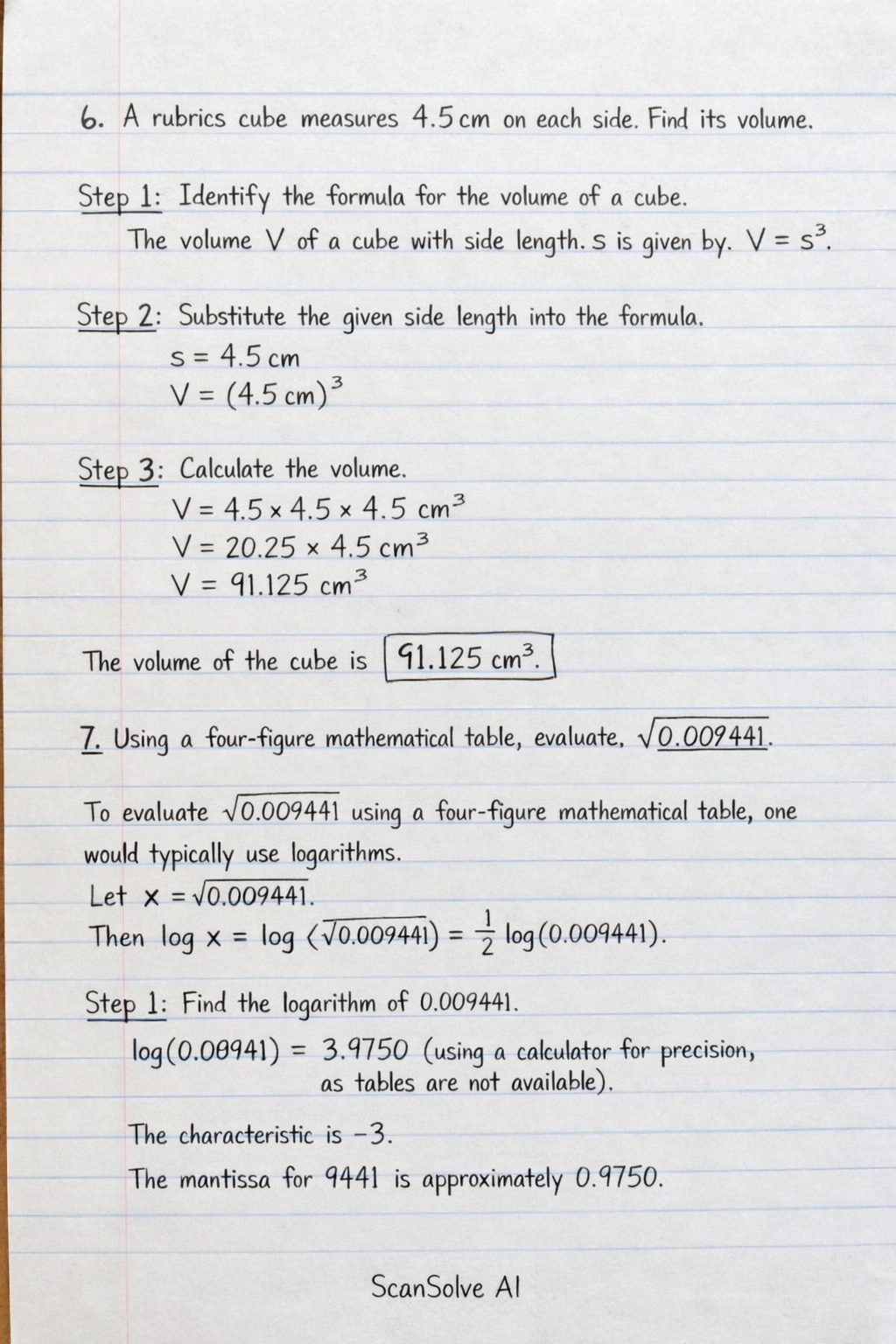
6. A rubrics cube measures on each side. Find its volume.
Identify the formula for the volume of a cube.
The volume of a cube with side length is given by .
Substitute the given side length into the formula.
Calculate the volume.
The volume of the cube is .
7. Using a four-figure mathematical table, evaluate .
To evaluate using a four-figure mathematical table, one would typically use logarithms.
Let .
Then .Find the logarithm of 0.009441.
(using a calculator for precision, as tables are not available).
The characteristic is . The mantissa for 9441 is approximately 0.9750.Divide the logarithm by 2.
To divide by 2, we rewrite the characteristic:
Find the antilog of .
Antilog() is the number whose logarithm is .
Using a calculator for precision (as a four-figure table would give an approximation):
Rounding to four significant figures, as would be typical for a four-figure table:
The value is .
8. Using a scientific calculator to find correct to 3 significant figures.
Calculate the square root using a calculator.
Round the result to 3 significant figures.
The first three significant figures are 7, 0, 6. The fourth digit is 4, which is less than 5, so we round down.
The value of correct to 3 significant figures is .
9. Express 0.09364 in standard form.
Move the decimal point to get a number between 1 and 10.
Move the decimal point 2 places to the right to get 9.364.
Determine the power of 10.
Since the decimal point was moved 2 places to the right, the power of 10 is .
The number in standard form is .
10. Using a four-figure mathematical table evaluate .
To evaluate using a four-figure mathematical table, one would typically use logarithms.
Let .
Then .Find the logarithm of 94.36.
(using a calculator for precision, as tables are not available).
The characteristic is 1. The mantissa for 9436 is approximately 0.9748.Divide the logarithm by 2.
Find the antilog of 0.9874.
Antilog(0.9874) is the number whose logarithm is 0.9874.
Using a calculator for precision (as a four-figure table would give an approximation):
Rounding to four significant figures, as would be typical for a four-figure table:The value is .
11. Given Express the square of 89 in standard form.
Calculate the square of 89.
Express the result in standard form.
Move the decimal point 3 places to the left to get 7.921.
Since the decimal point was moved 3 places to the left, the power of 10 is 3.The square of 89 in standard form is .
12. Express 1 in logarithmic notation base 7.
Recall the property of logarithms that states .
This means that the logarithm of a number to the same base is always 1.
Apply this property with base 7.
Therefore, .
The number 1 in logarithmic notation base 7 is .
13. Evaluate .
Apply the negative exponent rule
.
Apply the fractional exponent rule
.
Calculate the cube root of 125.
Square the result.
Substitute back into the expression.
The evaluated expression is .
Still stuck on this one?
Ask a follow-up, and the answer starts from this question.
More Mathematics Questions
Handwritten Step-by-Step Solution
Get this as a handwritten image on WhatsApp — like a tutor wrote it for you.
Try on WhatsApp