
A spherical balloon is being inflated at a rate of 10 cm3/min . How fast is the radius increasing when the radius is 5 cm? ( V = (4)/(3)pi r3 )
Mathematics
ScanSolve AI Answer
Answer
Step-by-step solution
4 stepsIdentify the given information and the formula.
We are given the rate of change of volume and the current radius . We need to find the rate of change of the radius .
The formula for the volume of a sphere is .Differentiate the volume formula with respect to time .
Using the chain rule, we differentiate both sides of the volume equation with respect to :
Substitute the given values into the differentiated equation.
We have and .
Solve for .
The rate at which the radius is increasing when the radius is 5 cm is cm/min.
Was this helpful?
Try one yourself
A new problem that tests the same skill.
Still stuck on this one?
Ask a follow-up, and the answer starts from this question.
Got a different question?Ask your own question
More Mathematics Questions
QGas is escaping from a spherical balloon at 45 ext m3/ extmin. How fast is the radius decreasing…QThe radius of a sphere is increasing at 0.5 cm/s. When r = 12 cm, find the rates at which the…QA spherical balloon's volume increases by 18p%. What is the percentage change in its radius?QGiven the radius of the spherical ball r = 1.5 cm:QA ball has a volume of 5000 cm³. Calculate the radius of the ball, rounded to one decimal place. Use…
Browse by topic:Geometry
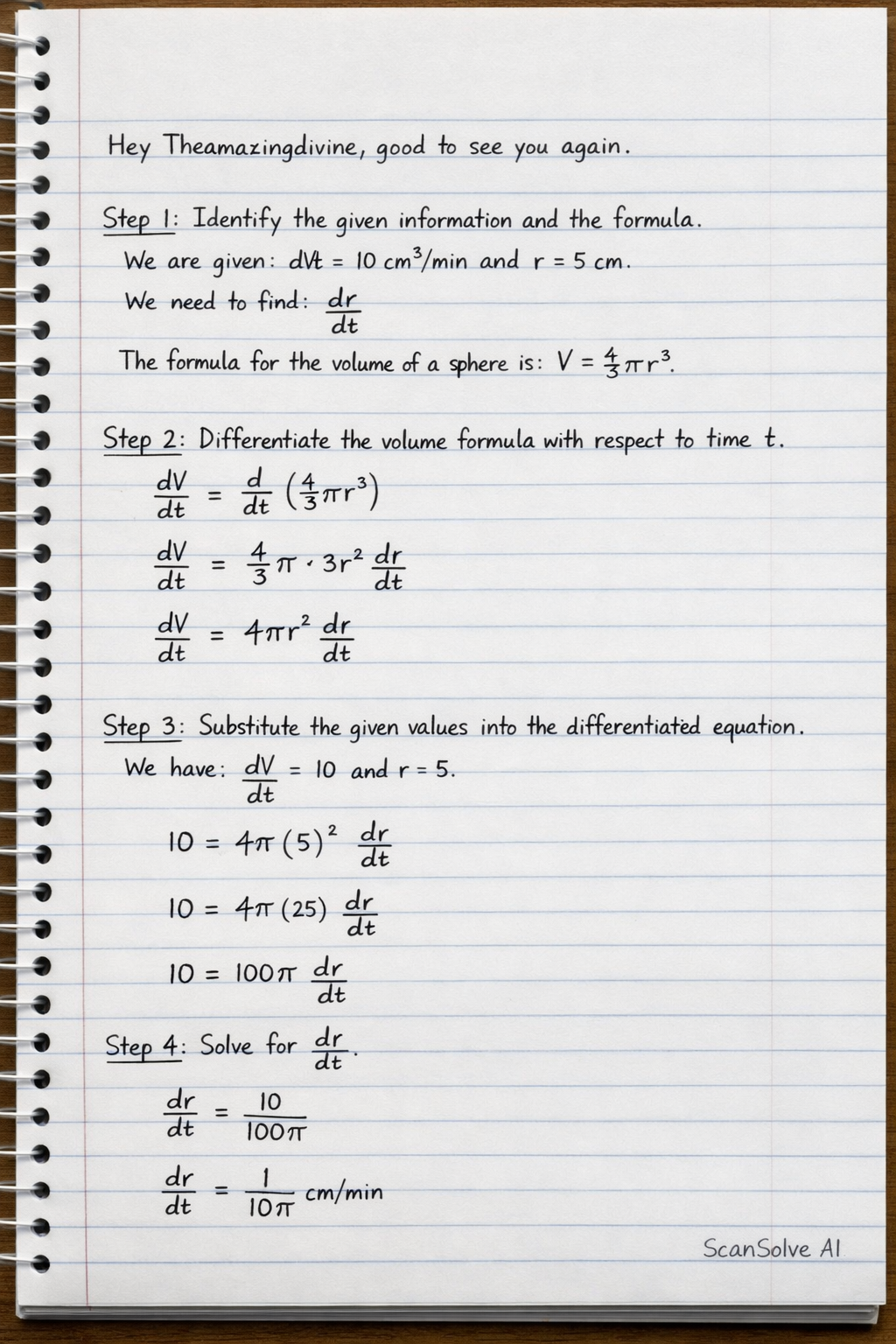
Handwritten Step-by-Step Solution
Get this as a handwritten image on WhatsApp — like a tutor wrote it for you.
Try on WhatsApp