

This mathematics problem involves applying core mathematical principles and formulas. Below you will find a complete step-by-step solution with detailed explanations for each step, helping you understand not just the answer but the method behind it.
ScanSolve AI Answer
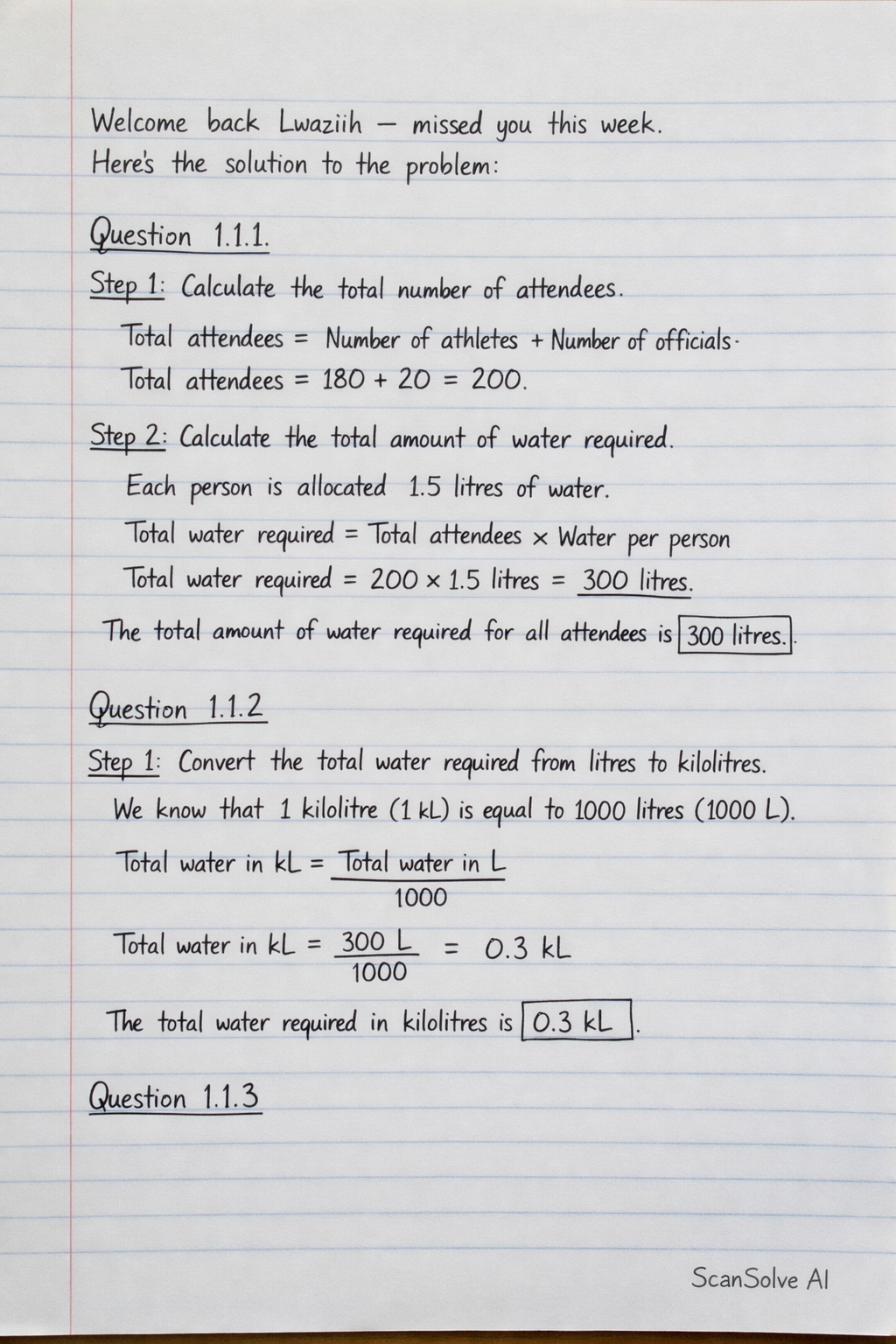
Welcome back Lwaziih — missed you this week. Here's the solution to the problem: Question 1.1.1 Step 1: Calculate the total number of attendees. Total attendees = Number of athletes + Number of officials Total attendees = 180 + 20 = 200 Step 2: Calculate the total amount of water required. Each person is allocated 1.5 litres of water. Total water required = Total attendees × Water per person Total water required = 200 × 1.5 litres = 300 litres The total amount of water required for all attendees is 300 litres. Question 1.1.2 Step 1: Convert the total water required from litres to kilolitres. We know that 1 kilolitre (1 kL) is equal to 1000 litres (1000 L). Total water in kL = Total water in L1000 Total water in kL = 300 L1000 = 0.3 kL The total water required in kilolitres is 0.3 kL. Question 1.1.3 Step 1: Determine the capacity of one water tank in litres. The problem states that water is stored in tanks of 2.5 kilolitres each. Tank capacity in L = 2.5 kL × 1000 L/kL = 2500 L Step 2: Calculate the number of full water tanks needed. Number of tanks = Total water requiredCapacity per tank Number of tanks = 300 L2500 L/tank = 0.12 tanks Since we cannot have a fraction of a tank and we need to ensure all water is available, we must round up to the next whole number. Therefore, the number of full water tanks needed is 1 tank. Question 1.1.4 Step 1: Calculate the total capacity of the tanks used. From 1.1.3, we determined that 1 tank is needed. Total capacity of tanks used = 1 tank × 2500 L/tank = 2500 L Step 2: Calculate the amount of water that will remain unused in the last tank. Unused water = Total capacity of tanks used - Total water required Unused water = 2500 L - 300 L = 2200 L The amount of water that will remain unused in the last tank is 2200 litres. Send me the next one 📸