We read your photo as:

A) State the total value of the digit 8 in 84,265,739. b) Round off 84,265,739 to the nearest million. 7. a) Ben’s age is t years and is not less than 14 years. Write an inequality for Ben’s age. b) I

Mathematics

ScanSolve AI Answer

Step-by-step solution

6 steps
  1. Solve Question 6 (top left)

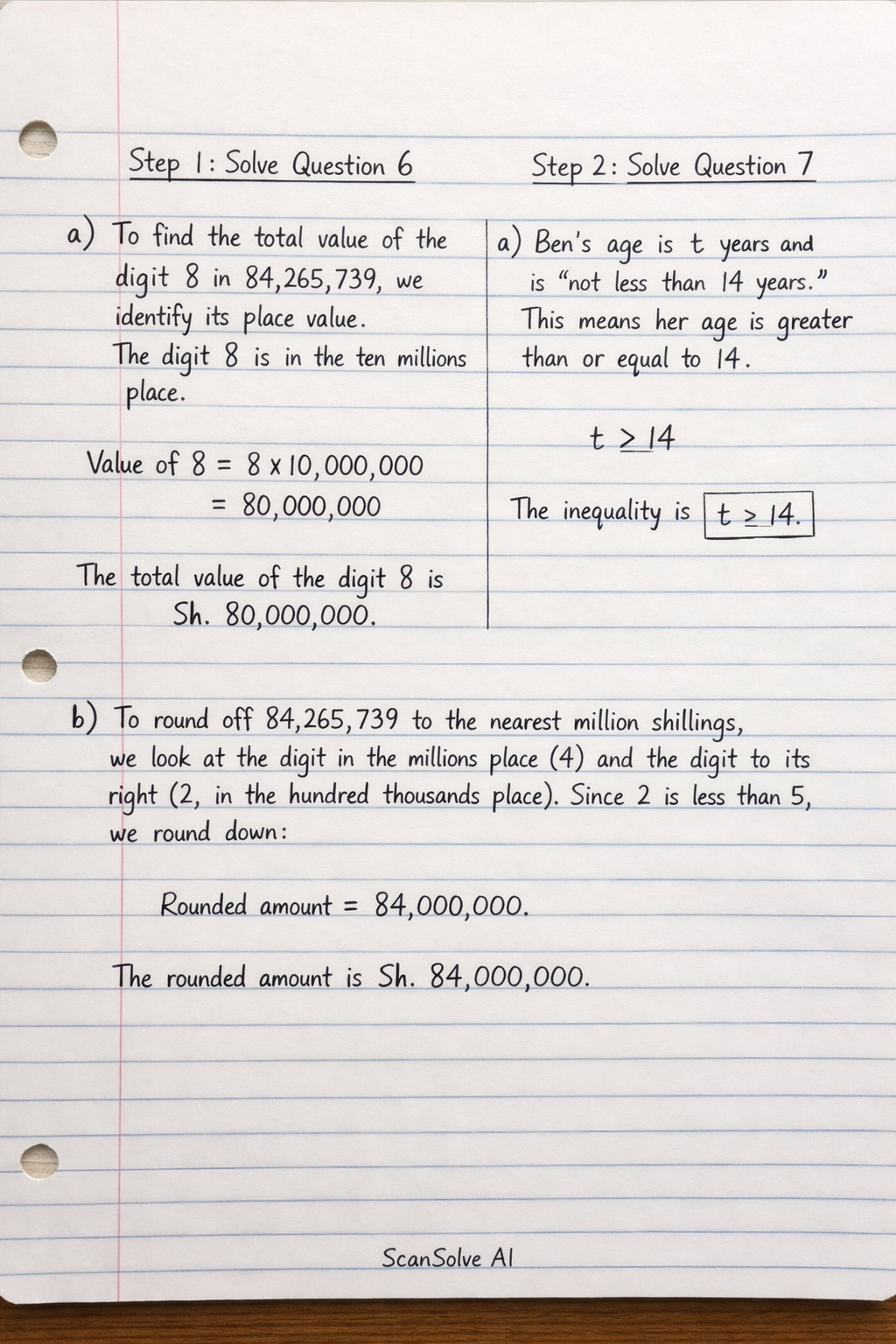
    a) To find the total value of the digit 8 in 84,265,739, we identify its place value. The digit 8 is in the ten millions place.

    Value of 8=8×10,000,000=80,000,000\text{Value of 8} = 8 \times 10,000,000 = 80,000,000

    The total value of the digit 8 is Sh. 80,000,000.

    b) To round off 84,265,739 to the nearest million shillings, we look at the digit in the millions place (4) and the digit to its right (2, in the hundred thousands place). Since 2 is less than 5, we round down, keeping the millions digit as 4 and changing all digits to its right to zero.

    Rounded amount=84,000,000\text{Rounded amount} = 84,000,000

    The rounded amount is Sh. 84,000,000.

  2. Solve Question 7 (top right)

    a) Ben's age is tt years and is "not less than 14 years". This means her age is greater than or equal to 14.

    t≥14t \ge 14

    The inequality is t≥14\boxed{t \ge 14}.

    b) To illustrate the inequality t≥14t \ge 14 on a number line, we draw a closed circle at 14 (indicating that 14 is included) and an arrow extending to the right (indicating all values greater than 14).

    Number line illustration:\text{Number line illustration:} ∙∘∘∘∘∘∘∘∘∘∘∘∘∘∘∘0123456789101112131415\begin{array}{cccccccccccccccc} \bullet & \circ & \circ & \circ & \circ & \circ & \circ & \circ & \circ & \circ & \circ & \circ & \circ & \circ & \circ & \circ \\ \hline 0 & 1 & 2 & 3 & 4 & 5 & 6 & 7 & 8 & 9 & 10 & 11 & 12 & 13 & 14 & 15 \end{array}

    (The line should extend from 14 to the right, with a solid circle at 14).

  3. Solve Question 5 (middle left)

    Let jj be the cost of one jacket and ss be the cost of one shirt.
    From the problem statement, we can form two linear equations:

    1. Gideon: 3j+2s=46003j + 2s = 4600
    2. John: 2j+3s=44002j + 3s = 4400

    To solve this system of equations, we can use the elimination method. Multiply Equation 1 by 2 and Equation 2 by 3 to make the coefficients of jj equal:

    2×(3j+2s)=2×4600  ⟹  6j+4s=9200(Equation 3)2 \times (3j + 2s) = 2 \times 4600 \implies 6j + 4s = 9200 \quad (\text{Equation 3}) 3×(2j+3s)=3×4400  ⟹  6j+9s=13200(Equation 4)3 \times (2j + 3s) = 3 \times 4400 \implies 6j + 9s = 13200 \quad (\text{Equation 4})

    Subtract Equation 3 from Equation 4:

    (6j+9s)−(6j+4s)=13200−9200(6j + 9s) - (6j + 4s) = 13200 - 9200 5s=40005s = 4000 s=40005s = \frac{4000}{5} s=800s = 800

    Now substitute the value of ss into Equation 1:

    3j+2(800)=46003j + 2(800) = 4600 3j+1600=46003j + 1600 = 4600 3j=4600−16003j = 4600 - 1600 3j=30003j = 3000 j=30003j = \frac{3000}{3} j=1000j = 1000

    The cost of each jacket is Sh. 1000 and the cost of each shirt is Sh. 800.

  4. Solve Question 8 (middle right)

    Total attendees = 5024.
    Learners were 58\frac{5}{8} of the total attendees:

    Number of learners=58×5024=5×628=3140\text{Number of learners} = \frac{5}{8} \times 5024 = 5 \times 628 = 3140

    Remaining attendees after learners:

    Remaining attendees=5024−3140=1884\text{Remaining attendees} = 5024 - 3140 = 1884

    Parents were 23\frac{2}{3} of the remaining attendees:

    Number of parents=23×1884=2×628=1256\text{Number of parents} = \frac{2}{3} \times 1884 = 2 \times 628 = 1256

    The rest were community members.

    Number of community members=Remaining attendees−Number of parents\text{Number of community members} = \text{Remaining attendees} - \text{Number of parents} Number of community members=1884−1256=628\text{Number of community members} = 1884 - 1256 = 628

    There were 628 community members.

  5. Solve Question 6 (bottom left - algebraic equation)

    Given the algebraic equation:

    (6t−2)+3(7−2t)=18(6t-2)+3(7-2t)=18

    First, distribute the 3 into the parenthesis:

    6t−2+(3×7)−(3×2t)=186t - 2 + (3 \times 7) - (3 \times 2t) = 18 6t−2+21−6t=186t - 2 + 21 - 6t = 18

    Combine like terms (6t6t and −6t-6t, and −2-2 and 21):

    (6t−6t)+(−2+21)=18(6t - 6t) + (-2 + 21) = 18 0t+19=180t + 19 = 18 19=1819 = 18

    This statement is a contradiction, meaning there is no value of tt that can satisfy the given equation.
    The equation has no solution.

  6. Solve Question 9 (bottom right)

    An employee earns Sh. 3600 for working 5 days.
    First, calculate the daily earning rate:

    Daily earning rate=Total earningsNumber of days=3600 Sh.5 days=720 Sh./day\text{Daily earning rate} = \frac{\text{Total earnings}}{\text{Number of days}} = \frac{3600 \text{ Sh.}}{5 \text{ days}} = 720 \text{ Sh./day}

    Now, calculate the earnings for 12 days at the same rate:

    Earnings for 12 days=Daily earning rate×12 days\text{Earnings for 12 days} = \text{Daily earning rate} \times 12 \text{ days} Earnings for 12 days=720 Sh./day×12 days\text{Earnings for 12 days} = 720 \text{ Sh./day} \times 12 \text{ days} Earnings for 12 days=8640 Sh.\text{Earnings for 12 days} = 8640 \text{ Sh.}

    The employee will earn Sh. 8640 after working for 12 days.

Was this helpful?

Still stuck on this one?

Ask a follow-up, and the answer starts from this question.

Got a different question?Ask your own question
Handwritten step-by-step solution preview

Handwritten Step-by-Step Solution

Get this as a handwritten image on WhatsApp — like a tutor wrote it for you.

Try on WhatsApp