
We read your photo as:
A) Step 1: Apply the negative exponent rule ((a)/(b))^-n = ((b)/(a))ⁿ.
Mathematics
ScanSolve AI Answer
Answers
2 partsStep-by-step solution
3 stepsPart a· 2 steps
Step 1: Apply the negative exponent rule .
Apply the fractional exponent rule .
Calculate the cube root of the numerator and the denominator.
The answer is .
Part b
Step 1: Expand the expression using the formula .
Here, and .
Simplify the expanded expression.
The answer is .
Was this helpful?
Try one yourself
A new problem that tests the same skill.
Still stuck on this one?
Ask a follow-up, and the answer starts from this question.
Got a different question?Ask your own question
More Mathematics Questions
QEvaluate the terms with negative exponents using the rule a^-n = (1)/(aⁿ) or ((a)/(b))^-n…QApply the exponent rule ((a)/(b))ⁿ = (aⁿ)/(bⁿ) to the second term.QApply the quotient rule for exponents, which states (a^m)/(aⁿ) = a^m-n.QApply the exponent rule b⁰ = 1.QApply the exponent rule a^m x aⁿ = a^m+n.
Browse by topic:Algebra
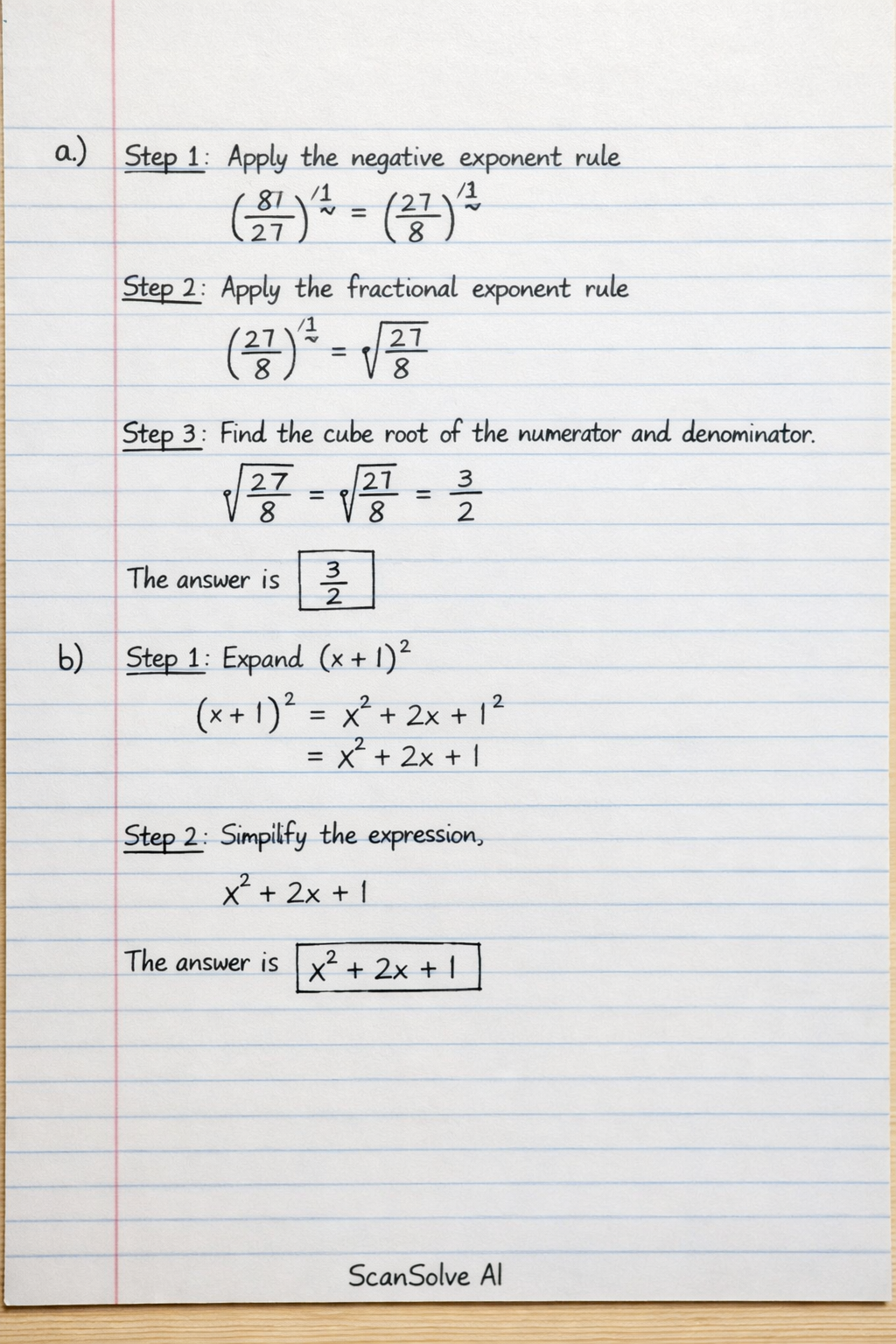
Handwritten Step-by-Step Solution
Get this as a handwritten image on WhatsApp — like a tutor wrote it for you.
Try on WhatsApp