
We read your photo as:
A survey of 300 people revealed that 150 liked I-phone and 200 liked Android. If 25 liked neither, how many liked both? Present in a Venn diagram.
ScanSolve AI Answer
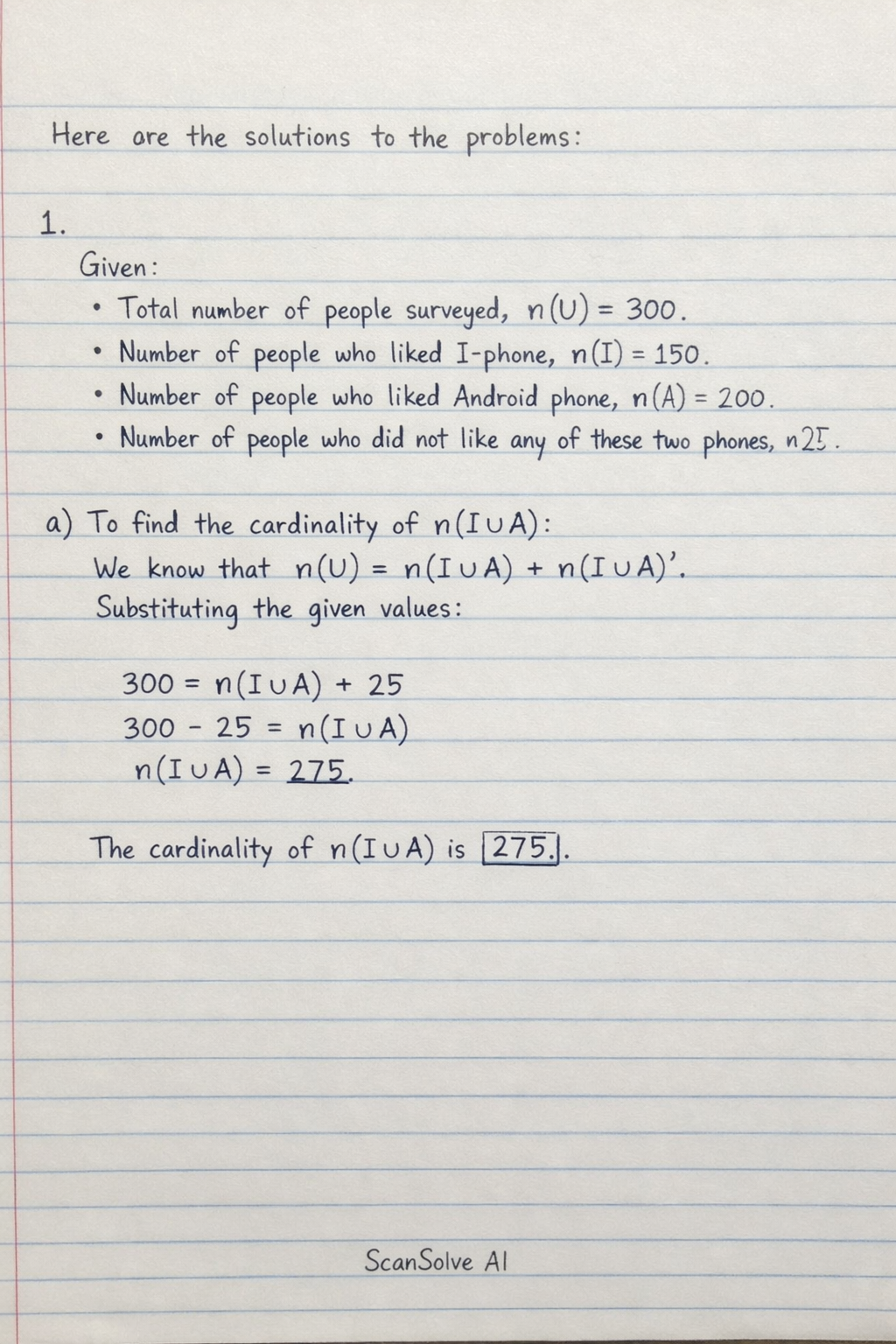
Here are the solutions to the problems:
1.
Given:
Total number of people surveyed, .
Number of people who liked I-phone, .
Number of people who liked Android phone, .
Number of people who did not like any of these two phones, .
a) To find the cardinality of :
We know that .
Substituting the given values:
The cardinality of is .
b) To present the information in a Venn diagram, we first need to find the number of people who liked both phones, .
We use the formula: .
Substituting the known values:
Now, we find the number of people who liked only I-phone and only Android phone:
Number of people who liked I-phone only, .
Number of people who liked Android phone only, .
Venn Diagram:
[A Venn diagram would be drawn here with two overlapping circles labeled 'I' and 'A'.
The intersection (I A) would contain '75'.
The part of circle 'I' not overlapping with 'A' would contain '75'.
The part of circle 'A' not overlapping with 'I' would contain '125'.
Outside both circles, within the universal set rectangle, would be '25'.]
c) Find the number of people who liked I-phone only.
From the calculations in part (b):
Number of people who liked I-phone only, .
The number of people who liked I-phone only is .
d) Compare the number of people who like both I-phone and Android phone and who do not like any of these two phones.
Number of people who like both I-phone and Android phone, .
Number of people who do not like any of these two phones, .
Comparing these two numbers, 75 is greater than 25.
The number of people who like both phones is 75, and the number of people who do not like any of these two phones is 25.
2.
Given:
Principal amount, .
Time, .
Annual interest rate, .
Interest is compounded half-yearly (semi-annual).
a) How many times is the interest calculated according to the semi-annual compound interest in 2 years?
For semi-annual compounding, interest is calculated 2 times per year.
Over 2 years, the total number of times interest is calculated will be:
Number of times = .
The interest is calculated 4 times in 2 years.
Still stuck on this one?
Ask a follow-up, and the answer starts from this question.
More Mathematics Questions
Handwritten Step-by-Step Solution
Get this as a handwritten image on WhatsApp — like a tutor wrote it for you.
Try on WhatsApp