
We read your photo as:
In a survey of a group, 60 like tea, 45 like coffee, 30 like milk, 25 like coffee and tea, 20 like milk and tea, 15 like coffee and milk and 10 like all three drinks. Show the information in a Venn-di
ScanSolve AI Answer
Answer
Step-by-step solution
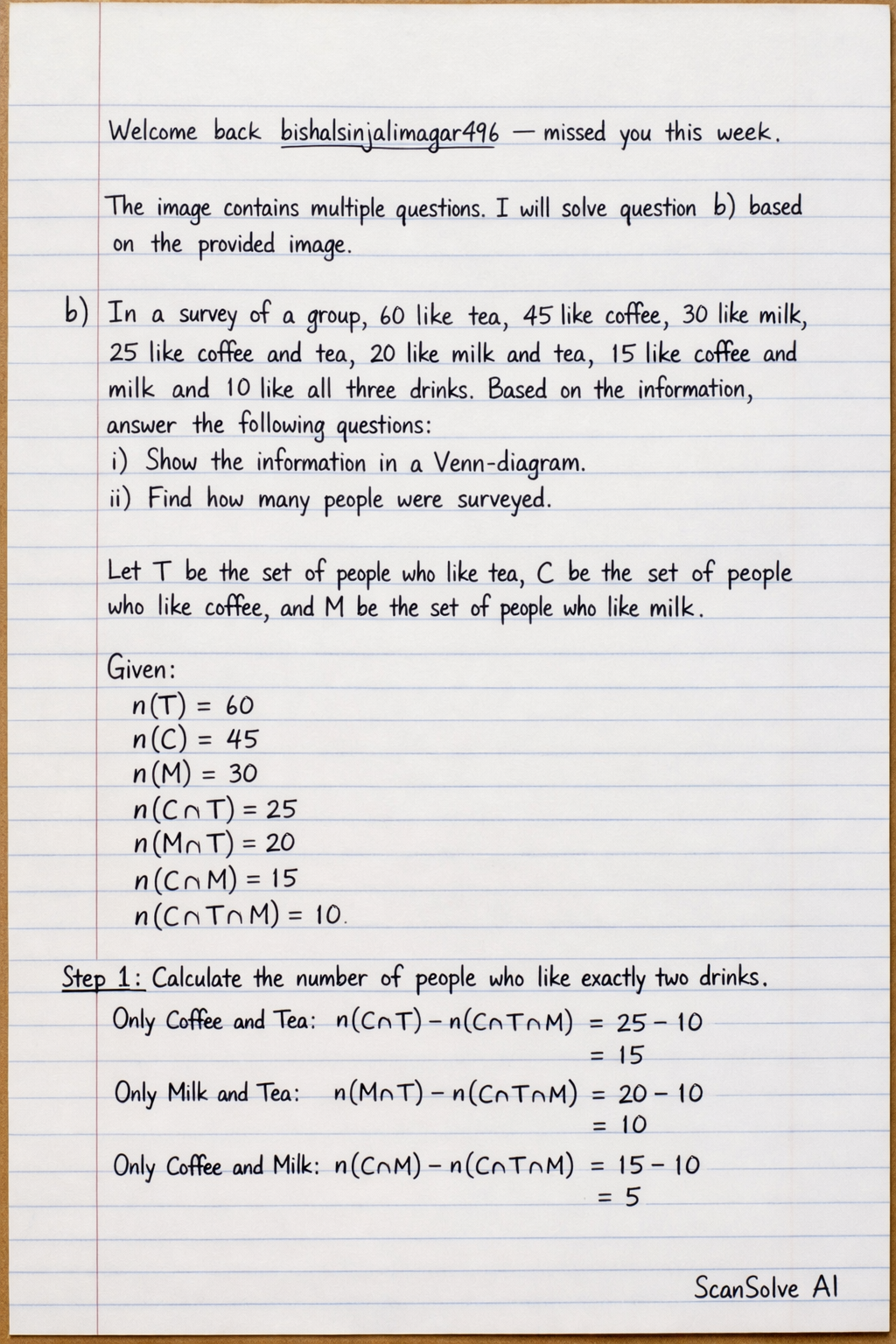
4 stepsThe image contains multiple questions. I will solve question b) based on the provided image.
b) In a survey of a group, 60 like tea, 45 like coffee, 30 like milk, 25 like coffee and tea, 20 like milk and tea, 15 like coffee and milk and 10 like all three drinks. Based on the information, answer the following questions:
Part i
Show the information in a Venn-diagram.
Part ii
Find how many people were surveyed.
Let be the set of people who like tea, be the set of people who like coffee, and be the set of people who like milk.
Given:
Calculate the number of people who like exactly two drinks.
- Only Coffee and Tea:
- Only Milk and Tea:
- Only Coffee and Milk:
Calculate the number of people who like only one drink.
- Only Tea:
- Only Coffee:
- Only Milk:
i) Show the information in a Venn-diagram.
The Venn diagram would show three overlapping circles for Tea (T), Coffee (C), and Milk (M).
- The intersection of all three () is 10.
- The intersection of only and is 15.
- The intersection of only and is 10.
- The intersection of only and is 5.
- The region for only is 25.
- The region for only is 15.
- The region for only is 5.
ii) Find how many people were surveyed.
The total number of people surveyed is the union of all three sets, .
Using the Principle of Inclusion-Exclusion:
Alternatively, sum all the distinct regions from Step 1 and Step 2:
The number of people surveyed is .
Try one yourself
A new problem that tests the same skill.
Still stuck on this one?
Ask a follow-up, and the answer starts from this question.
More Mathematics Questions
Handwritten Step-by-Step Solution
Get this as a handwritten image on WhatsApp — like a tutor wrote it for you.
Try on WhatsApp