
We read your photo as:
A) The height of the pyramid from which the frustum was cut from. b) The surface area of the frustum
ScanSolve AI Answer
Answers
2 partsStep-by-step solution
9 stepsPart a· 3 steps
The height of the pyramid from which the frustum was cut from.
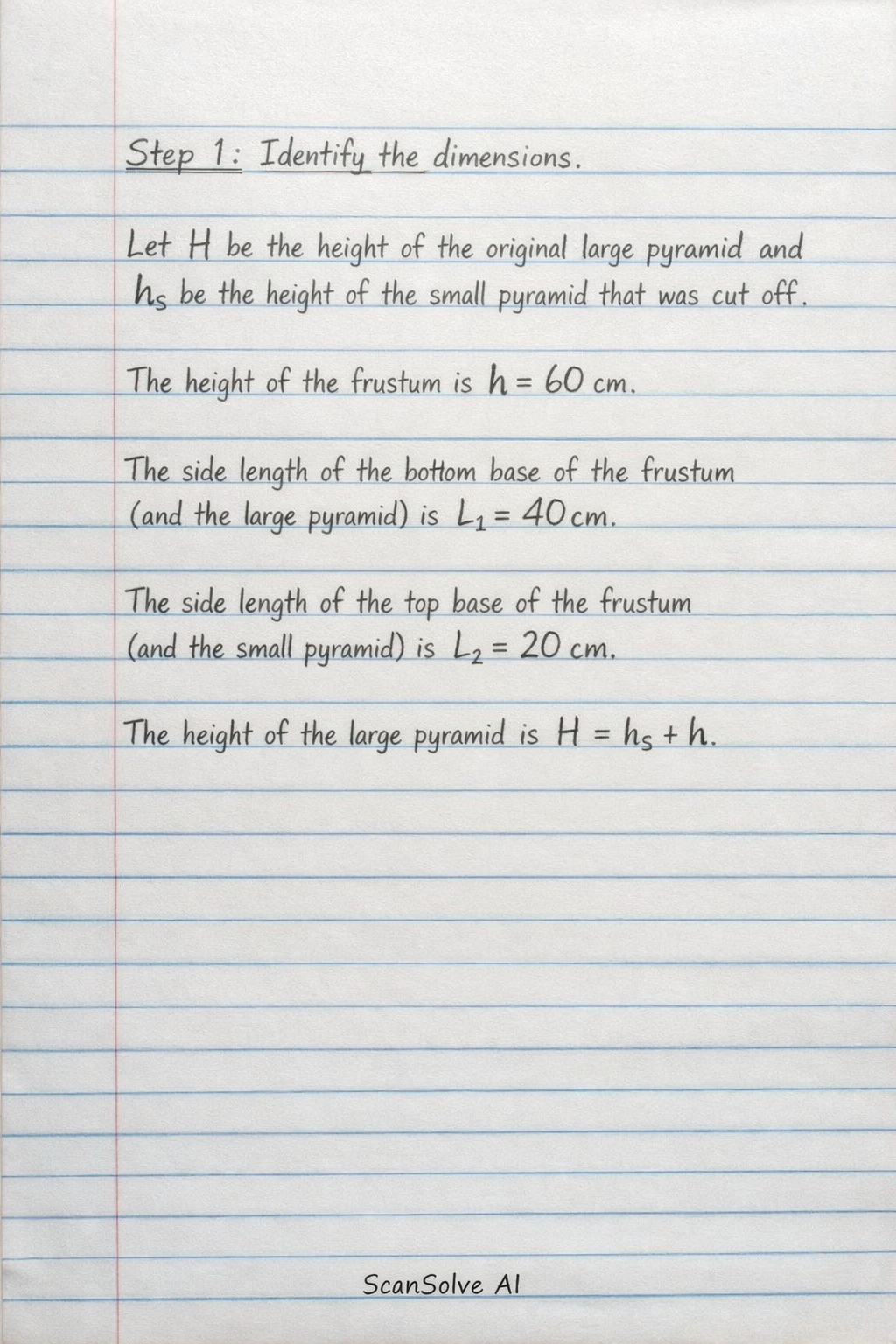
Identify the dimensions.
Let be the height of the original large pyramid and be the height of the small pyramid that was cut off.
The height of the frustum is cm.
The side length of the bottom base of the frustum (and the large pyramid) is cm.
The side length of the top base of the frustum (and the small pyramid) is cm.
The height of the large pyramid is .Use similar triangles to find the height .
Consider a cross-section of the pyramid. By similar triangles, the ratio of the heights to the base side lengths (or half-side lengths) is constant:
Substitute :
Substitute the given values cm, cm, and cm:
Solve for .
Multiply both sides by 40:
The height of the pyramid from which the frustum was cut is .
Part b
The surface area of the frustum
Determine the components of the surface area.
The frustum is an open container, meaning it has no top base. Its surface area consists of the area of the bottom base and the area of the four trapezoidal lateral faces.
Area of bottom base ():Calculate the slant height of the frustum ().
Consider a right triangle formed by the height of the frustum (), the difference in half-base lengths, and the slant height of the frustum ().
The horizontal leg of this triangle is cm.
Using the Pythagorean theorem:Calculate the area of one trapezoidal lateral face.
The area of a trapezoid is given by , where and are the parallel sides and is the height (which is the slant height in this case).
Calculate the total lateral surface area ().
There are 4 identical lateral faces:
Calculate the total surface area of the frustum.
The surface area of the frustum is .
Part c· 1 step
The capacity of the frustum in litres
Calculate the area of the top and bottom
Try one yourself
A new problem that tests the same skill.
Still stuck on this one?
Ask a follow-up, and the answer starts from this question.
More Mathematics Questions
Handwritten Step-by-Step Solution
Get this as a handwritten image on WhatsApp — like a tutor wrote it for you.
Try on WhatsApp