
We read your photo as:
A village has 650 youths. 250 of them are girls. 425 youths like music and 90 girls do not like music. How many boys do not like music?
ScanSolve AI Answer
Answer
Step-by-step solution
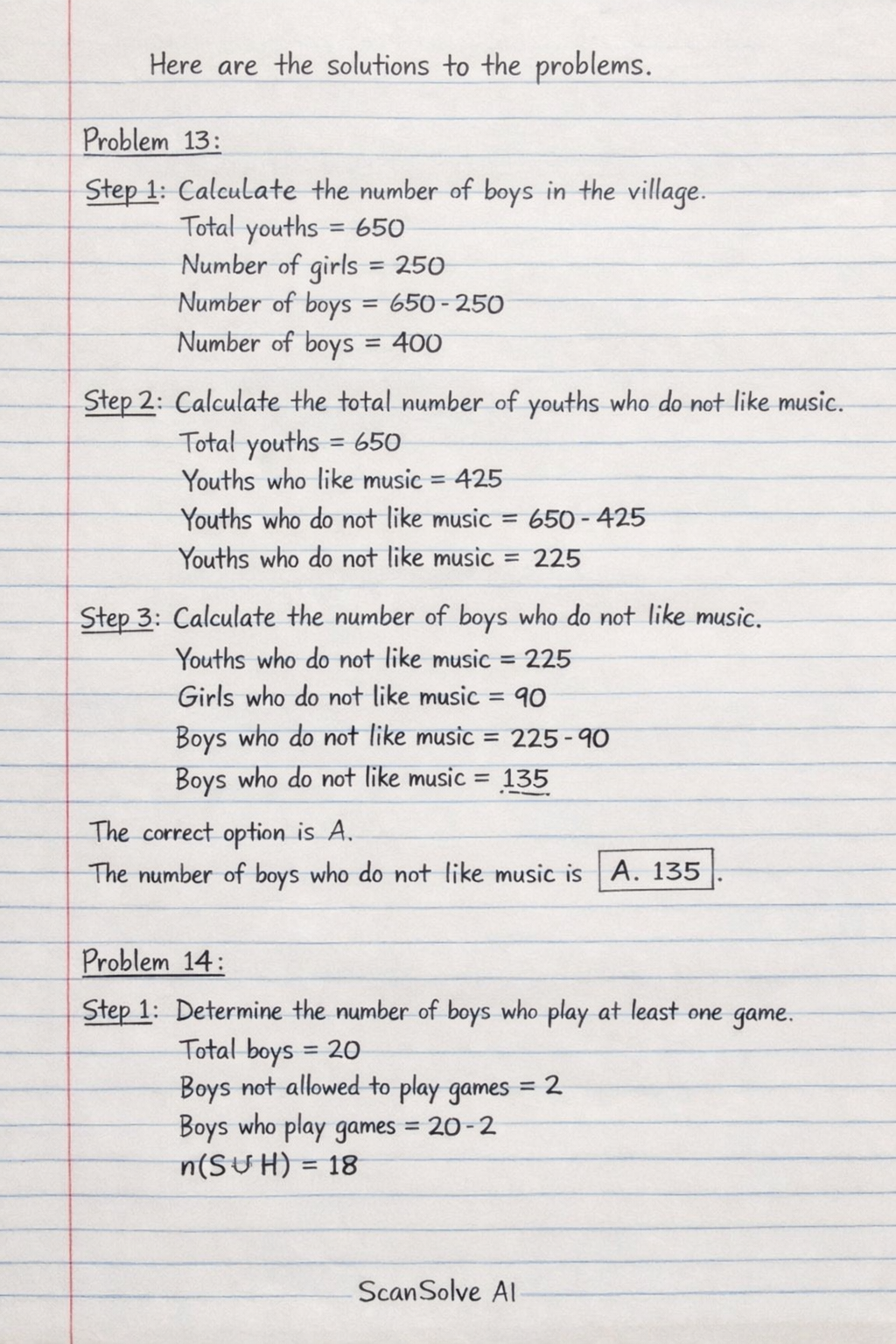
7 stepsHere are the solutions to the problems.
:
Calculate the number of boys in the village.
Total youths = 650
Number of girls = 250
Number of boys = Total youths - Number of girlsCalculate the total number of youths who do not like music.
Total youths = 650
Youths who like music = 425
Youths who do not like music = Total youths - Youths who like musicCalculate the number of boys who do not like music.
Youths who do not like music = 225
Girls who do not like music = 90
Boys who do not like music = Youths who do not like music - Girls who do not like musicThe correct option is A.
The number of boys who do not like music is .:
Determine the number of boys who play at least one game.
Total boys = 20
Boys not allowed to play games = 2
Boys who play games = Total boys - Boys not allowed to play gamesUse the Principle of Inclusion-Exclusion.
Let be the set of boys who play soccer and be the set of boys who play hockey.
We are given:
The formula is .
We need to find .The correct option is C.
The number of students who play soccer and hockey is .:
The set difference represents all elements that are in set but not in set .
This is equivalent to the intersection of set and the complement of set , denoted as .
Therefore, .
The correct option is C.
is same as .:
We are given:
We need to find .Use the formula for to find .
Use the formula for to find .
The correct option is D.
is .:
Let be the set of people who buy and be the set of people who sell.
We are given:
Percentage of people who buy,
Percentage of people who sell,
All people buy or sell or do both, which means .
We need to find the percentage of people who do both, .Use the Principle of Inclusion-Exclusion for percentages:
The correct option is A.
The percentage of people who do both is .
Try one yourself
A new problem that tests the same skill.
Still stuck on this one?
Ask a follow-up, and the answer starts from this question.
More Mathematics Questions
Handwritten Step-by-Step Solution
Get this as a handwritten image on WhatsApp — like a tutor wrote it for you.
Try on WhatsApp