
We read your photo as:
A village has a population of 20,000. If the population grows at a rate of R% per annum, the population after T years is given by the formula P_T = P(1 + R/100)^T. a) Find the population after 2 years
ScanSolve AI Answer
Answers
3 partsStep-by-step solution
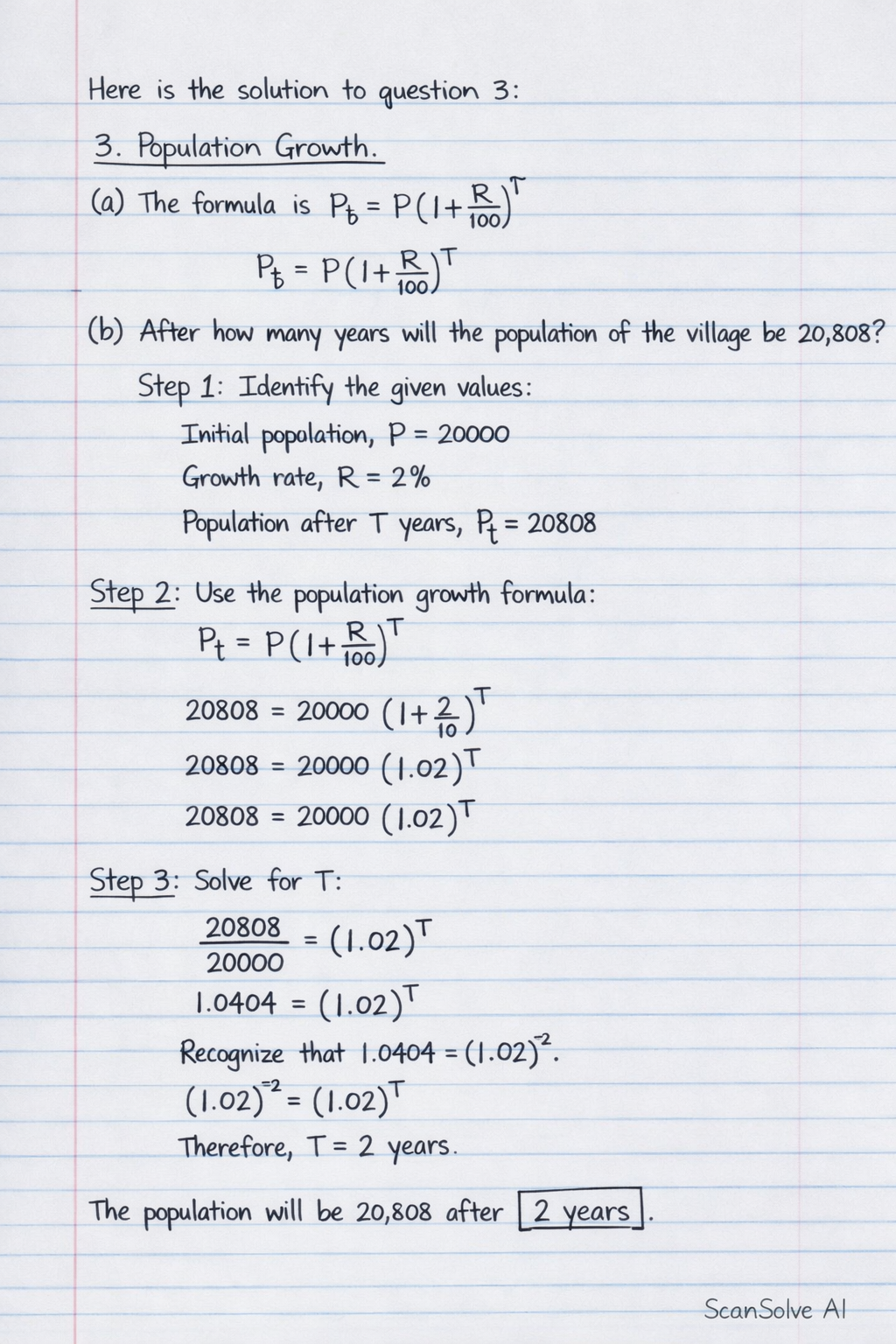
6 stepsHere is the solution to question 3:
3. Population Growth
Part a
If the initial population is , growth rate is per annum, and population after years is , the formula to find is
The formula is .
Part b
After how many years will the population of the village be 20,808?
Identify the given values.
Initial population,
Annual growth rate, (from the problem description)
Population after years,Use the population growth formula.
Substitute the given values:
Solve for .
Recognize that .
Therefore, years.
The population will be 20,808 after .
Part c1218
If the population increases at the rate of 3% per annum, by what number will the population of the village be increased in 2 years?
Identify the given values for this part.
Initial population,
New annual growth rate,
Time, yearsCalculate the population after 2 years ().
Substitute the values:
Calculate the increase in population.
Increase = Final population - Initial population
Increase =
Increase =
Increase = 1218The population will be increased by .
Try one yourself
A new problem that tests the same skill.
Still stuck on this one?
Ask a follow-up, and the answer starts from this question.
More Mathematics Questions
Handwritten Step-by-Step Solution
Get this as a handwritten image on WhatsApp — like a tutor wrote it for you.
Try on WhatsApp