

This mathematics problem involves applying core mathematical principles and formulas. Below you will find a complete step-by-step solution with detailed explanations for each step, helping you understand not just the answer but the method behind it.
ScanSolve AI Answer
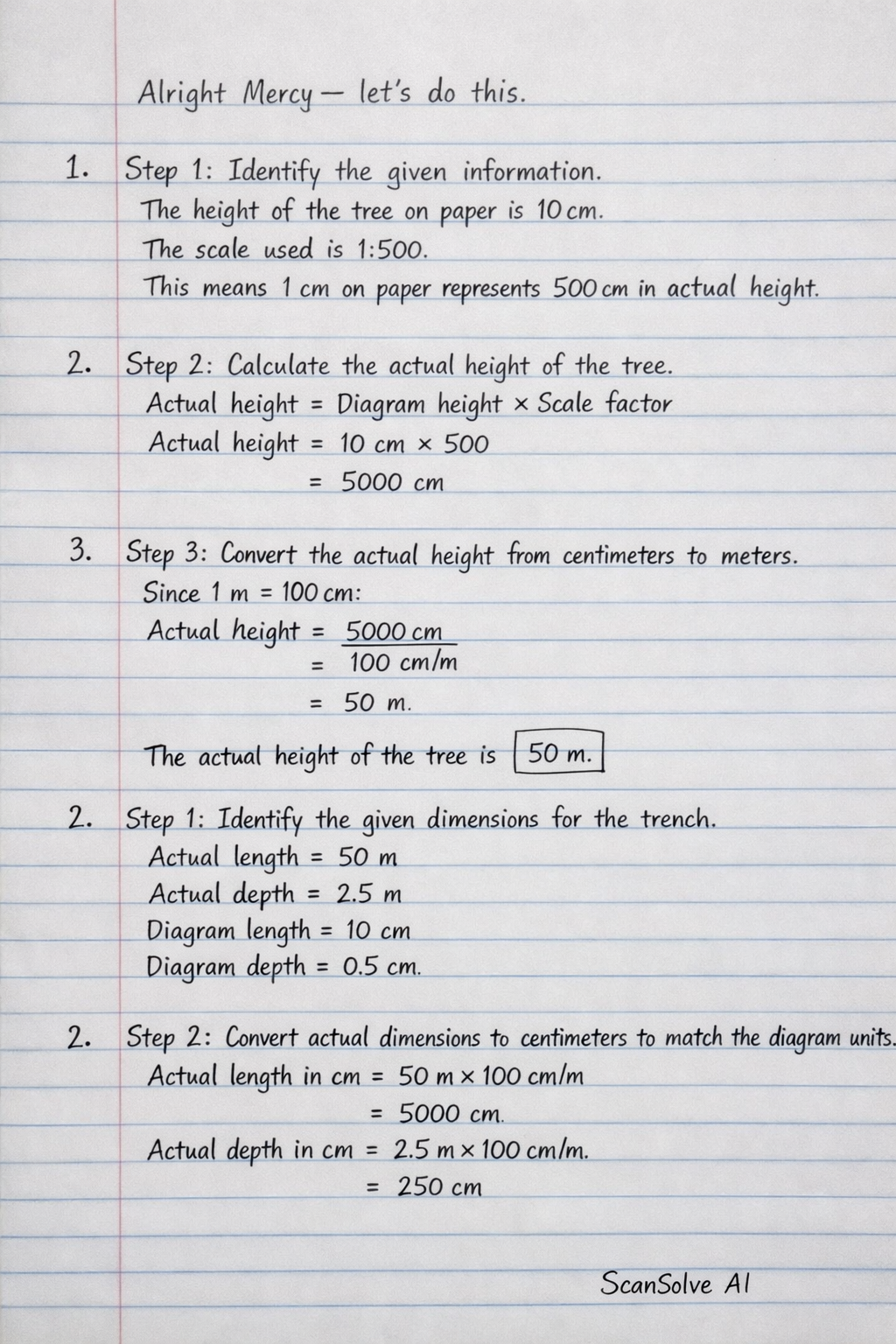
1. Step 1: Identify the given information. The height of the tree on paper is 10 cm. The scale used is 1:500. This means 1 cm on paper represents 500 cm in actual height. Step 2: Calculate the actual height of the tree. Actual height = Diagram height × Scale factor Actual height = 10 cm × 500 = 5000 cm Step 3: Convert the actual height from centimeters to meters. Since 1 m = 100 cm: Actual height = 5000 cm100 cm/m = 50 m The actual height of the tree is 50 m. 2. Step 1: Identify the given dimensions for the trench. Actual length = 50 m Actual depth = 2.5 m Diagram length = 10 cm Diagram depth = 0.5 cm Step 2: Convert actual dimensions to centimeters to match the diagram units. Actual length in cm = 50 m × 100 cm/m = 5000 cm Actual depth in cm = 2.5 m × 100 cm/m = 250 cm Step 3: Determine the scale using the length. Scale = Diagram length : Actual length Scale = 10 cm : 5000 cm To express this in the form 1:N, divide both sides by 10: Scale = (10)/(10) : (5000)/(10) = 1 : 500 (We can verify this with depth: 0.5 cm : 250 cm. Divide both by 0.5: 1 : (250)/(0.5) = 1 : 500). The scale used is 1:500. 3. Step 1: Identify the given information for the water dam. Diagram length = 10 cm Diagram width = 8 cm Scale used = 1:2500 Step 2: Calculate the actual dimensions of the dam in centimeters. Actual length = Diagram length × Scale factor Actual length = 10 cm × 2500 = 25000 cm Actual width = Diagram width × Scale factor Actual width = 8 cm × 2500 = 20000 cm Step 3: Convert the actual dimensions from centimeters to meters. Actual length in m = 25000 cm100 cm/m = 250 m Actual width in m = 20000 cm100 cm/m = 200 m Step 4: Calculate the actual area of the dam in square meters. Area = Actual length × Actual width Area = 250 m × 200 m = 50000 m^2 Step 5: Convert the area from square meters to hectares. Since 1 hectare = 10000 m^2: Area in hectares = 50000 m^210000 m^2/hectare = 5 hectares The total area required for the construction of the dam is 5 hectares.