
We read your photo as:
Draw a scale drawing of the land using the measurements given survey.
ScanSolve AI Answer
Step-by-step solution
5 stepsThis question asks to draw a scale drawing of the land. As an AI, I cannot physically draw, but I can provide you with the step-by-step instructions to create the scale drawing yourself using the given measurements.
A scale drawing represents a real object or area with accurate proportions, but at a reduced or enlarged size. You will need a ruler, a protractor (or set square for perpendicular lines), and a pencil.
Choose a suitable scale*.
First, determine the total length of the baseline AB.
The segments along the baseline are units.
For example, if you choose a scale of , then the baseline AB on your drawing would be long. All other measurements would also be divided by 5.Draw the baseline AB*.
Draw a straight horizontal line segment on your paper. Label the left end A and the right end B. The length of this line should correspond to the total length of the baseline (56 units) according to your chosen scale.
Mark the offset points along the baseline*.
Measure and mark the following points along the baseline AB from point A:
- At 16 units from A (e.g., if using the 1:5 scale). Let's call this point .
- At units from A (e.g., if using the 1:5 scale). Let's call this point .
- At units from A (e.g., if using the 1:5 scale). Let's call this point .
Draw the offsets perpendicular to the baseline*.
From each marked point on the baseline, draw a line segment perpendicular to the baseline, representing the offset. Ensure you draw them on the correct side (left or right) as indicated in the diagram.
- From (16 units from A), draw a perpendicular line segment 8 units long to the left to locate point Q. (e.g., ).
- From (44 units from A), draw a perpendicular line segment 16 units long to the left to locate point P. (e.g., ).
- From (16 units from A), draw a perpendicular line segment 18 units long to the right to locate point R. (e.g., ).
- From (26 units from A), draw a perpendicular line segment 32 units long to the right to locate point S. (e.g., ).
Connect the points to form the outline of the land*.
Connect the points in the following order to complete the boundary of the land: A to Q, Q to P, P to B, B to S, S to R, and finally R back to A.
The resulting drawing will be a scale representation of the land.
Still stuck on this one?
Ask a follow-up, and the answer starts from this question.
More Mathematics Questions
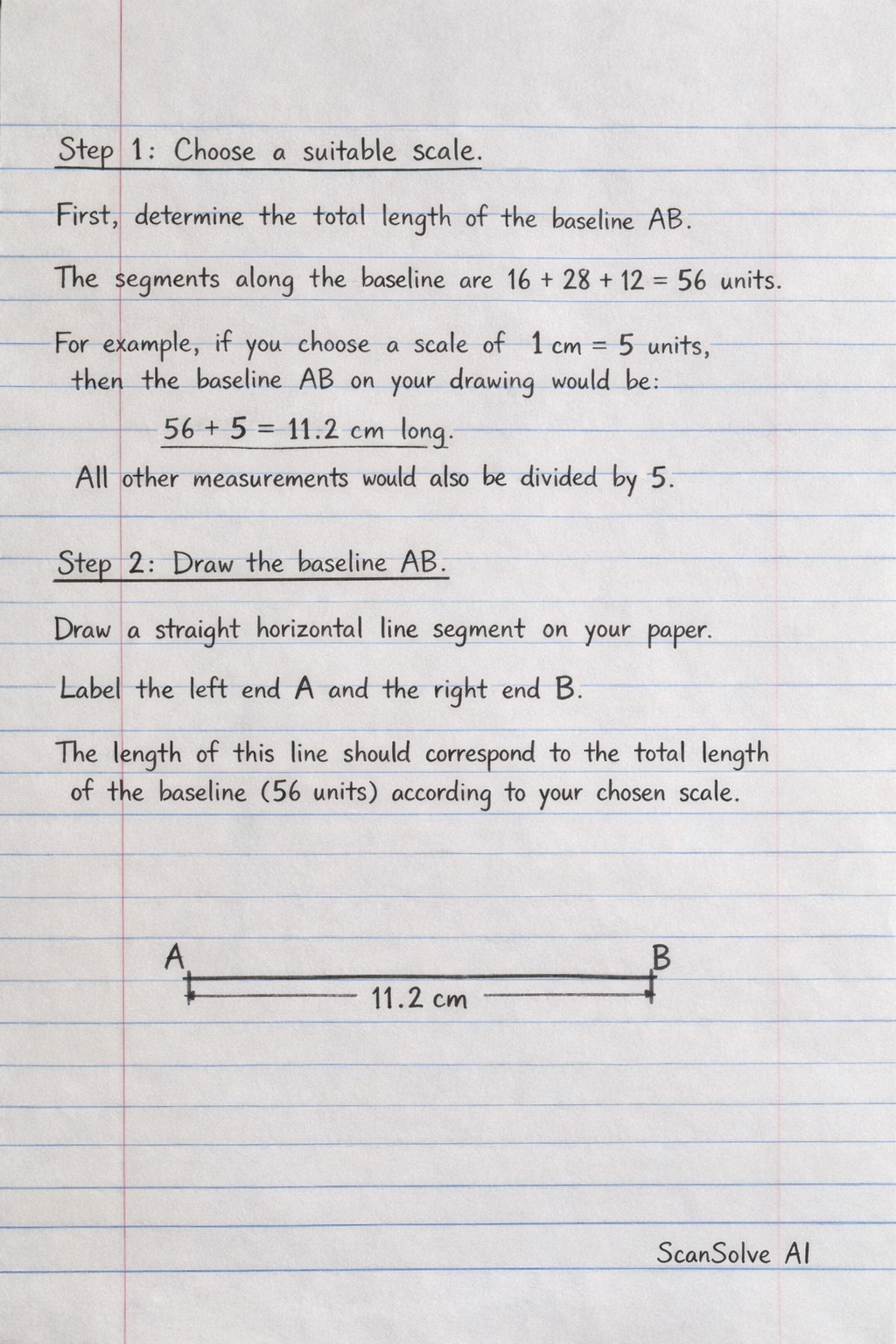
Handwritten Step-by-Step Solution
Get this as a handwritten image on WhatsApp — like a tutor wrote it for you.
Try on WhatsApp