
We read your photo as:
A. What is the actual price each motor bike in Papua New Guinea Kina? b. Find the total revenue received by the firm in Papua New Guinea Kina. c. The rate of exchange changes to K1 = A$0.25. Does this
ScanSolve AI Answer
Answers
7 partsStep-by-step solution
14 stepsPart 1
Part a
What is the actual price each motor bike in Papua New Guinea Kina?
Identify the price in Australian Dollars and the initial exchange rate.
Price in AUD = A$2,000 Initial exchange rate = K1 = A$1
Convert the price from AUD to Kina.
Since K1 = A
1, the price in Kina is numerically the same as in AUD.
$$ \text{Price in Kina} = \text{Price in AUD} \times \frac{\text{Kina}}{\text{AUD}} = \text{A\
2,000} \times \frac{\text{K1}}{\text{A$1}} = \text{K2,000} $$ The actual price each motorbike in Papua New Guinea Kina is .
Part b
Find the total revenue received by the firm in Papua New Guinea Kina.
Identify the price per motorbike and the number of sales.
Price per motorbike = K2,000 (from part a)
Sales = 150 motorbikesCalculate the total revenue.
The total revenue received by the firm is .
Part c
The rate of exchange changes to K1 = A$0.25. Does this represent a depreciation or appreciation?
Compare the initial and new exchange rates.
Initial rate: K1 = A$1 New rate: K1 = A$0.25
Determine the change in value of the Kina.
The Kina now buys fewer Australian Dollars (A1). This means the Kina has become weaker.
This represents a of the Papua New Guinea Kina.
Part d
What would be the new price of each motorbike in Papua New Guinea Kina?
Identify the price in Australian Dollars and the new exchange rate.
Price in AUD = A$2,000 New exchange rate = K1 = A$0.25
Convert the price from AUD to Kina using the new exchange rate.
To find out how many Kina are in A
1, we can rearrange the exchange rate:
$$ \text{A\
1} = \frac{\text{K1}}{0.25} = \text{K4} \text{New Price in Kina} = \text{Price in AUD} \times \frac{\text{Kina}}{\text{AUD}} = \text{A$2,000} \times \frac{\text{K4}}{\text{A$1}} = \text{K8,000} $$ The new price of each motorbike in Papua New Guinea Kina would be .
Part e
What will happen to the demand for motorbike in Papua New Guinea?
Observe the change in price.
The price of the motorbike increased from K2,000 to K8,000.
Consider the law of demand.
According to the law of demand, an increase in price generally leads to a decrease in quantity demanded.
The demand for motorbikes in Papua New Guinea will .
Part f
If the demand for motor bike has not changed despite the change in price, what would be the new revenue for the firm?
Identify the new price and the assumed unchanged demand.
New price per motorbike = K8,000 (from part d)
Assumed sales (unchanged demand) = 150 motorbikesCalculate the new revenue.
The new revenue for the firm, assuming demand has not changed, would be .
Part g
What is the state of elasticity of demand for the motor bike?
Identify the given price elasticity of demand.
Price elasticity of demand = 0.5
Determine the state of elasticity.
Since the price elasticity of demand (0.5) is less than 1, the demand is inelastic.
The state of elasticity of demand for the motorbike is .
Try one yourself
A new problem that tests the same skill.
Still stuck on this one?
Ask a follow-up, and the answer starts from this question.
More Mathematics Questions
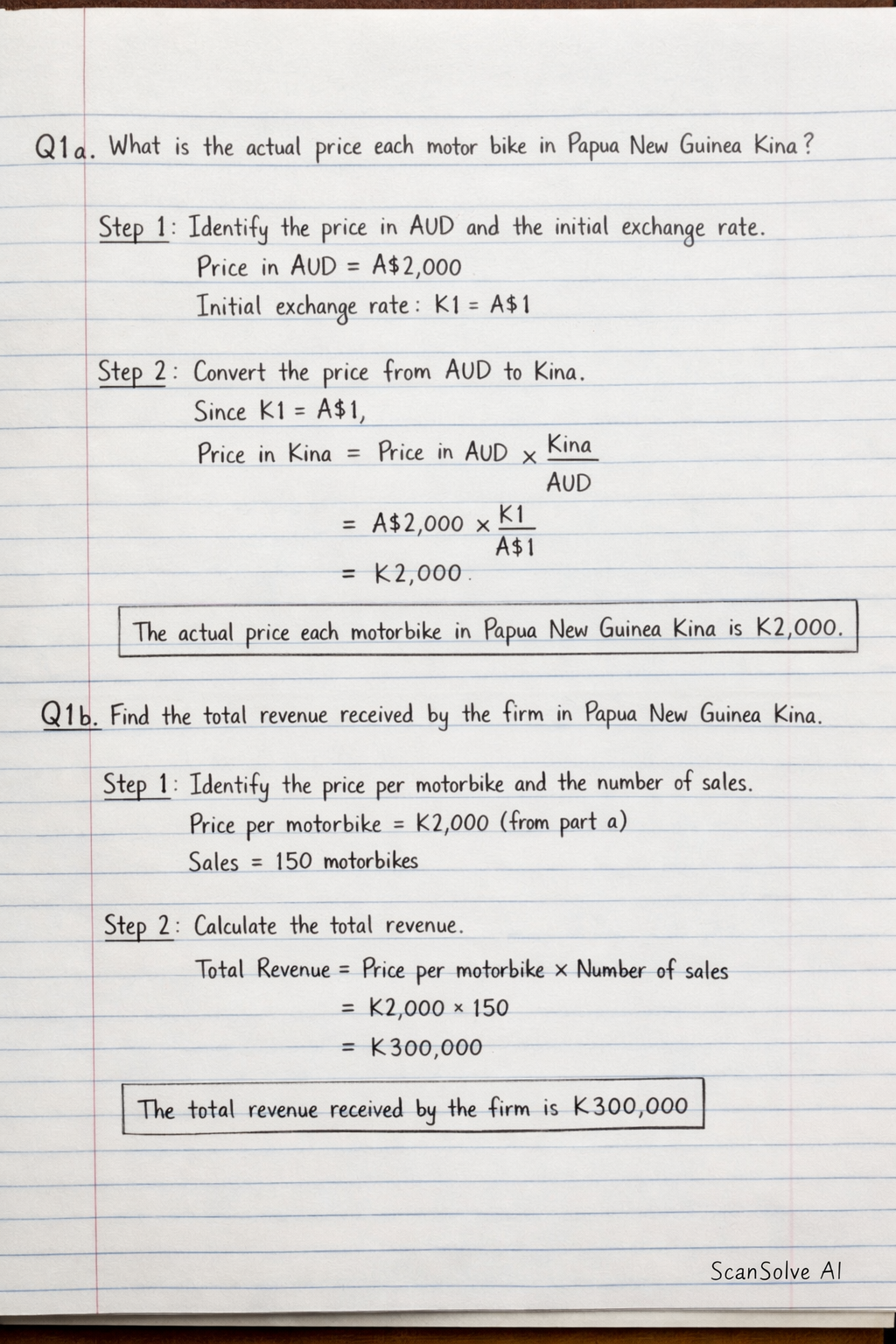
Handwritten Step-by-Step Solution
Get this as a handwritten image on WhatsApp — like a tutor wrote it for you.
Try on WhatsApp