
We read your photo as:
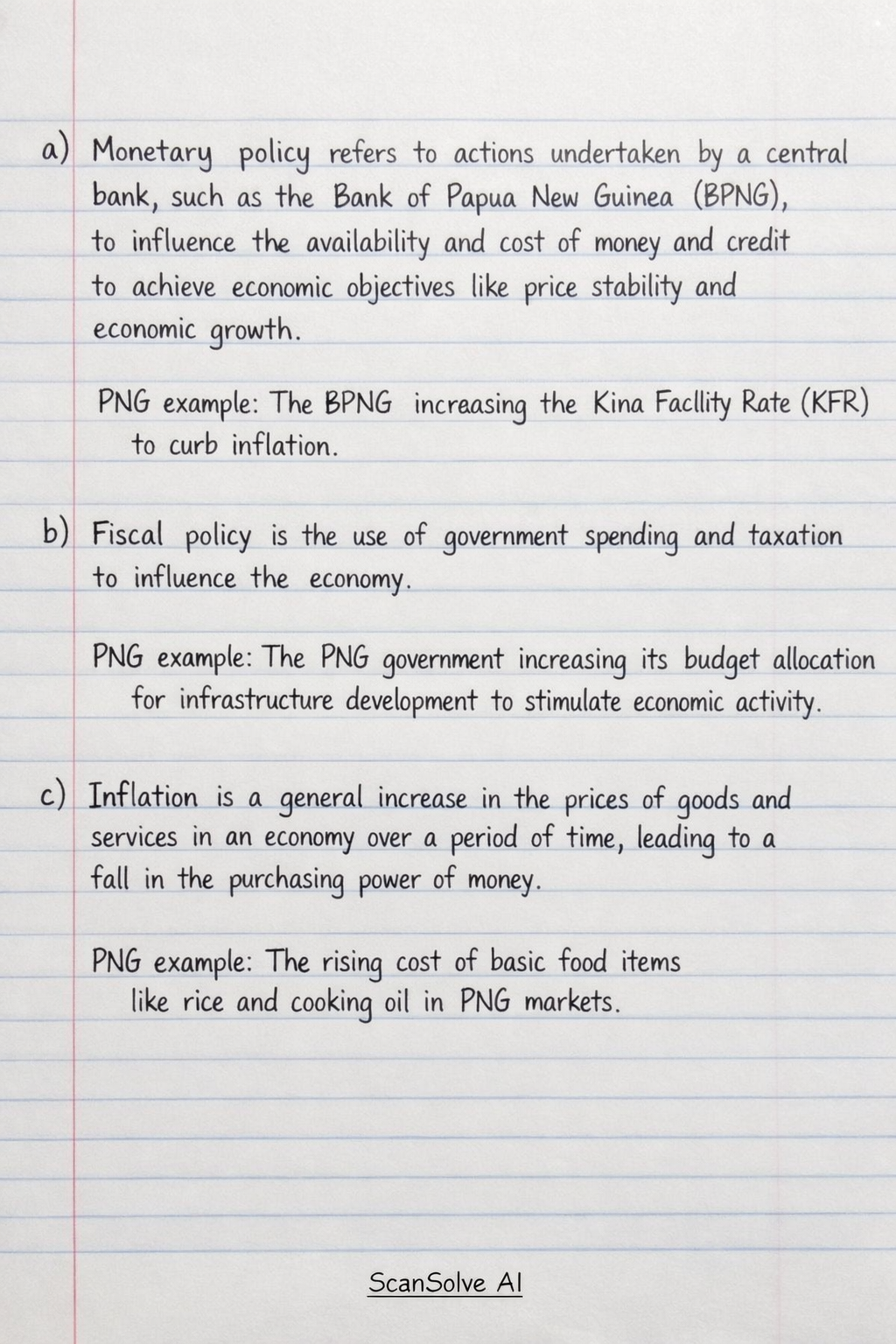
A) Monetary policy refers to actions undertaken by a central bank, such as the Bank of Papua New Guinea (BPNG), to influence the availability and cost of money and credit to achieve economic obj
ScanSolve AI Answer
Q32.
a) Monetary policy refers to actions undertaken by a central bank, such as the Bank of Papua New Guinea (BPNG), to influence the availability and cost of money and credit to achieve economic objectives like price stability and economic growth.
PNG example: The BPNG increasing the Kina Facility Rate (KFR) to curb inflation.
b) Fiscal policy is the use of government spending and taxation to influence the economy.
PNG example: The PNG government increasing its budget allocation for infrastructure development to stimulate economic activity.
c) Inflation is a general increase in the prices of goods and services in an economy over a period of time, leading to a fall in the purchasing power of money.
PNG example: The rising cost of basic food items like rice and cooking oil in PNG markets.
d) Credit creation is the process by which commercial banks expand the money supply by making loans, which in turn creates new deposits in the banking system.
PNG example: A commercial bank like BSP Financial Group lending K100,000 to a small business, which then deposits the funds into its account, increasing the money supply.
Q33.
The six instruments of monetary policy used by the Bank of Papua New Guinea (BPNG) are:
- Kina Facility Rate (KFR): This is the policy interest rate at which commercial banks can borrow from or lend to the BPNG. Increasing the KFR makes borrowing more expensive for banks, which contracts the economy by reducing lending and investment.
- Open Market Operations (OMOs): These involve the BPNG buying or selling government securities (e.g., Treasury Bills) in the open market. Selling government securities removes money from the banking system, thereby contracting the economy.
- Cash Reserve Requirement (CRR): This is the percentage of deposits that commercial banks are required to hold in reserve with the BPNG. Increasing the CRR reduces the amount of money banks have available to lend, thus contracting the economy.
- Discount Window/Lending Facility: This allows commercial banks to borrow funds from the BPNG, usually at a penalty rate, to meet short-term liquidity needs. Increasing the interest rate on this facility makes borrowing more costly for banks, which contracts the economy.
- Selective Credit Controls: These are regulations that direct credit to specific sectors or restrict it from others. Imposing stricter controls on lending to certain sectors can contract economic activity in those areas.
- Moral Suasion: This involves the BPNG using persuasion and informal influence to encourage commercial banks to follow its policy objectives. For example, encouraging banks to tighten lending standards would contract the economy.
Q34.
Restrictive (Contractionary) Monetary Policy:
a) Its purpose is to slow down economic growth, reduce inflation, and cool an overheating economy by decreasing the money supply and credit availability.
b) It would be used in PNG when inflation is high or the economy is experiencing unsustainable growth that could lead to asset bubbles.
c) Two specific policy actions are to increase the Kina Facility Rate (KFR) and to sell government securities in open market operations.
Expansionary Monetary Policy:
a) Its purpose is to stimulate economic growth, increase employment, and combat deflation by increasing the money supply and credit availability.
b) It would be used in PNG during an economic recession or a period of low growth and high unemployment.
c) Two specific policy actions are to decrease the Kina Facility Rate (KFR) and to buy government securities in open market operations.
Q35.
The five types of unemployment are:
- Frictional Unemployment: This is short-term unemployment that occurs when people are between jobs, searching for new ones, or entering the workforce for the first time. It is a natural part of a dynamic labor market. PNG example: A recent university graduate in Port Moresby actively searching for their first job after completing their studies.
- Structural Unemployment: This type of unemployment arises from a mismatch between the skills workers possess and the skills demanded by employers, or a geographical mismatch between jobs and workers. It often results from technological changes or shifts in industry structure. PNG example: Miners in a remote area becoming unemployed after a mine closes due to depleted resources, and they lack the skills for new jobs in urban centers.
- Cyclical Unemployment: This unemployment is caused by downturns in the business cycle, such as recessions. When aggregate demand falls, businesses reduce production and lay off workers. PNG example: Workers in the tourism sector losing their jobs during a global economic slowdown that reduces international travel to PNG.
- Seasonal Unemployment: This occurs due to seasonal variations in demand for labor in certain industries. PNG example: Workers employed in coffee harvesting who are unemployed during the off-season once the harvest is complete.
- Voluntary Unemployment: This occurs when individuals choose not to work at the prevailing wage rate, or are not actively seeking employment, even though jobs are available. This can be due to personal preferences or other non-economic factors. PNG example: An individual in a rural village who chooses to focus on subsistence farming rather than seeking formal employment in the urban sector, despite job opportunities existing.
Still stuck on this one?
Ask a follow-up, and the answer starts from this question.
More Accounting Questions
Handwritten Step-by-Step Solution
Get this as a handwritten image on WhatsApp — like a tutor wrote it for you.
Try on WhatsApp