

This mathematics problem involves applying core mathematical principles and formulas. Below you will find a complete step-by-step solution with detailed explanations for each step, helping you understand not just the answer but the method behind it.
ScanSolve AI Answer
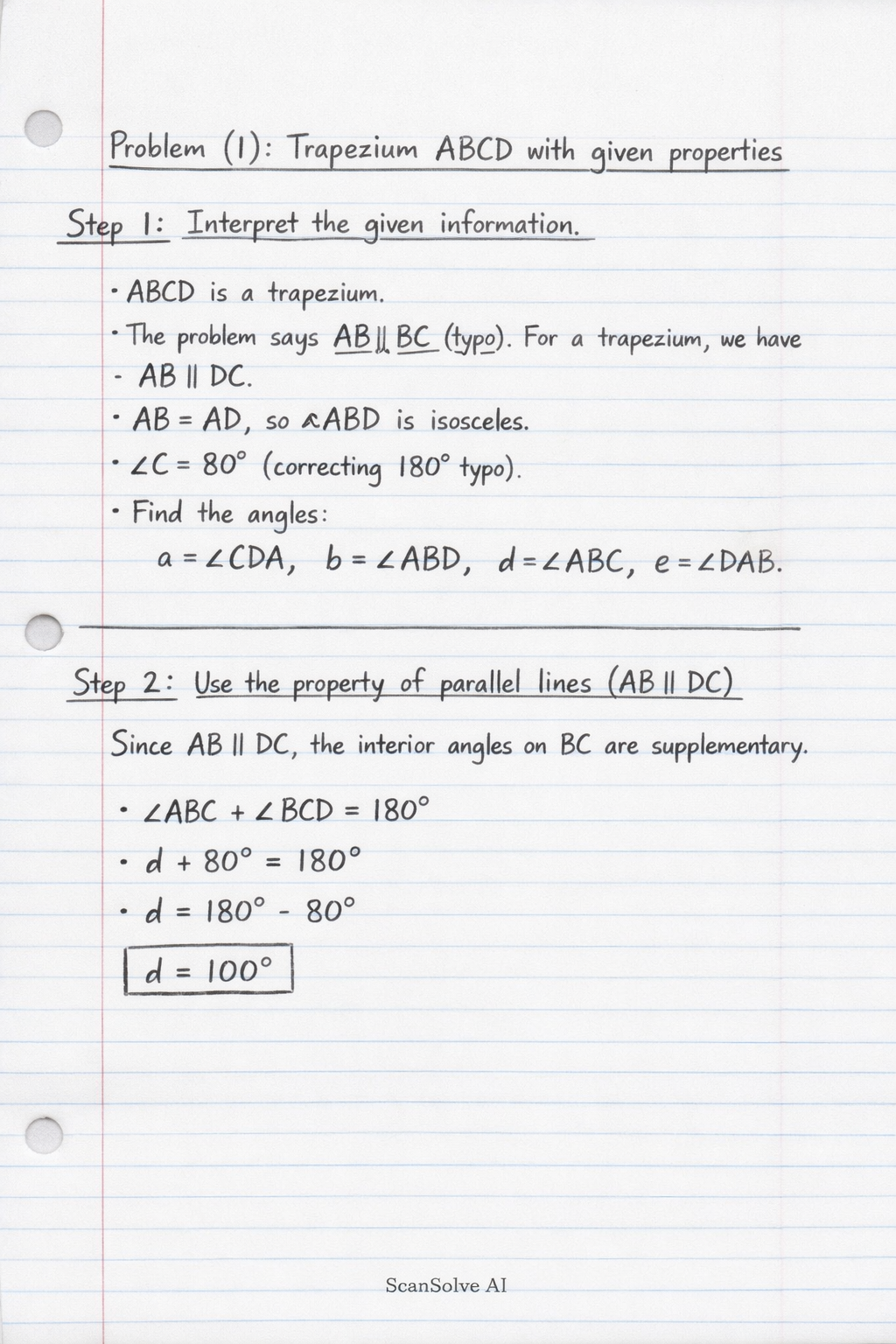
Here's the step-by-step solution for problem (1): Problem (1): Trapezium ABCD with given properties Step 1: Interpret the given information and correct typos. ABCD is a trapezium. The problem states AB BC, which is a typo. For a trapezium, one pair of opposite sides must be parallel. From the diagram, it's clear that AB DC. We will proceed with this assumption. AB = AD. This means ABD is an isosceles triangle. C = 80^. (The text says 180^, which is impossible for an angle in a quadrilateral; we use the diagram's 80^). We need to find the unknown angles: a = CDA, b = ABD, d = ABC, e = DAB. Step 2: Use the property of parallel lines (AB DC). Since AB DC, the consecutive interior angles on the transversal BC are supplementary: ABC + BCD = 180^ d + 80^ = 180^ d = 180^ - 80^ d = 100^ Also, since AB DC, the alternate interior angles formed by the transversal BD are equal: ABD = BDC b = BDC Step 3: Use the property of the isosceles triangle ABD. Given AB = AD, ABD is an isosceles triangle. The base angles opposite the equal sides are equal: ABD = ADB b = ADB Step 4: Determine angle a ( CDA). From Step 2 and Step 3, we have ADB = b and BDC = b. Therefore, CDA is the sum of these two angles: CDA = ADB + BDC a = b + b a = 2b Step 5: Determine angle e ( DAB). In ABD, the sum of angles is 180^: DAB + ABD + ADB = 180^ e + b + b = 180^ e + 2b = 180^ Step 6: Use the property of an isosceles trapezium. In a trapezium where the non-parallel sides are equal, it is an isosceles trapezium. In this case, the condition AB=AD along with AB DC and C = 80^ implies that AD=BC, making it an isosceles trapezium. In an isosceles trapezium, the base angles are equal: CDA = BCD a = 80^ Step 7: Solve for b and e using the value of a. From Step 4, we have a = 2b. Substitute a = 80^: 80^ = 2b b = (80^)/(2) b = 40^ From Step 5, we have e + 2b = 180^. Substitute 2b = 80^: e + 80^ = 180^ e = 180^ - 80^ e = 100^ Summary of unknown angles: a = CDA = 80^ b = ABD = 40^ d = ABC = 100^ e = DAB = 100^