We read your photo as:

Abel wants to build a backyard patio using bricks. The diagram below demonstrates the shape of the patio. The patio will be fenced and paved. Abel will also add a round 12-inch-high pit, built with bricks in one of the corners of the patio. The diameter of the fire pit is 91,44 cm.

Mathematics

ScanSolve AI Answer

Step-by-step solution

16 steps

2.1.1

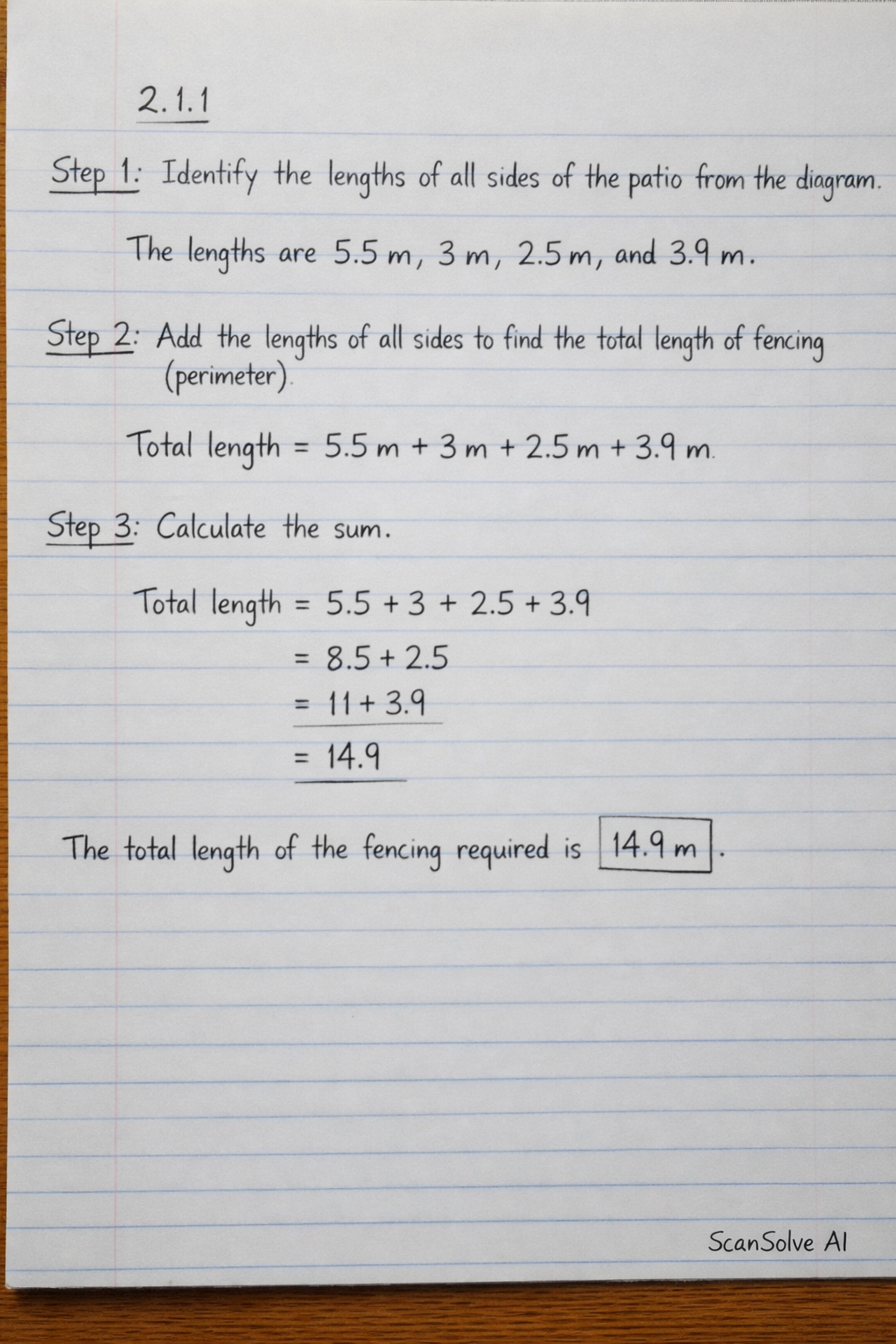
  1. Identify the lengths of all sides of the patio from the diagram.

    The lengths are 5.5 m5.5\, \text{m}, 3 m3\, \text{m}, 2.5 m2.5\, \text{m}, and 3.9 m3.9\, \text{m}.

  2. Add the lengths of all sides to find the total length of fencing (perimeter).

    Total length=5.5 m+3 m+2.5 m+3.9 m\text{Total length} = 5.5\, \text{m} + 3\, \text{m} + 2.5\, \text{m} + 3.9\, \text{m}
  3. Calculate the sum.

    Total length=14.9 m\text{Total length} = 14.9\, \text{m}

    The total length of the fencing required is 14.9 m\boxed{\text{14.9 m}}.

    2.1.2

  4. Calculate the radius (rr) of the fire pit from its diameter.

    Given diameter (DD) = 91.44 cm91.44\, \text{cm}.

    r=D2=91.44 cm2=45.72 cmr = \frac{D}{2} = \frac{91.44\, \text{cm}}{2} = 45.72\, \text{cm}
  5. Substitute the radius and given height (h=30.48 cmh = 30.48\, \text{cm}) into the lateral surface area formula.

    Lateral surface area=2×3.142×r×h\text{Lateral surface area} = 2 \times 3.142 \times r \times h Lateral surface area=2×3.142×45.72 cm×30.48 cm\text{Lateral surface area} = 2 \times 3.142 \times 45.72\, \text{cm} \times 30.48\, \text{cm}
  6. Calculate the lateral surface area.

    Lateral surface area=8760.96672 cm2\text{Lateral surface area} = 8760.96672\, \text{cm}^2

    Rounding to two decimal places:

    Lateral surface area≈8760.97 cm2\text{Lateral surface area} \approx 8760.97\, \text{cm}^2

    The lateral surface area of the fire pit is 8760.97 cm2\boxed{\text{8760.97 cm}^2}.

    2.2.1
    The map scale represents the ratio of a distance on the map to the corresponding actual distance in reality.

    2.2.2

  7. Divide the first part of the ratio (25) by 25 to get 1.

    2525=1\frac{25}{25} = 1
  8. Divide the second part of the ratio (10 000 000) by 25.

    10 000 00025=400 000\frac{10\,000\,000}{25} = 400\,000

    The map scale as a unit ratio is 1 : 400 000\boxed{\text{1 : 400 000}}.

    2.2.3

  9. Calculate the actual distance in cm using the unit ratio from 2.2.2 (1 cm on map = 400 000 cm in reality).

    Given map distance = 10.8 cm10.8\, \text{cm}.

    Actual distance in cm=10.8 cm×400 000\text{Actual distance in cm} = 10.8\, \text{cm} \times 400\,000 Actual distance in cm=4 320 000 cm\text{Actual distance in cm} = 4\,320\,000\, \text{cm}
  10. Convert the actual distance from cm to km.

    (Note: 1 km=100 000 cm1\, \text{km} = 100\,000\, \text{cm}).

    Actual distance in km=4 320 000 cm100 000 cm/km\text{Actual distance in km} = \frac{4\,320\,000\, \text{cm}}{100\,000\, \text{cm/km}}
  11. Calculate the actual distance in km.

    Actual distance in km=43.2 km\text{Actual distance in km} = 43.2\, \text{km}

    The actual distance between the two towns is 43.2 km\boxed{\text{43.2 km}}.

    2.2.4

  12. Convert Phumeza's estimated distance from cm to km.

    Estimated distance = 5 400 000 cm5\,400\,000\, \text{cm}.

    Estimated distance in km=5 400 000 cm100 000 cm/km=54 km\text{Estimated distance in km} = \frac{5\,400\,000\, \text{cm}}{100\,000\, \text{cm/km}} = 54\, \text{km}
  13. Calculate the travel time using the formula Time = Distance/Speed.

    Given speed = 120 km/h120\, \text{km/h}.

    Time=54 km120 km/h=0.45 hours\text{Time} = \frac{54\, \text{km}}{120\, \text{km/h}} = 0.45\, \text{hours}
  14. Convert the travel time from hours to minutes.

    Travel time in minutes=0.45 hours×60 minutes/hour=27 minutes\text{Travel time in minutes} = 0.45\, \text{hours} \times 60\, \text{minutes/hour} = 27\, \text{minutes}
  15. Calculate the arrival time by adding the travel time to the departure time (08:00 a.m.).

    Arrival time=08:00 a.m.+27 minutes=08:27 a.m.\text{Arrival time} = 08:00\, \text{a.m.} + 27\, \text{minutes} = 08:27\, \text{a.m.}
  16. Compare the arrival time with the desired arrival time (before 09:00 a.m.).

    Since 08:27 a.m. is before 09:00 a.m., Phumeza's mother will have the possibility of arriving before 09:00 a.m.

    Phumeza's mother will arrive at 08:27 a.m.\boxed{\text{08:27 a.m.}}, which is before 09:00 a.m.

Was this helpful?

Still stuck on this one?

Ask a follow-up, and the answer starts from this question.

Got a different question?Ask your own question
Handwritten step-by-step solution preview

Handwritten Step-by-Step Solution

Get this as a handwritten image on WhatsApp — like a tutor wrote it for you.

Try on WhatsApp