
We read your photo as:
Afternoon, answer this activity first before you answer those that I gave you in the class as a preparation for the informal test. We will mark them tomorrow morning. Date it the 22nd 07/2026 as a Classwork
ScanSolve AI Answer
Answer
Step-by-step solution
5 steps-
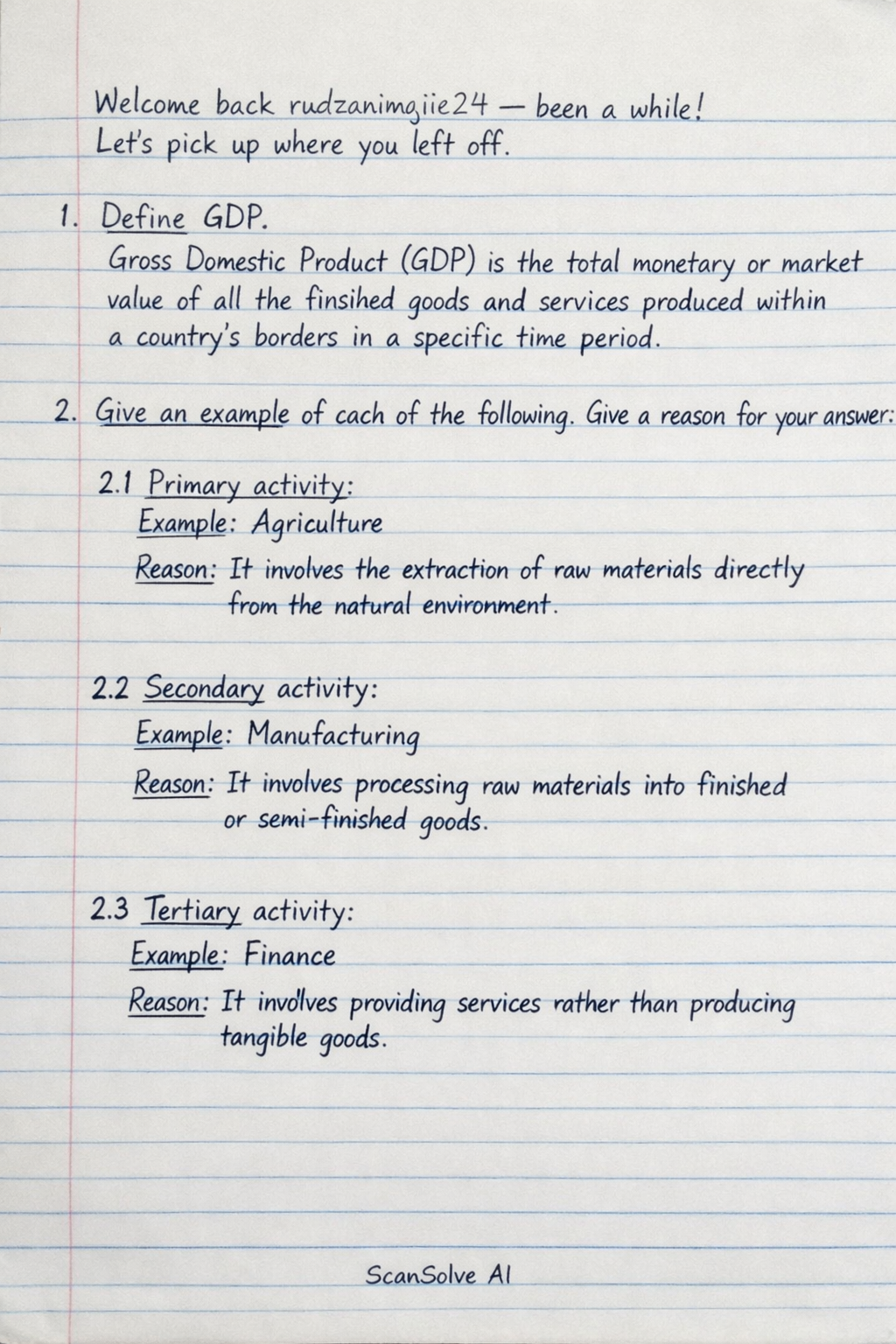
Define GDP. Gross Domestic Product (GDP) is the total monetary or market value of all the finished goods and services produced within a country's borders in a specific time period.
-
Give an example of each of the following. Give a reason for your answer:
Part 2.1
Primary activity
    *   Example: **Agriculture**
    *   Reason: It involves the extraction of raw materials directly from the natural environment.
Part 2.2
Secondary activity
    *   Example: **Manufacturing**
    *   Reason: It involves processing raw materials into finished or semi-finished goods.
Part 2.3
Tertiary activity
    *   Example: **Finance**
    *   Reason: It involves providing services rather than producing tangible goods.
3. What percentage did trade contribute to the GDP of South Africa in 2017?
Locate "Trade" on the pie chart.
Read the percentage value associated with "Trade".
Trade contributed **15%** to the GDP of South Africa in 2017. $$ \boxed{\text{15%}} $$4. Which of the sectors, mining or trade, was the largest contributor to the GDP of South Africa in 2017?
Identify the contribution of Mining from the chart.
Mining: $8\%$Identify the contribution of Trade from the chart.
Trade: $15\%$Compare the two percentages.
Since $15\% > 8\%$, **Trade** was the largest contributor. $$ \boxed{\text{Trade}} $$5. With regard to the graph, do you think that South Africa is a developing country? Give two reasons for your answer. Yes, South Africa is a developing country. * Reason 1: There is still a significant contribution from primary sectors like Mining () and secondary sectors like Manufacturing (), which are typically larger in developing economies compared to fully developed ones. * Reason 2: While the tertiary (service) sector is the largest overall, the economy is not yet overwhelmingly dominated by highly advanced, knowledge-based services, and still maintains a substantial industrial and resource extraction base.
Try one yourself
A new problem that tests the same skill.
Still stuck on this one?
Ask a follow-up, and the answer starts from this question.
More Mathematics Questions
Handwritten Step-by-Step Solution
Get this as a handwritten image on WhatsApp — like a tutor wrote it for you.
Try on WhatsApp