We read your photo as:

An office messenger on an errand covered 14 km using a bicycle. The speed of the bicycle was increased by 1 unit after covering the first 6 km. If the total journey was completed in 4 hours, find the speed for the remaining journey.

Mathematics

ScanSolve AI Answer

Answer

4 km/h4 \text{ km/h}

Step-by-step solution

5 steps
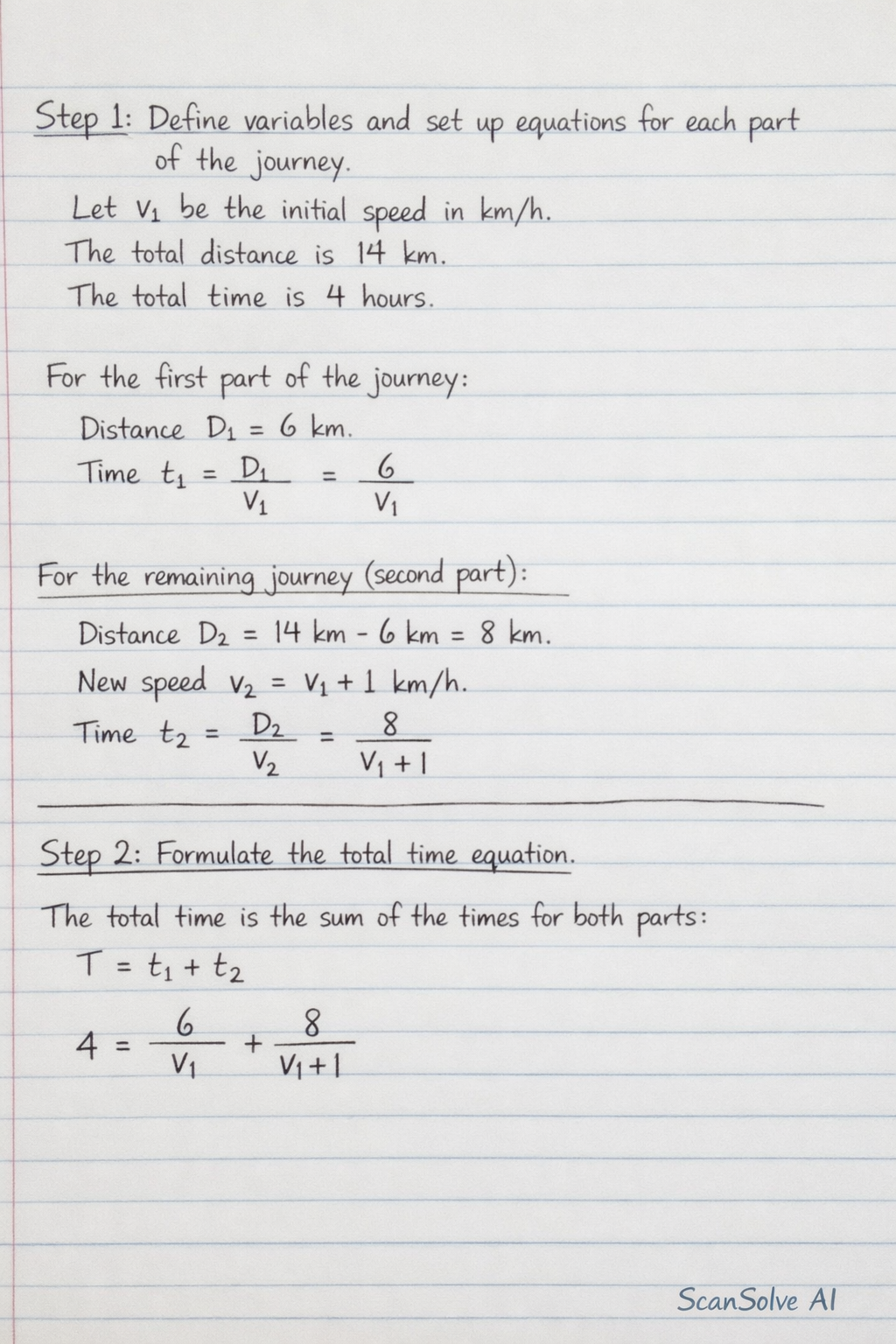
  1. Define variables and set up equations for each part of the journey.

    Let v1v_1 be the initial speed in km/h.
    The total distance is 14 km14 \text{ km}.
    The total time is 4 hours4 \text{ hours}.

    For the first part of the journey:
    Distance D1=6 kmD_1 = 6 \text{ km}.
    Time t1=D1v1=6v1t_1 = \frac{D_1}{v_1} = \frac{6}{v_1}.

    For the remaining journey (second part):
    Distance D2=14 km−6 km=8 kmD_2 = 14 \text{ km} - 6 \text{ km} = 8 \text{ km}.
    The speed was increased by 1 unit1 \text{ unit}, so the new speed v2=v1+1 km/hv_2 = v_1 + 1 \text{ km/h}.
    Time t2=D2v2=8v1+1t_2 = \frac{D_2}{v_2} = \frac{8}{v_1 + 1}.

  2. Formulate the total time equation.

    The total time is the sum of the times for both parts:

    T=t1+t2T = t_1 + t_2 4=6v1+8v1+14 = \frac{6}{v_1} + \frac{8}{v_1 + 1}
  3. Solve the equation for v1v_1.

    Multiply the entire equation by v1(v1+1)v_1(v_1 + 1) to eliminate the denominators:

    4v1(v1+1)=6(v1+1)+8v14v_1(v_1 + 1) = 6(v_1 + 1) + 8v_1 4v12+4v1=6v1+6+8v14v_1^2 + 4v_1 = 6v_1 + 6 + 8v_1 4v12+4v1=14v1+64v_1^2 + 4v_1 = 14v_1 + 6

    Rearrange into a standard quadratic equation form ax2+bx+c=0ax^2 + bx + c = 0:

    4v12+4v1−14v1−6=04v_1^2 + 4v_1 - 14v_1 - 6 = 0 4v12−10v1−6=04v_1^2 - 10v_1 - 6 = 0

    Divide by 2 to simplify:

    2v12−5v1−3=02v_1^2 - 5v_1 - 3 = 0
  4. Use the quadratic formula to find v1v_1.

    The quadratic formula is v1=−b±b2−4ac2av_1 = \frac{-b \pm \sqrt{b^2 - 4ac}}{2a}. Here, a=2a=2, b=−5b=-5, c=−3c=-3.

    v1=−(−5)±(−5)2−4(2)(−3)2(2)v_1 = \frac{-(-5) \pm \sqrt{(-5)^2 - 4(2)(-3)}}{2(2)} v1=5±25+244v_1 = \frac{5 \pm \sqrt{25 + 24}}{4} v1=5±494v_1 = \frac{5 \pm \sqrt{49}}{4} v1=5±74v_1 = \frac{5 \pm 7}{4}

    Two possible solutions for v1v_1:

    v1=5+74=124=3v_1 = \frac{5 + 7}{4} = \frac{12}{4} = 3 v1=5−74=−24=−0.5v_1 = \frac{5 - 7}{4} = \frac{-2}{4} = -0.5

    Since speed cannot be negative, we take v1=3 km/hv_1 = 3 \text{ km/h}.

  5. Calculate the speed for the remaining journey.

    The speed for the remaining journey is v2=v1+1v_2 = v_1 + 1.

    v2=3 km/h+1 km/hv_2 = 3 \text{ km/h} + 1 \text{ km/h} v2=4 km/hv_2 = 4 \text{ km/h}

    The speed for the remaining journey is 4 km/h4 \text{ km/h}.

Was this helpful?

Try one yourself

A new problem that tests the same skill.

Still stuck on this one?

Ask a follow-up, and the answer starts from this question.

Got a different question?Ask your own question
Handwritten step-by-step solution preview

Handwritten Step-by-Step Solution

Get this as a handwritten image on WhatsApp — like a tutor wrote it for you.

Try on WhatsApp