We read your photo as:

Analyze function h(x) = x3 − 2x2 − 15x: find intercepts and stationary points.

Mathematics

ScanSolve AI Answer

This answer stops before the end.

It was cut off when it was first written. Ask ScanSolve this question again for the full working.

Graph of h(x) = x³ − 2x² − 15x

Use the left and right arrow keys to trace the curve, up and down to jump between key points, and plus and minus to zoom.

Key points of h(x) = x³ − 2x² − 15x
Pointxy
x-intercept−30
Maximum−1.6714.81
x-intercept00
Minimum3−36
x-intercept50

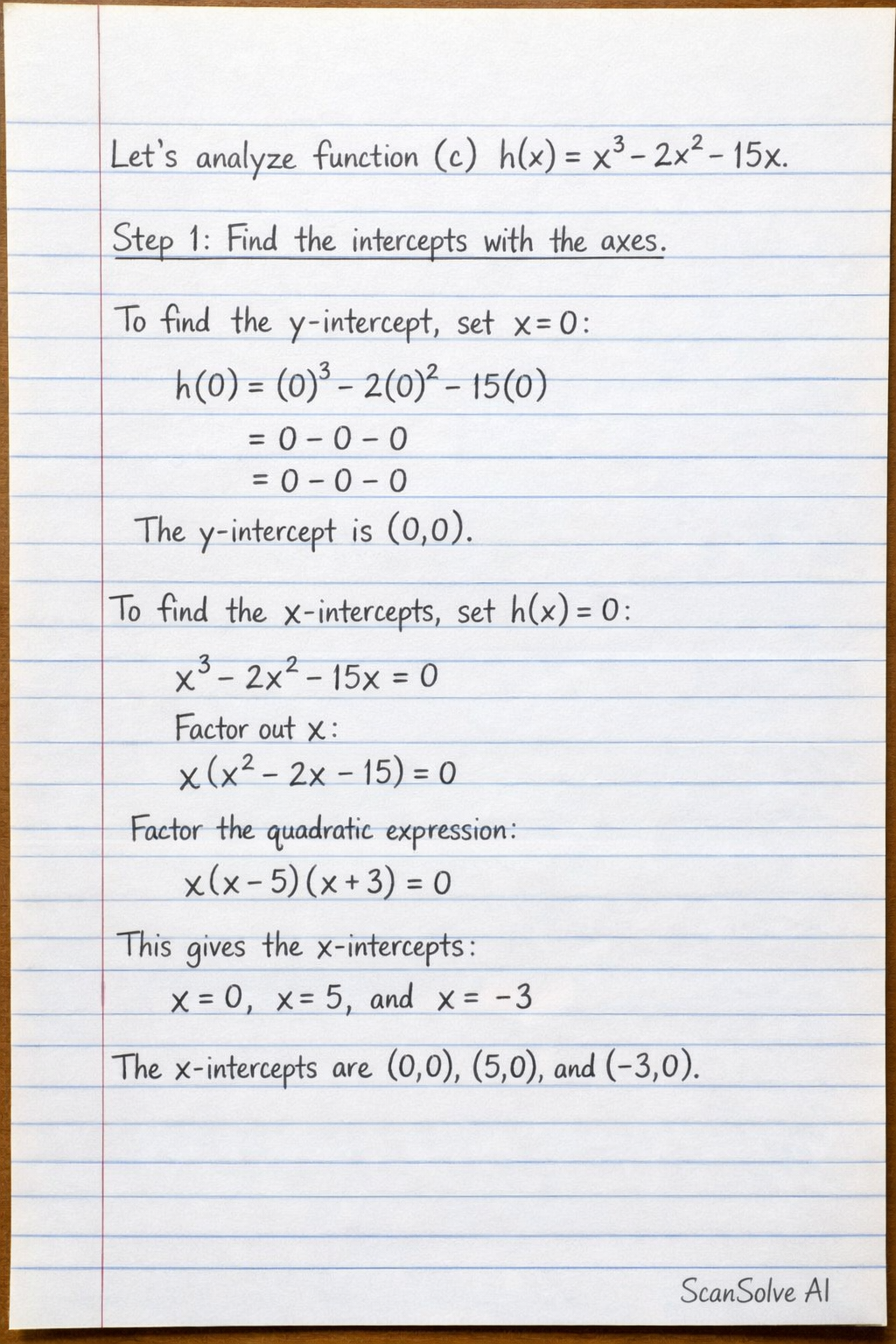
Let's analyze function (c) h(x)=x3−2x2−15xh(x) = x^3 - 2x^2 - 15x.

Step 1: Find the intercepts with the axes.
To find the y-intercept, set x=0x=0:

h(0)=(0)3−2(0)2−15(0)=0h(0) = (0)^3 - 2(0)^2 - 15(0) = 0

The y-intercept is (0,0)(0,0).

To find the x-intercepts, set h(x)=0h(x)=0:

x3−2x2−15x=0x^3 - 2x^2 - 15x = 0

Factor out xx:

x(x2−2x−15)=0x(x^2 - 2x - 15) = 0

Factor the quadratic expression:

x(x−5)(x+3)=0x(x-5)(x+3) = 0

This gives the x-intercepts: x=0x=0, x=5x=5, and x=−3x=-3.
The x-intercepts are (0,0)(0,0), (5,0)(5,0), and (−3,0)(-3,0).

Step 2: Find the stationary points.
First, find the first derivative h′(x)h'(x):

h′(x)=ddx(x3−2x2−15x)=3x2−4x−15h'(x) = \frac{d}{dx}(x^3 - 2x^2 - 15x) = 3x^2 - 4x - 15

Set h′(x)=0h'(x)=0 to find the x-coordinates of the stationary points:

3x2−4x−15=03x^2 - 4x - 15 = 0

Using the quadratic formula x=−b±b2−4ac2ax = \frac{-b \pm \sqrt{b^2 - 4ac}}{2a}:

x=−(−4)±(−4)2−4(3)(−15)2(3)x = \frac{-(-4) \pm \sqrt{(-4)^2 - 4(3)(-15)}}{2(3)} x=4±16+1806x = \frac{4 \pm \sqrt{16 + 180}}{6} x=4±1966x = \frac{4 \pm \sqrt{196}}{6} x=4±146x = \frac{4 \pm 14}{6}

The x-coordinates are:

x1=4+146=186=3x_1 = \frac{4 + 14}{6} = \frac{18}{6} = 3 x2=4−146=−106=−53x_2 = \frac{4 - 14}{6} = \frac{-10}{6} = -\frac{5}{3}

Now, find the corresponding y-coordinates by substituting these values back into h(x)h(x):
For x=3x=3:

h(3)=(3)3−2(3)2−15(3)=27−2(9)−45=27−18−45=9−45=−36h(3) = (3)^3 - 2(3)^2 - 15(3) = 27 - 2(9) - 45 = 27 - 18 - 45 = 9 - 45 = -36

Stationary point 1: (3,−36)(3, -36).

For x=−53x=-\frac{5}{3}:

h(−53)=(−53)3−2(−53)2−15(−53)h\left(-\frac{5}{3}\right) = \left(-\frac{5}{3}\right)^3 - 2\left(-\frac{5}{3}\right)^2 - 15\left(-\frac{5}{3}\right) h(−53)=−12527−2(259)+25h\left(-\frac{5}{3}\right) = -\frac{125}{27} - 2\left(\frac{25}{9}\right) + 25 h(−53)=−12527−509+25h\left(-\frac{5}{3}\right) = -\frac{125}{27} - \frac{50}{9} + 25

To combine these, use a common denominator of 27:

h(−53)=−12527−50×39×3+25×2727h\left(-\frac{5}{3}\right) = -\frac{125}{27} - \frac{50 \times 3}{9 \times 3} + \frac{25 \times 27}{27}
Was this helpful?

Still stuck on this one?

Ask a follow-up, and the answer starts from this question.

Got a different question?Ask your own question
Handwritten step-by-step solution preview

Handwritten Step-by-Step Solution

Get this as a handwritten image on WhatsApp — like a tutor wrote it for you.

Try on WhatsApp