
We read your photo as:
For the curve y = -2x3 + 3x2, find the x-intercepts, y-intercept, and stationary points.
ScanSolve AI Answer
Answers
3 partsUse the left and right arrow keys to trace the curve, up and down to jump between key points, and plus and minus to zoom.
| Point | x | y |
|---|---|---|
| Minimum | 0 | 0 |
| Maximum | 1 | 1 |
| x-intercept | 1.5 | 0 |
Step-by-step solution
12 stepshere's the solution to question 23.
The equation of the curve is .
Part a(i)· 3 steps
the x-intercept of the curve.
Find
Set to find the x-intercepts.
Factor out .
Solve for .
The x-intercepts are .
Part a(ii)(0, 0)
the y-intercept of the curve.
Set to find the y-intercept.
Calculate .
The y-intercept is .
Part b
(i) Determine the stationary points of the curve.
Find the first derivative .
Set to find the x-coordinates of the stationary points.
Factor out .
Solve for .
Substitute the x-values back into the original equation to find the corresponding y-values.
For :
Point:
For :
Point:
The stationary points are .
Part b(ii)· 2 steps
For each point in (b)(i) above, determine whether it is a maximum or a minimum.
Find the second derivative .
Evaluate at each stationary point.
For (where ):
Since , the point is a local minimum.
For (where ):
Since , the point is a local maximum.
Part c
Sketch the curve.
The curve has the following characteristics:
- x-intercepts: and
- y-intercept:
- Local minimum:
- Local maximum:
The sketch should show a curve that:
- Comes from positive y-values (as , ).
- Decreases to a local minimum at .
- Increases to a local maximum at .
- Decreases again, passing through the x-axis at and continuing towards negative y-values (as , ).
Here is a description of the sketch:
Draw a coordinate plane. Plot the points , , and .
The curve starts from the top-left, goes down to touch the origin as a minimum point. From the origin, it turns and goes up to the point as a maximum point. From , it turns and goes down, crossing the x-axis at and continuing downwards.
Try one yourself
A new problem that tests the same skill.
Still stuck on this one?
Ask a follow-up, and the answer starts from this question.
More Mathematics Questions
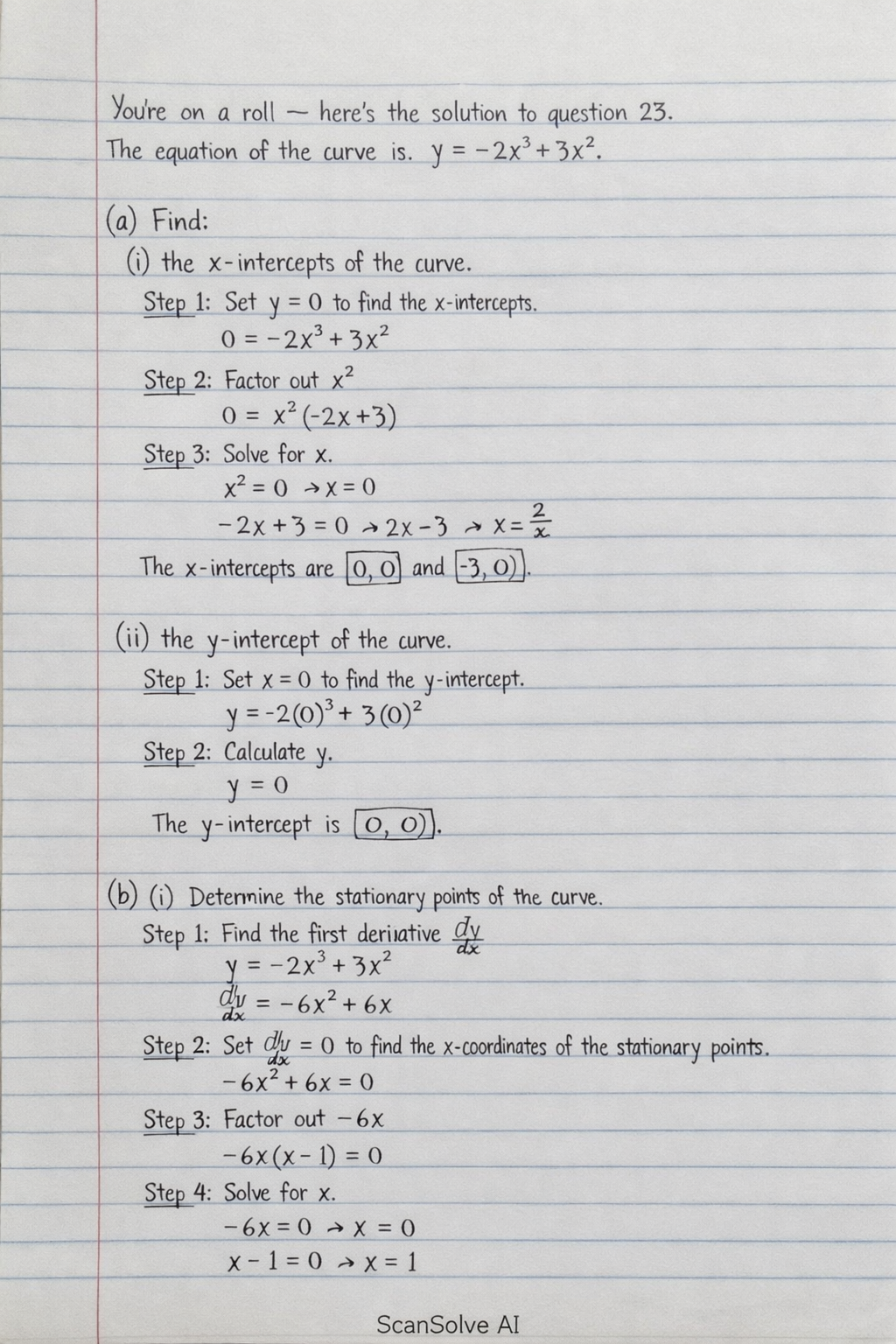
Handwritten Step-by-Step Solution
Get this as a handwritten image on WhatsApp — like a tutor wrote it for you.
Try on WhatsApp