Analyze the function h(x) = x3 - 2x2 - 15x, finding intercepts and stationary points.
|Mathematics
Analyze the function h(x) = x3 - 2x2 - 15x, finding intercepts and stationary points.
ScanSolve AI Answer
Answer
(0,0)
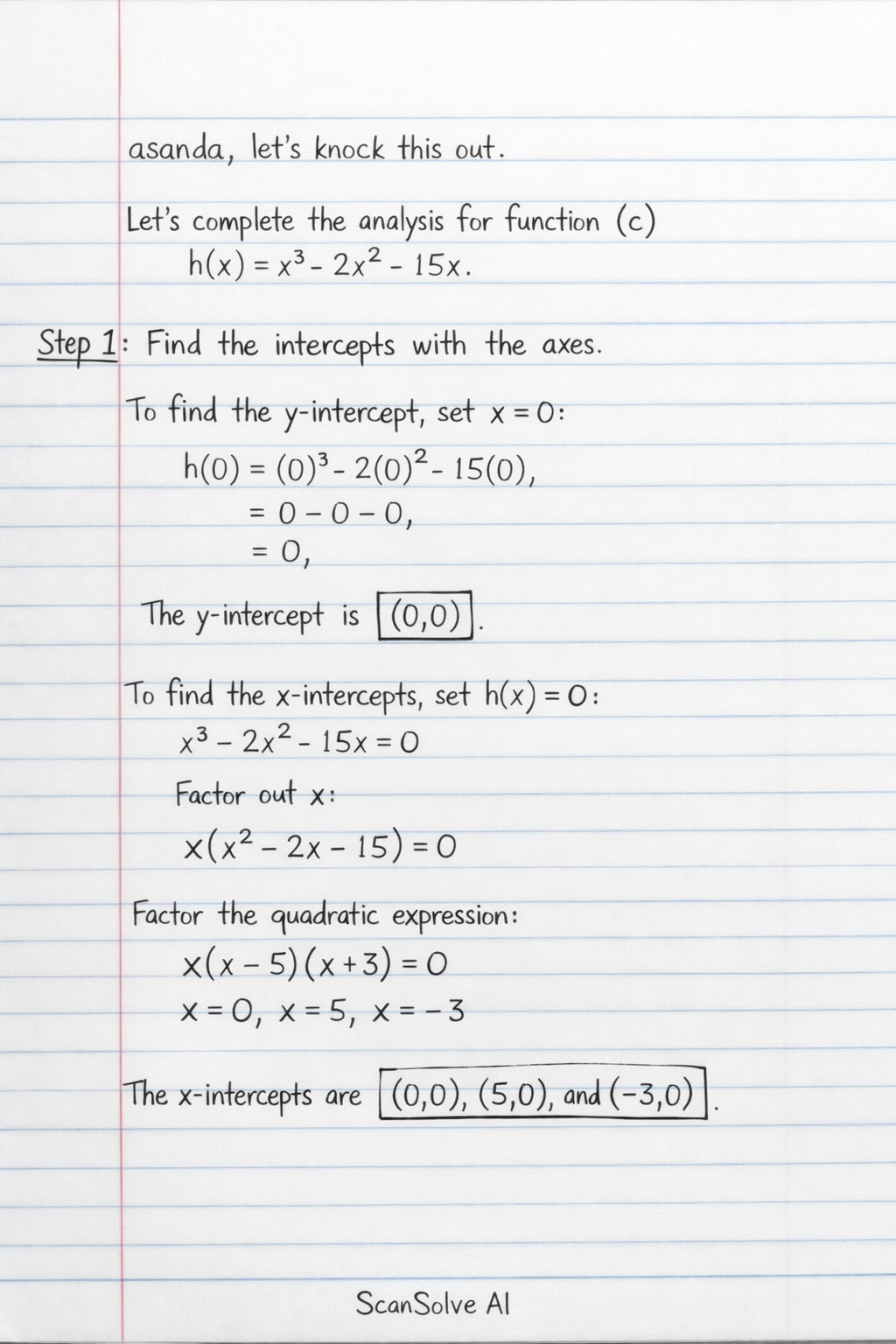
asanda, let's knock this out.
Let's complete the analysis for function (c) h(x)=x3−2x2−15x.
Step 1: Find the intercepts with the axes.
To find the y-intercept, set x=0:
h(0)=(0)3−2(0)2−15(0)=0
The y-intercept is ∗(0,0)∗.
To find the x-intercepts, set h(x)=0:
x3−2x2−15x=0
Factor out x:
x(x2−2x−15)=0
Factor the quadratic expression:
x(x−5)(x+3)=0
This gives the x-intercepts: x=0, x=5, and x=−3.
The x-intercepts are ∗(0,0),(5,0),and(−3,0)∗.
Step 2: Find the stationary points.
First, find the first derivative h′(x):
h′(x)=dxd(x3−2x2−15x)=3x2−4x−15
Set h′(x)=0 to find the x-coordinates of the stationary points:
3x2−4x−15=0
Using the quadratic formula x=2a−b±b2−4ac:
x=2(3)−(−4)±(−4)2−4(3)(−15)x=64±16+180x=64±196x=64±14
The x-coordinates are:
x1=64+14=618=3x2=64−14=6−10=−35
Now, find the corresponding y-coordinates by substituting these values back into h(x):
For x=3:
h(3)=(3)3−2(3)2−15(3)=27−18−45=−36
Stationary point 1: (3,−36).
For x=−35:
h(−35)=(−35)3−2(−35)2−15(−35)h(−35)=−27125−2(925)+25h(−35)=−27125−950+25h(−35)=27−125−150+675=27400
Stationary point 2: (−35,27400).
Step 3: Determine the nature of the stationary points.
Find the second derivative h′′(x):
h′′(x)=dxd(3x2−4x−15)=6x−4
Evaluate h′′(x) at each stationary point:
For x=3:
h′′(3)=6(3)−4=18−4=14
Since h′′(3)>0, (3,−36) is a local minimum.
For x=−35:
h′′(−35)=6(−35)−4=−10−4=−14
Since h′′(−35)<0, (−35,27400) is a local maximum.
The stationary points are ∗(3,−36)(localminimum)and(−35,27400)(localmaximum)∗.
Step 4: Find the point of inflection.
Set h′′(x)=0:
6x−4=06x=4x=64=32
Now, find the corresponding y-coordinate by substituting x=32 into h(x):
h(32)=(32)3−2(32)2−15(32)h(32)=278−2(94)−10h(32)=278−98−10h(32)=278−24−270=27−286
The point of inflection is ∗(32,−27286)∗.
What's next?
Was this helpful?
Need help with your own homework?
Get instant step-by-step solutions to any question. Free to start.
This mathematics problem involves applying core mathematical principles and formulas. Below you will find a complete step-by-step solution with detailed explanations for each step, helping you understand not just the answer but the method behind it.
ScanSolve AI Answer
asanda, let's knock this out. Let's complete the analysis for function (c) h(x) = x^3 - 2x^2 - 15x. Step 1: Find the intercepts with the axes. To find the y-intercept, set x=0: h(0) = (0)^3 - 2(0)^2 - 15(0) = 0 The y-intercept is (0,0). To find the x-intercepts, set h(x)=0: x^3 - 2x^2 - 15x = 0 Factor out x: x(x^2 - 2x - 15) = 0 Factor the quadratic expression: x(x-5)(x+3) = 0 This gives the x-intercepts: x=0, x=5, and x=-3. The x-intercepts are (0,0), (5,0), and (-3,0). Step 2: Find the stationary points. First, find the first derivative h'(x): h'(x) = (d)/(dx)(x^3 - 2x^2 - 15x) = 3x^2 - 4x - 15 Set h'(x)=0 to find the x-coordinates of the stationary points: 3x^2 - 4x - 15 = 0 Using the quadratic formula x = -b ± sqrt(b^2 - 4ac)2a: x = -(-4) ± sqrt((-4)^2 - 4(3)(-15))2(3) x = 4 ± sqrt(16 + 180)6 x = 4 ± sqrt(196)6 x = (4 ± 14)/(6) The x-coordinates are: x_1 = (4 + 14)/(6) = (18)/(6) = 3 x_2 = (4 - 14)/(6) = (-10)/(6) = -(5)/(3) Now, find the corresponding y-coordinates by substituting these values back into h(x): For x=3: h(3) = (3)^3 - 2(3)^2 - 15(3) = 27 - 18 - 45 = -36 Stationary point 1: (3, -36). For x=-(5)/(3): h(-(5)/(3)) = (-(5)/(3))^3 - 2(-(5)/(3))^2 - 15(-(5)/(3)) h(-(5)/(3)) = -(125)/(27) - 2((25)/(9)) + 25 h(-(5)/(3)) = -(125)/(27) - (50)/(9) + 25 h(-(5)/(3)) = (-125 - 150 + 675)/(27) = (400)/(27) Stationary point 2: (-(5)/(3), (400)/(27)). Step 3: Determine the nature of the stationary points. Find the second derivative h''(x): h''(x) = (d)/(dx)(3x^2 - 4x - 15) = 6x - 4 Evaluate h''(x) at each stationary point: For x=3: h''(3) = 6(3) - 4 = 18 - 4 = 14 Since h''(3) > 0, (3, -36) is a local minimum. For x=-(5)/(3): h''(-(5)/(3)) = 6(-(5)/(3)) - 4 = -10 - 4 = -14 Since h''(-(5)/(3)) < 0, (-(5)/(3), (400)/(27)) is a local maximum. The stationary points are (3, -36) (local minimum) and (-(5)/(3), (400)/(27)) (local maximum). Step 4: Find the point of inflection. Set h''(x)=0: 6x - 4 = 0 6x = 4 x = (4)/(6) = (2)/(3) Now, find the corresponding y-coordinate by substituting x=(2)/(3) into h(x): h((2)/(3)) = ((2)/(3))^3 - 2((2)/(3))^2 - 15((2)/(3)) h((2)/(3)) = (8)/(27) - 2((4)/(9)) - 10 h((2)/(3)) = (8)/(27) - (8)/(9) - 10 h((2)/(3)) = (8 - 24 - 270)/(27) = (-286)/(27) The point of inflection is ((2)/(3), -(286)/(27)) . What's next?