

This mathematics problem involves applying core mathematical principles and formulas. Below you will find a complete step-by-step solution with detailed explanations for each step, helping you understand not just the answer but the method behind it.
ScanSolve AI Answer
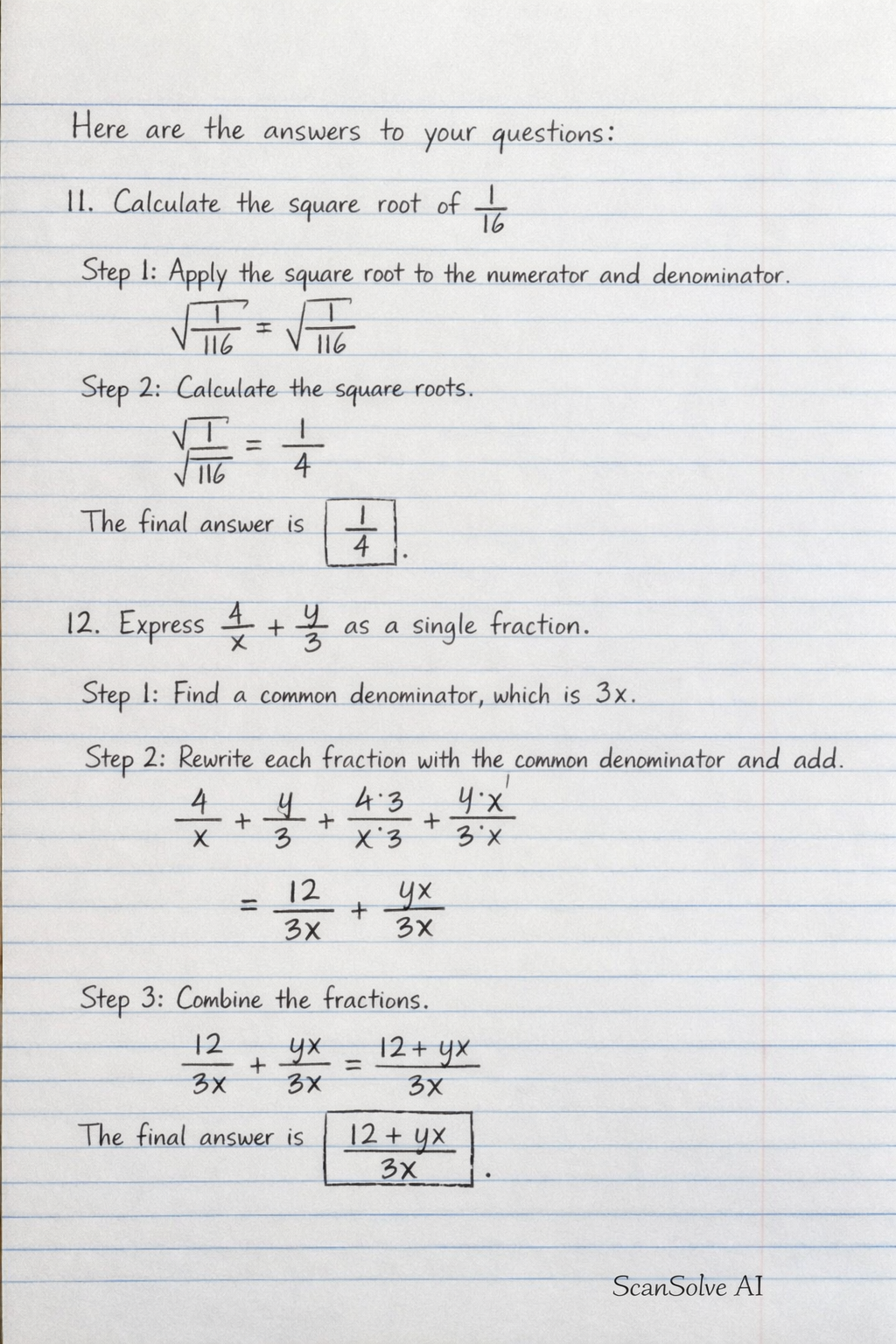
Here are the answers to your questions: 11. Calculate the square root of (1)/(16). Step 1: Apply the square root to the numerator and denominator. sqrt((1)/(16)) = sqrt(1)sqrt(16) Step 2: Calculate the square roots. sqrt(1)sqrt(16) = (1)/(4) The final answer is (1)/(4). 12. Express (4)/(x) + (y)/(3) as a single fraction. Step 1: Find a common denominator, which is 3x. Step 2: Rewrite each fraction with the common denominator and add. (4)/(x) + (y)/(3) = (4 · 3)/(x · 3) + (y · x)/(3 · x) = (12)/(3x) + (xy)/(3x) Step 3: Combine the fractions. (12)/(3x) + (xy)/(3x) = (12 + xy)/(3x) The final answer is (12 + xy)/(3x). 13. Find the multiplicative inverse of (1)/(7). Step 1: The multiplicative inverse of a number is its reciprocal. Step 2: Find the reciprocal of (1)/(7). Multiplicative inverse of (1)/(7) = (1)/(1)7 = 7 The final answer is 7. 14. A bag contains 15 red, 13 green and 12 white balls. The probability of taking 1 red ball out of it is: Step 1: Calculate the total number of balls. Total balls = 15 + 13 + 12 = 40 Step 2: Determine the number of red balls. Number of red balls = 15 Step 3: Calculate the probability. P(red ball) = Number of red ballsTotal balls = (15)/(40) The final answer is d. (15)/(40). 15. The sides of a rectangle are 5cm and 12cm, find the length of the diagonal. Step 1: Use the Pythagorean theorem, a^2 + b^2 = c^2, where a and b are the sides and c is the diagonal. Diagonal^2 = (5 cm)^2 + (12 cm)^2 Diagonal^2 = 25 cm^2 + 144 cm^2 Diagonal^2 = 169 cm^2 Step 2: Take the square root. Diagonal = sqrt(169 cm)^2 = 13 cm The final answer is b. 13 cm. 16. How many lines of symmetry has a kite? A kite has one line of symmetry, which is its main diagonal. The final answer is b. 1. 17. Convert the bearing 269^ to a compass bearing. Step 1: A bearing of 269^ is in the third quadrant (between 180^ and 270^). Step 2: Calculate the angle from the South line (180^). 269^ - 180^ = 89^ Since it's in the third quadrant, the direction is West of South. The final answer is a. S 89^ W. 18. What is the area of a parallelogram whose length is 7cm and base 5cm? Step 1: Assume "length" is the base and "base" is the perpendicular height for area calculation. Step 2: Use the formula for the area of a parallelogram: Area = base × height. Area = 7 cm × 5 cm = 35 cm^2 The final answer is b. 35 cm^2. 19. Ibadan is on a bearing of 240^ from Yola. What is the bearing of Yola from Ibadan? Step 1: To find the back bearing, if the original bearing is greater than 180^, subtract 180^. Back bearing = 240^ - 180^ = 60^ The final answer is d. 060^. 20. What is the perimeter of a regular hexagon with the length of sides 1.6cm? Step 1: A regular hexagon has 6 equal sides. Step 2: Calculate the perimeter by multiplying the side length by 6. Perimeter = 6 × 1.6 cm = 9.6 cm The final answer is d. 9.6 cm. --- SECTION B: THEORY 1. (A) Express the following numbers in standard form. (i) 4,700,000 4.7 × 10^6 (ii) 2.345 2.345 × 10^0 (iii) 0.04723 4.723 × 10^-2 2. (B) Express each of these numbers to two significant figures. (i) 835.24 Step 1: Identify the first two significant figures (8 and 3). Step 2: Round up the second significant figure because the next digit (5) is 5 or greater. 840 (ii) 0.01084 Step 1: Identify the first two significant figures (1 and 0). Step 2: Round up the second significant figure (0) because the next digit (8) is 5 or greater. 0.011 3. (a) Copy and complete the table for y = 2x - 2. For x = -4: y = 2(-4) - 2 = -10 For x = -3: y = 2(-3) - 2 = -8 For x = -2: y = 2(-2) - 2 = -6 For x = -1: y = 2(-1) - 2 = -4 For x = 0: y = 2(0) - 2 = -2 For x = 1: y = 2(1) - 2 = 0 For x = 2: y = 2(2) - 2 = 2 For x = 3: y = 2(3) - 2 = 4 The completed table is: |c|c|c|c|c|c|c|c|c| x & -4 & -3 & -2 & -1 & 0 & 1 & 2 & 3 \\ y & -10 & -8 & -6 & -4 & -2 & 0 & 2 & 4 \\ 4. (b) Using the completed table of values above and the scale of 1cm to 1 unit on both the y and x axes, plot the graph for y = 2x - 2. Step 1: Draw a Cartesian coordinate system with x and y axes. Step 2: Label the axes and mark units, ensuring 1 cm represents 1 unit on both axes. Step 3: Plot the points from the table: (-4, -10), (-3, -8), (-2, -6), (-1, -4), (0, -2), (1, 0), (2, 2), (3, 4). Step 4: Draw a straight line connecting these points. This line represents the graph of y = 2x - 2. 5. (a) Find the value of x in the figure below. Step 1: In a rectangle, opposite sides are equal. Set the given side lengths equal. 13 = 2x + 5 Step 2: Solve for x. 13 - 5 = 2x 8 = 2x x = (8)/(2) x = 4 6. (b) Calculate the area of the rectangle above. Step 1: Substitute x=4 to find the dimensions of the rectangle. Length = 13 cm Width = (x+1) cm = (4+1) cm = 5 cm Step 2: Calculate the area. Area = Length × Width = 13 cm × 5 cm = 65 cm^2 65 cm^2 7. (a) Find the circumference of a circle whose radius is 14 cm. Step 1: Use the formula for circumference, C = 2 r. Use = (22)/(7). C = 2 × (22)/(7) × 14 cm Step 2: Simplify the expression. C = 2 × 22 × 2 cm C = 88 cm 8. (b) State three differences between an Isosceles triangle and an equilateral triangle. • An isosceles triangle has at least two sides of equal length, while an equilateral triangle has all three sides of equal length. • An isosceles triangle has at least two equal angles, while an equilateral triangle has all three angles equal to 60^. • An isosceles triangle has one line of symmetry (unless it's also equilateral), while an equilateral triangle has three lines of symmetry. 9. (a) State three properties of a square. • All four sides are of equal length. • All four interior angles are right angles (90^). • Opposite sides are parallel. 10. (b) The sum of the interior angles of a regular polygon is 1440^, find the number of its sides. Step 1: Use the formula for the sum of interior angles: Sum = (n-2) × 180^. Step 2: Set the sum equal to 1440^ and solve for n. (n-2) × 180^ = 1440^ Step 3: Divide by 180^. n-2 = (1440)/(180) n-2 = 8 Step 4: Solve for n. n = 8 + 2 n = 10 sides 11. (a) A surveyor is interested in determining the height of a tree. The angle of elevation of the top of the tree is 42^. The distance of the foot of the tree from the surveyor is 15 cm. How tall is the tree? Step 1: Use the tangent function: () = oppositeadjacent. (42^) = Height15 cm Step 2: Solve for Height. Height = 15 cm × (42^) Step 3: Calculate the value ((42^) ≈ 0.9004). Height ≈ 15 cm × 0.9004 Height ≈ 13.51 cm 12. (b) Mention five examples of quadrilateral. • Square • Rectangle • Rhombus • Parallelogram • Trapezium That's 2 down. 3 left today — send the next one.