We read your photo as:

A) Express the following vectors in terms of b and c only. i) AE ii) BD b) By expressing vectors BF in two ways, find the ratio BF:FD given that BF = hBD and AF = Tae c) Hence find vector BF in terms of b and c only

Mathematics

ScanSolve AI Answer

Answers

4 parts
a(i)

i) AE⃗=12b+12c\text{i) } \vec{AE} = \frac{1}{2}\mathbf{b} + \frac{1}{2}\mathbf{c}

a(ii)

ii) BD⃗=−b+12c\text{ii) } \vec{BD} = -\mathbf{b} + \frac{1}{2}\mathbf{c}

b

BF : FD=2:1\text{BF : FD} = 2 : 1

c

BF⃗=−23b+13c\vec{BF} = -\frac{2}{3}\mathbf{b} + \frac{1}{3}\mathbf{c}

Step-by-step solution

12 steps

To solve this problem, we need to make an assumption about the positions of points D and E on the sides of the triangle, as no ratios are explicitly given in the diagram or text. Given that the problem asks for specific vector expressions and a numerical ratio, it is standard in such problems to assume that D and E are midpoints. This assumption is further supported by the fact that the intersection point F (the centroid) divides the medians in a 2:1 ratio, which is a common result in vector geometry problems of this type.

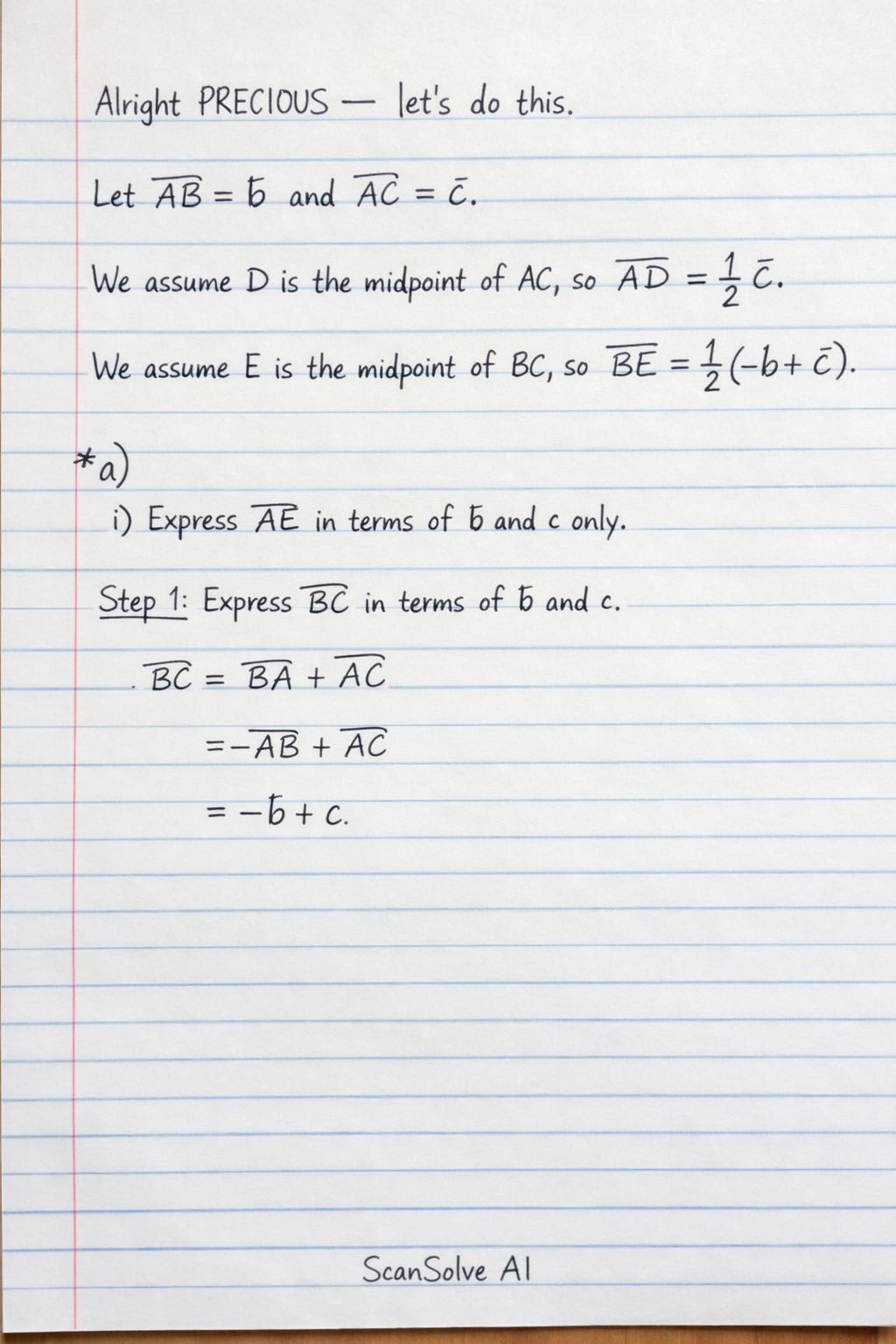
Let AB⃗=b\vec{AB} = \mathbf{b} and AC⃗=c\vec{AC} = \mathbf{c}.
We assume D is the midpoint of AC, so AD⃗=12AC⃗=12c\vec{AD} = \frac{1}{2}\vec{AC} = \frac{1}{2}\mathbf{c}.
We assume E is the midpoint of BC, so BE⃗=12BC⃗\vec{BE} = \frac{1}{2}\vec{BC}.

Part a(i)· 3 steps

Express AE⃗\vec{AE} in terms of b\mathbf{b} and c\mathbf{c} only.

  1. Express BC⃗\vec{BC} in terms of b\mathbf{b} and c\mathbf{c}.

    BC⃗=BA⃗+AC⃗=−AB⃗+AC⃗=−b+c\vec{BC} = \vec{BA} + \vec{AC} = -\vec{AB} + \vec{AC} = -\mathbf{b} + \mathbf{c}
  2. Express BE⃗\vec{BE} in terms of b\mathbf{b} and c\mathbf{c}.

    Since E is the midpoint of BC,

    BE⃗=12BC⃗=12(−b+c)=−12b+12c\vec{BE} = \frac{1}{2}\vec{BC} = \frac{1}{2}(-\mathbf{b} + \mathbf{c}) = -\frac{1}{2}\mathbf{b} + \frac{1}{2}\mathbf{c}
  3. Express AE⃗\vec{AE} using the path AB⃗+BE⃗\vec{AB} + \vec{BE}.

    AE⃗=AB⃗+BE⃗=b+(−12b+12c)\vec{AE} = \vec{AB} + \vec{BE} = \mathbf{b} + \left(-\frac{1}{2}\mathbf{b} + \frac{1}{2}\mathbf{c}\right) AE⃗=b−12b+12c\vec{AE} = \mathbf{b} - \frac{1}{2}\mathbf{b} + \frac{1}{2}\mathbf{c} AE⃗=12b+12c\vec{AE} = \frac{1}{2}\mathbf{b} + \frac{1}{2}\mathbf{c}

    i) AE⃗=12b+12c\boxed{\text{i) } \vec{AE} = \frac{1}{2}\mathbf{b} + \frac{1}{2}\mathbf{c}}

Part a(ii)

ii) BD⃗=−b+12c\text{ii) } \vec{BD} = -\mathbf{b} + \frac{1}{2}\mathbf{c}

Express BD⃗\vec{BD} in terms of b\mathbf{b} and c\mathbf{c} only.

  1. Express BA⃗\vec{BA} in terms of b\mathbf{b}.

    BA⃗=−AB⃗=−b\vec{BA} = -\vec{AB} = -\mathbf{b}
  2. Express AD⃗\vec{AD} in terms of c\mathbf{c}.

    Since D is the midpoint of AC,

    AD⃗=12AC⃗=12c\vec{AD} = \frac{1}{2}\vec{AC} = \frac{1}{2}\mathbf{c}
  3. Express BD⃗\vec{BD} using the path BA⃗+AD⃗\vec{BA} + \vec{AD}.

    BD⃗=BA⃗+AD⃗=−b+12c\vec{BD} = \vec{BA} + \vec{AD} = -\mathbf{b} + \frac{1}{2}\mathbf{c}

    ii) BD⃗=−b+12c\boxed{\text{ii) } \vec{BD} = -\mathbf{b} + \frac{1}{2}\mathbf{c}}

Part b

BF : FD=2:1\text{BF : FD} = 2 : 1

By expressing vectors BF⃗\vec{BF} in two ways, find the ratio BF:FD given that BF⃗=hBD⃗\vec{BF} = h\vec{BD} and AF⃗=tAE⃗\vec{AF} = t\vec{AE} where hh and tt are constants.

  1. Express AF⃗\vec{AF} in terms of b\mathbf{b}, c\mathbf{c}, and tt.

    We are given AF⃗=tAE⃗\vec{AF} = t\vec{AE}. Substitute AE⃗\vec{AE} from part (a) i.

    AF⃗=t(12b+12c)\vec{AF} = t\left(\frac{1}{2}\mathbf{b} + \frac{1}{2}\mathbf{c}\right) AF⃗=t2b+t2c(Equation 1)\vec{AF} = \frac{t}{2}\mathbf{b} + \frac{t}{2}\mathbf{c} \quad \text{(Equation 1)}
  2. Express AF⃗\vec{AF} in terms of b\mathbf{b}, c\mathbf{c}, and hh.

    We use the path AF⃗=AB⃗+BF⃗\vec{AF} = \vec{AB} + \vec{BF}. We are given BF⃗=hBD⃗\vec{BF} = h\vec{BD}.
    Substitute BD⃗\vec{BD} from part (a) ii.

    BF⃗=h(−b+12c)=−hb+h2c\vec{BF} = h\left(-\mathbf{b} + \frac{1}{2}\mathbf{c}\right) = -h\mathbf{b} + \frac{h}{2}\mathbf{c}

    Now substitute this into the expression for AF⃗\vec{AF}:

    AF⃗=b+(−hb+h2c)\vec{AF} = \mathbf{b} + \left(-h\mathbf{b} + \frac{h}{2}\mathbf{c}\right) AF⃗=(1−h)b+h2c(Equation 2)\vec{AF} = (1-h)\mathbf{b} + \frac{h}{2}\mathbf{c} \quad \text{(Equation 2)}
  3. Equate the coefficients of b\mathbf{b} and c\mathbf{c} from Equation 1 and Equation 2.

    Since b\mathbf{b} and c\mathbf{c} are non-parallel vectors, their coefficients must be equal.

    t2b+t2c=(1−h)b+h2c\frac{t}{2}\mathbf{b} + \frac{t}{2}\mathbf{c} = (1-h)\mathbf{b} + \frac{h}{2}\mathbf{c}

    Comparing coefficients of b\mathbf{b}:

    t2=1−h(Equation 3)\frac{t}{2} = 1-h \quad \text{(Equation 3)}

    Comparing coefficients of c\mathbf{c}:

    t2=h2(Equation 4)\frac{t}{2} = \frac{h}{2} \quad \text{(Equation 4)}
  4. Solve the simultaneous equations for hh and tt.

    From Equation 4, we get t=ht = h.
    Substitute t=ht=h into Equation 3:

    h2=1−h\frac{h}{2} = 1-h

    Multiply both sides by 2:

    h=2−2hh = 2 - 2h 3h=23h = 2 h=23h = \frac{2}{3}

    Since BF⃗=hBD⃗\vec{BF} = h\vec{BD}, this means BF⃗=23BD⃗\vec{BF} = \frac{2}{3}\vec{BD}.
    The ratio BF:FD is h:(1−h)h : (1-h).

    BF : FD=23:(1−23)=23:13=2:1\text{BF : FD} = \frac{2}{3} : \left(1 - \frac{2}{3}\right) = \frac{2}{3} : \frac{1}{3} = 2 : 1

    BF : FD=2:1\boxed{\text{BF : FD} = 2 : 1}

Part c

BF⃗=−23b+13c\vec{BF} = -\frac{2}{3}\mathbf{b} + \frac{1}{3}\mathbf{c}

Hence find vector BF⃗\vec{BF} in terms of b\mathbf{b} and c\mathbf{c} only.

  1. Use the value of hh found in part (b).

    We found h=23h = \frac{2}{3}.
    We know BF⃗=hBD⃗\vec{BF} = h\vec{BD}.

  2. Substitute hh and BD⃗\vec{BD} (from part a) ii) into the expression for BF⃗\vec{BF}.

    BF⃗=23(−b+12c)\vec{BF} = \frac{2}{3}\left(-\mathbf{b} + \frac{1}{2}\mathbf{c}\right) BF⃗=−23b+23⋅12c\vec{BF} = -\frac{2}{3}\mathbf{b} + \frac{2}{3} \cdot \frac{1}{2}\mathbf{c} BF⃗=−23b+13c\vec{BF} = -\frac{2}{3}\mathbf{b} + \frac{1}{3}\mathbf{c}

    BF⃗=−23b+13c\boxed{\vec{BF} = -\frac{2}{3}\mathbf{b} + \frac{1}{3}\mathbf{c}}

Was this helpful?

Try one yourself

A new problem that tests the same skill.

Still stuck on this one?

Ask a follow-up, and the answer starts from this question.

Got a different question?Ask your own question
Handwritten step-by-step solution preview

Handwritten Step-by-Step Solution

Get this as a handwritten image on WhatsApp — like a tutor wrote it for you.

Try on WhatsApp