This mathematics problem involves applying core mathematical principles and formulas. Below you will find a complete step-by-step solution with detailed explanations for each step, helping you understand not just the answer but the method behind it.
ScanSolve AI Answer
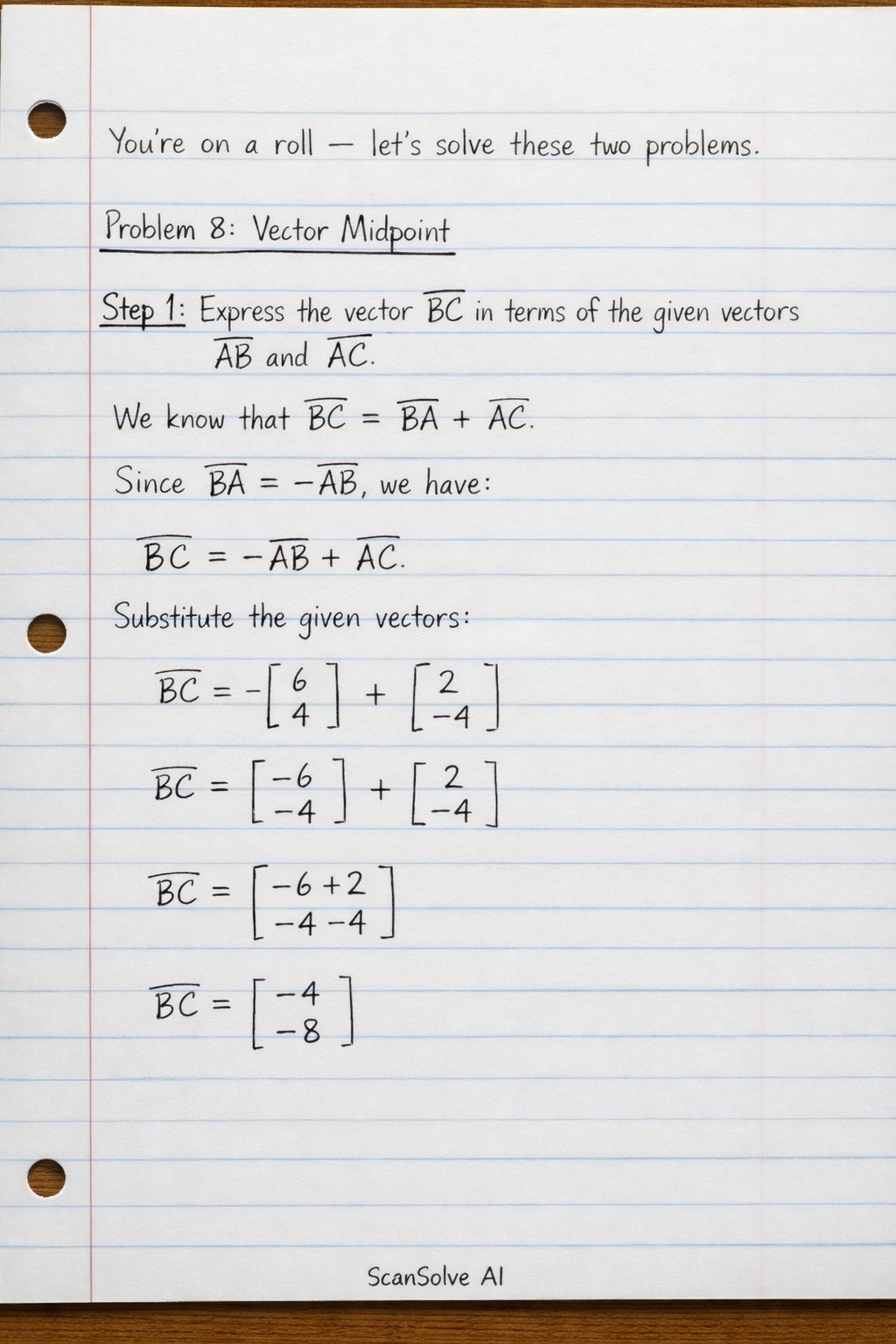
You're on a roll — let's solve these two problems.
Problem 8: Vector Midpoint
Step 1: Express the vector $\vec{BC}$ in terms of the given vectors $\vec{AB}$ and $\vec{AC}$.
We know that $\vec{BC} = \vec{BA} + \vec{AC}$.
Since $\vec{BA} = -\vec{AB}$, we have:
$$ \vec{BC} = -\vec{AB} + \vec{AC} $$
Substitute the given vectors:
$$ \vec{BC} = -\begin{pmatrix} 6 \\ 4 \end{pmatrix} + \begin{pmatrix} 2 \\ -4 \end{pmatrix} $$
$$ \vec{BC} = \begin{pmatrix} -6 \\ -4 \end{pmatrix} + \begin{pmatrix} 2 \\ -4 \end{pmatrix} $$
$$ \vec{BC} = \begin{pmatrix} -6 + 2 \\ -4 - 4 \end{pmatrix} $$
$$ \vec{BC} = \begin{pmatrix} -4 \\ -8 \end{pmatrix} $$
Step 2: Calculate the position vector of the midpoint M of BC relative to point A.
Let M be the midpoint of BC. The position vector of M relative to A, denoted $\vec{AM}$, can be found using the formula:
$$ \vec{AM} = \frac{1}{2}(\vec{AB} + \vec{AC}) $$
Substitute the given vectors:
$$ \vec{AM} = \frac{1}{2} \left( \begin{pmatrix} 6 \\ 4 \end{pmatrix} + \begin{pmatrix} 2 \\ -4 \end{pmatrix} \right) $$
$$ \vec{AM} = \frac{1}{2} \begin{pmatrix} 6 + 2 \\ 4 - 4 \end{pmatrix} $$
$$ \vec{AM} = \frac{1}{2} \begin{pmatrix} 8 \\ 0 \end{pmatrix} $$
$$ \vec{AM} = \begin{pmatrix} 4 \\ 0 \end{pmatrix} $$
The midpoint of $\vec{BC}$ (represented as the position vector from A) is $\boxed{\begin{pmatrix} 4 \\ 0 \end{pmatrix}}$.
Problem 9: Total Surface Area of a Cone
Step 1: Identify the given values for the cone.
Radius of the base, $r = OC = 7$ cm.
Slanting height, $l = AC = 21$ cm.
Step 2: Recall the formula for the total surface area of a cone.
The total surface area ($TSA$) of a cone is the sum of the area of its circular base and its curved surface area.
$$ TSA = \pi r^2 + \pi r l $$
This formula can also be written as:
$$ TSA = \pi r (r + l) $$
Step 3: Substitute the given values into the formula and calculate the total surface area.
$$ TSA = \pi (7 \text{ cm}) (7 \text{ cm} + 21 \text{ cm}) $$
$$ TSA = \pi (7 \text{ cm}) (28 \text{ cm}) $$
$$ TSA = 196\pi \text{ cm}^2 $$
To get a numerical value, use $\pi \approx 3.14159$:
$$ TSA \approx 196 \times 3.14159 $$
$$ TSA \approx 615.75244 \text{ cm}^2 $$
Rounding to two decimal places:
$$ TSA \approx 615.75 \text{ cm}^2 $$
The total surface area of the cone is $\boxed{615.75 \text{ cm}^2}$.
That's all the problems from the image! What's next?
Express the vector BC in terms of the given vectors AB and AC.
|Mathematics
Express the vector BC in terms of the given vectors AB and AC.
ScanSolve AI Answer
You're on a roll — let's solve these two problems.
Problem 8: Vector Midpoint
Step 1: Express the vector BC in terms of the given vectors AB and AC.
We know that BC=BA+AC.
Since BA=−AB, we have:
BC=−AB+AC
Substitute the given vectors:
BC=−(64)+(2−4)BC=(−6−4)+(2−4)BC=(−6+2−4−4)BC=(−4−8)
Step 2: Calculate the position vector of the midpoint M of BC relative to point A.
Let M be the midpoint of BC. The position vector of M relative to A, denoted AM, can be found using the formula:
AM=21(AB+AC)
Substitute the given vectors:
AM=21((64)+(2−4))AM=21(6+24−4)AM=21(80)AM=(40)
The midpoint of BC (represented as the position vector from A) is (40).
Problem 9: Total Surface Area of a Cone
Step 1: Identify the given values for the cone.
Radius of the base, r=OC=7 cm.
Slanting height, l=AC=21 cm.
Step 2: Recall the formula for the total surface area of a cone.
The total surface area (TSA) of a cone is the sum of the area of its circular base and its curved surface area.
TSA=πr2+πrl
This formula can also be written as:
TSA=πr(r+l)
Step 3: Substitute the given values into the formula and calculate the total surface area.
TSA=π(7cm)(7cm+21cm)TSA=π(7cm)(28cm)TSA=196πcm2
To get a numerical value, use π≈3.14159:
TSA≈196×3.14159TSA≈615.75244cm2
Rounding to two decimal places:
TSA≈615.75cm2
The total surface area of the cone is 615.75cm2.
That's all the problems from the image! What's next?
Need help with your own homework?
Get instant step-by-step solutions to any question. Free to start.