
We read your photo as:
The equation of a curve is given as y = 3x2 − x3. a) Determine the coordinates of the turning points of the curve. b) Determine the nature of the stationary points. c) Determine the intercepts. d) Sketch the curve.
ScanSolve AI Answer
Answers
3 partsStep-by-step solution
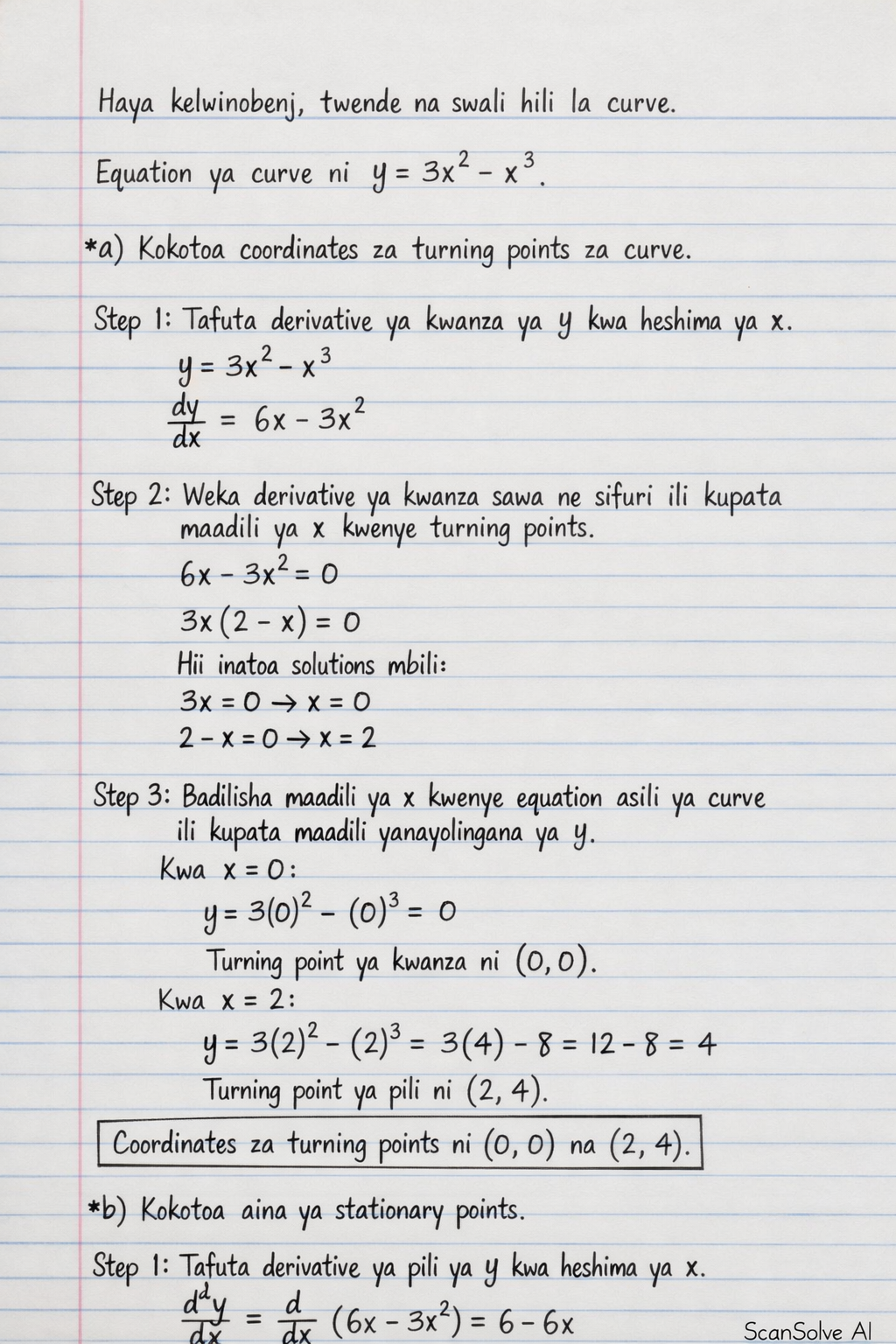
7 stepsHaya kelvinobenj, twende na swali hili la curve.
Equation ya curve ni .
Part a· 3 steps
Kokotoa coordinates za turning points za curve.
Tafuta derivative ya kwanza ya kwa heshima ya .
Weka derivative ya kwanza sawa na sifuri ili kupata maadili ya kwenye turning points.
Hii inatoa solutions mbili:
Badilisha maadili ya kwenye equation asili ya curve ili kupata maadili yanayolingana ya .
Kwa :
Turning point ya kwanza ni .
Kwa :
Turning point ya pili ni .
Coordinates za turning points ni .
Part b
Kokotoa aina ya stationary points.
Tafuta derivative ya pili ya kwa heshima ya .
Tathmini derivative ya pili kwa kila turning point.
Kwa :
Kwa kuwa , point ni local minimum.
Kwa :
Kwa kuwa , point ni local maximum.
Aina ya stationary points ni:
ni .
ni .
Part c(0, 0)
Kokotoa intercepts.
Tafuta y-intercept (ambapo ).
Badilisha kwenye equation asili:
Y-intercept ni .
Tafuta x-intercepts (ambapo ).
Weka kwenye equation asili:
Toa kama common factor:
Hii inatoa solutions mbili:
X-intercepts ni .
Part d
Chora curve.
Ili kuchora curve, tunatumia taarifa zilizopatikana:
- Turning points: (minimum) na (maximum).
- Intercepts: (y-intercept na x-intercept) na (x-intercept).
- Tabia ya curve:
- Kama , .
- Kama , .
Mchoro wa curve utaonyesha:
- Curve inatoka juu kushoto (kutoka ).
- Inashuka hadi kufikia local minimum kwenye .
- Kisha inapanda hadi kufikia local maximum kwenye .
- Baada ya hapo, inashuka tena, ikipita kwenye x-axis kwenye .
- Inaendelea kushuka kuelekea chini kulia (kuelekea ).
Try one yourself
A new problem that tests the same skill.
Still stuck on this one?
Ask a follow-up, and the answer starts from this question.
More Mathematics Questions
Handwritten Step-by-Step Solution
Get this as a handwritten image on WhatsApp — like a tutor wrote it for you.
Try on WhatsApp