We read your photo as:

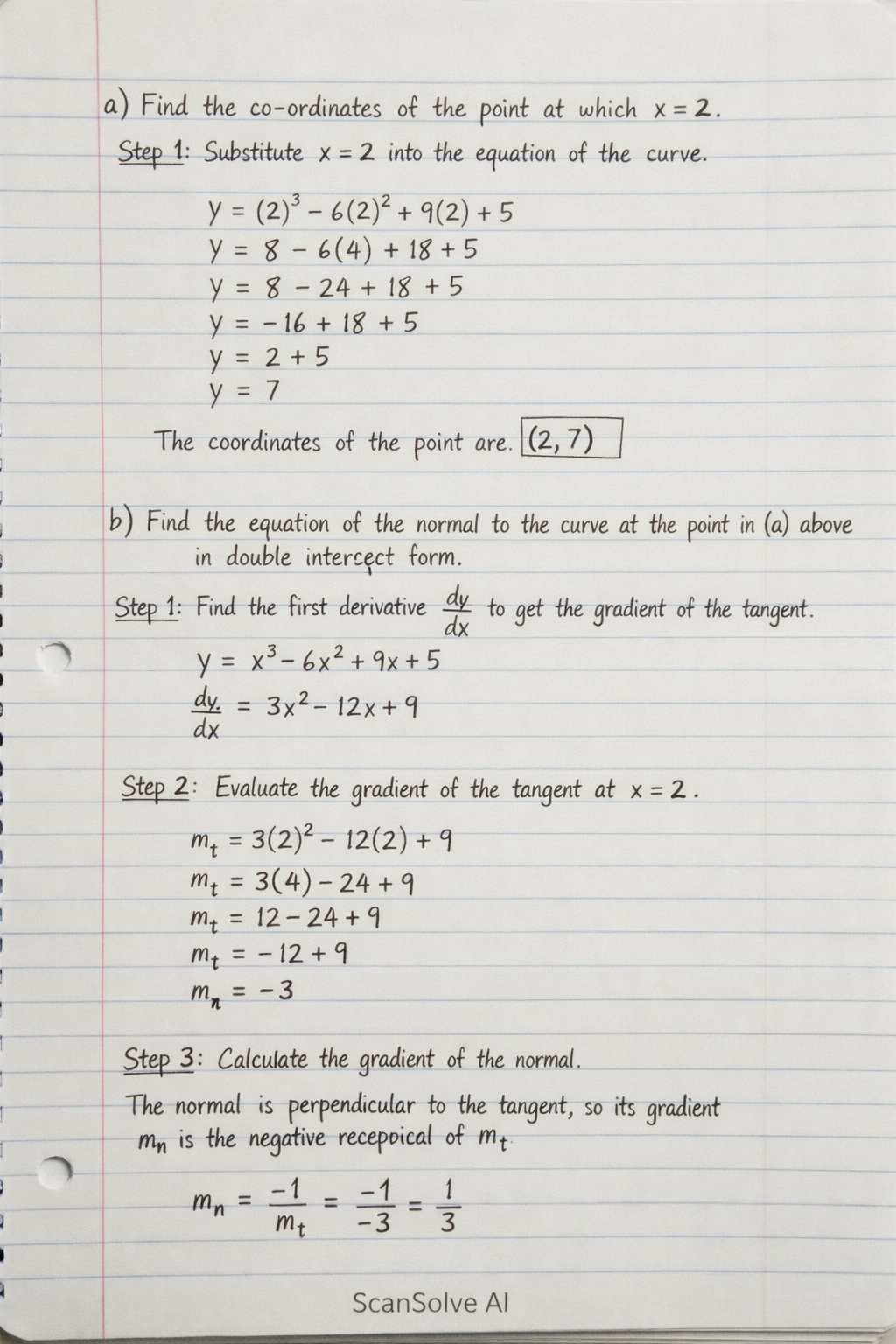
A) Find the co-ordinates of the point at which x=2. b) Find the equation of the normal to the curve at the point in (a) above in double intercept form.

Mathematics

ScanSolve AI Answer

Answers

3 parts
a
(2, 7)
b

x−19+y19/3=1\frac{x}{-19} + \frac{y}{19/3} = 1

c

(1,9) which is a local maximum(1, 9) \text{ which is a local maximum}

(3,5) which is a local minimum(3, 5) \text{ which is a local minimum}

Step-by-step solution

9 steps

The equation of the curve is given by y=5−6x2+x3+9xy = 5 - 6x^2 + x^3 + 9x, which can be rewritten as y=x3−6x2+9x+5y = x^3 - 6x^2 + 9x + 5.

Part a· 1 step

Find the co-ordinates of the point at which x=2x=2.

  1. Substitute x=2x=2 into the equation of the curve.

    y=(2)3−6(2)2+9(2)+5y = (2)^3 - 6(2)^2 + 9(2) + 5 y=8−6(4)+18+5y = 8 - 6(4) + 18 + 5 y=8−24+18+5y = 8 - 24 + 18 + 5 y=−16+18+5y = -16 + 18 + 5 y=2+5y = 2 + 5 y=7y = 7

    The coordinates of the point are (2,7)\boxed{(2, 7)}.

Part b

x−19+y19/3=1\frac{x}{-19} + \frac{y}{19/3} = 1

Find the equation of the normal to the curve at the point in (a) above in double intercept form.

  1. Find the first derivative dydx\frac{dy}{dx} to get the gradient of the tangent.

    y=x3−6x2+9x+5y = x^3 - 6x^2 + 9x + 5 dydx=3x2−12x+9\frac{dy}{dx} = 3x^2 - 12x + 9
  2. Evaluate the gradient of the tangent at x=2x=2.

    mt=3(2)2−12(2)+9m_t = 3(2)^2 - 12(2) + 9 mt=3(4)−24+9m_t = 3(4) - 24 + 9 mt=12−24+9m_t = 12 - 24 + 9 mt=−12+9m_t = -12 + 9 mt=−3m_t = -3
  3. Calculate the gradient of the normal.

    The normal is perpendicular to the tangent, so its gradient mnm_n is the negative reciprocal of mtm_t.

    mn=−1mt=−1−3=13m_n = -\frac{1}{m_t} = -\frac{1}{-3} = \frac{1}{3}
  4. Find the equation of the normal using the point (2,7)(2, 7) and gradient mn=13m_n = \frac{1}{3}.

    Using the point-slope form y−y1=mn(x−x1)y - y_1 = m_n(x - x_1):

    y−7=13(x−2)y - 7 = \frac{1}{3}(x - 2)

    Multiply by 3 to clear the fraction:

    3(y−7)=x−23(y - 7) = x - 2 3y−21=x−23y - 21 = x - 2

    Rearrange into the form Ax+By=CAx + By = C:

    x−3y=−19x - 3y = -19
  5. Convert the equation to double intercept form xa+yb=1\frac{x}{a} + \frac{y}{b} = 1.

    Divide the entire equation by −19-19:

    x−19−3y−19=−19−19\frac{x}{-19} - \frac{3y}{-19} = \frac{-19}{-19} x−19+3y19=1\frac{x}{-19} + \frac{3y}{19} = 1

    This can also be written as:

    x−19+y19/3=1\frac{x}{-19} + \frac{y}{19/3} = 1

    The equation of the normal in double intercept form is x−19+y19/3=1\boxed{\frac{x}{-19} + \frac{y}{19/3} = 1}.

Part c

(1,9) which is a local maximum(1, 9) \text{ which is a local maximum}

Determine the stationary points of the curve and their nature.

  1. Find the x-coordinates of the stationary points by setting dydx=0\frac{dy}{dx} = 0.

    dydx=3x2−12x+9\frac{dy}{dx} = 3x^2 - 12x + 9 3x2−12x+9=03x^2 - 12x + 9 = 0

    Divide by 3:

    x2−4x+3=0x^2 - 4x + 3 = 0

    Factor the quadratic equation:

    (x−1)(x−3)=0(x - 1)(x - 3) = 0

    So, the x-coordinates of the stationary points are x=1x = 1 and x=3x = 3.

  2. Find the y-coordinates of the stationary points by substituting the x-values into the original curve equation y=x3−6x2+9x+5y = x^3 - 6x^2 + 9x + 5.

    For x=1x = 1:

    y=(1)3−6(1)2+9(1)+5y = (1)^3 - 6(1)^2 + 9(1) + 5 y=1−6+9+5y = 1 - 6 + 9 + 5 y=−5+9+5y = -5 + 9 + 5 y=4+5y = 4 + 5 y=9y = 9

    The first stationary point is (1,9)(1, 9).

    For x=3x = 3:

    y=(3)3−6(3)2+9(3)+5y = (3)^3 - 6(3)^2 + 9(3) + 5 y=27−6(9)+27+5y = 27 - 6(9) + 27 + 5 y=27−54+27+5y = 27 - 54 + 27 + 5 y=−27+27+5y = -27 + 27 + 5 y=5y = 5

    The second stationary point is (3,5)(3, 5).

  3. Determine the nature of the stationary points using the second derivative test.

    Find the second derivative d2ydx2\frac{d^2y}{dx^2}:

    dydx=3x2−12x+9\frac{dy}{dx} = 3x^2 - 12x + 9 d2ydx2=6x−12\frac{d^2y}{dx^2} = 6x - 12

    Evaluate d2ydx2\frac{d^2y}{dx^2} at each stationary point:
    For x=1x = 1:

    d2ydx2=6(1)−12=6−12=−6\frac{d^2y}{dx^2} = 6(1) - 12 = 6 - 12 = -6

    Since d2ydx2<0\frac{d^2y}{dx^2} < 0, the point (1,9)(1, 9) is a local maximum.

    For x=3x = 3:

    d2ydx2=6(3)−12=18−12=6\frac{d^2y}{dx^2} = 6(3) - 12 = 18 - 12 = 6

    Since d2ydx2>0\frac{d^2y}{dx^2} > 0, the point (3,5)(3, 5) is a local minimum.

    The stationary points are:
    (1,9) which is a local maximum\boxed{(1, 9) \text{ which is a local maximum}}
    (3,5) which is a local minimum\boxed{(3, 5) \text{ which is a local minimum}}

Was this helpful?

Try one yourself

A new problem that tests the same skill.

Still stuck on this one?

Ask a follow-up, and the answer starts from this question.

Got a different question?Ask your own question
Handwritten step-by-step solution preview

Handwritten Step-by-Step Solution

Get this as a handwritten image on WhatsApp — like a tutor wrote it for you.

Try on WhatsApp