
We read your photo as:
Question 4: a) Find the size of angles x, y and z. b) The diagram shows a circle with centre O. RS is a diameter. What is the size of angle x?
ScanSolve AI Answer
Answers
2 partsStep-by-step solution
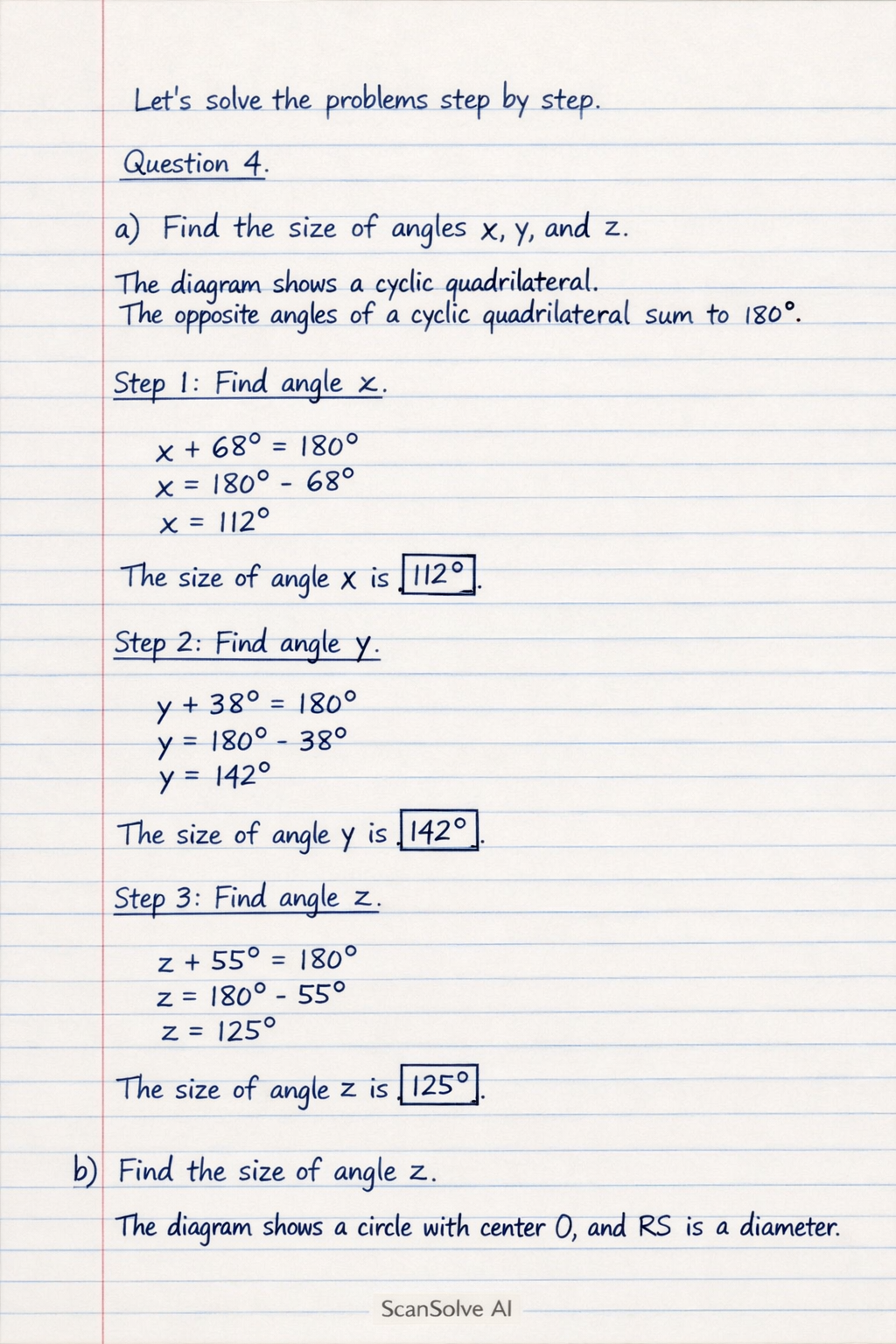
6 stepsLet's solve the problems step by step.
Part 4
Part a
Find the size of angles , , and .
The diagram shows a cyclic quadrilateral. The opposite angles of a cyclic quadrilateral sum to .
Find angle .
The angles and are opposite angles in the cyclic quadrilateral.
The size of angle is .
Find angle .
The angles and are opposite angles in the cyclic quadrilateral.
The size of angle is .
Find angle .
The angles and are opposite angles in the cyclic quadrilateral.
The size of angle is .
Part b
Find the size of angle .
The diagram shows a circle with center , and is a diameter.
Recognize that is a right angle because it subtends the diameter .
Use the angles in triangle .
The sum of angles in a triangle is .
Solve for angle .
Since , the angle is the remaining angle in the triangle.
The size of angle is .
Try one yourself
A new problem that tests the same skill.
Still stuck on this one?
Ask a follow-up, and the answer starts from this question.
More Mathematics Questions
Handwritten Step-by-Step Solution
Get this as a handwritten image on WhatsApp — like a tutor wrote it for you.
Try on WhatsApp