
We read your photo as:
Find the size of angles w, x, y and z, giving a reason for your answer in each case.
ScanSolve AI Answer
Step-by-step solution
12 stepsHere are the solutions for the geometry problems.
Question 2
a)
The diagram shows two parallel horizontal lines intersected by two transversals, forming an isosceles triangle.
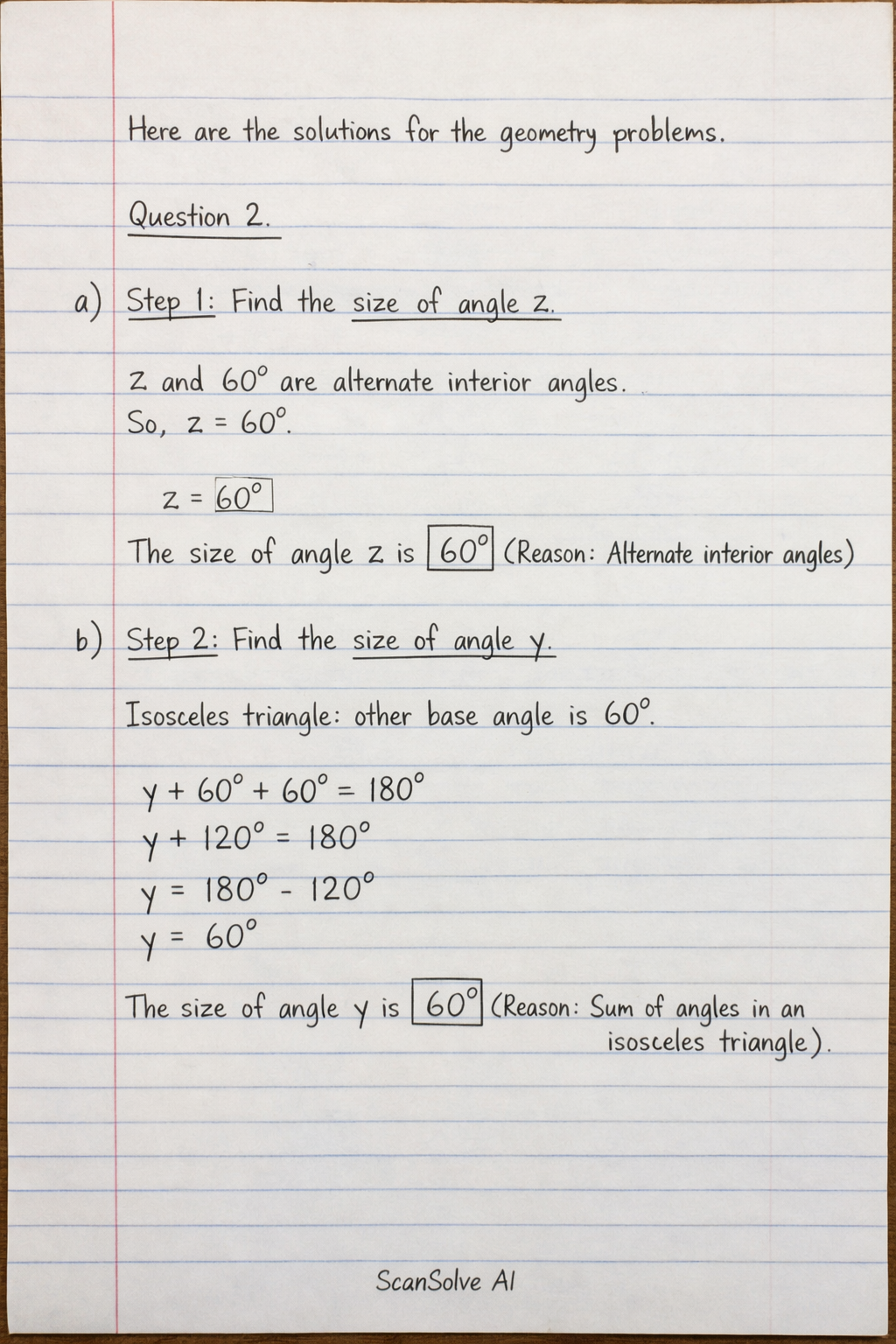
Find the size of angle .
Angle and the given angle are alternate interior angles because they are between parallel lines and on opposite sides of a transversal. Alternate interior angles are equal.
The size of angle is (Reason: Alternate interior angles).
Find the size of angle .
The triangle is isosceles, and angle is one of its base angles. Therefore, the other base angle (at the top-left vertex of the triangle) is also . The sum of angles in a triangle is .
The size of angle is (Reason: Sum of angles in an isosceles triangle).
Find the size of angle .
Angle and angle are vertically opposite angles. Vertically opposite angles are equal.
The size of angle is (Reason: Vertically opposite angles).
Find the size of angle .
Angle and the top-left base angle of the isosceles triangle (which is ) are alternate interior angles because they are between parallel lines and on opposite sides of a transversal. Alternate interior angles are equal.
The size of angle is (Reason: Alternate interior angles).
b)
In the diagram, PQ is parallel to RS, and PY = PZ.Find the interior angle at R.
The angle and the interior angle form a linear pair on a straight line. Angles on a straight line sum to .
Find angle .
Since PQ is parallel to RS, angle and angle are alternate interior angles. Alternate interior angles are equal.
Find the base angles of triangle PYZ.
Given that PY = PZ, triangle PYZ is an isosceles triangle. The base angles opposite the equal sides are equal, so . The sum of angles in a triangle is .
Solve for , which is .
Therefore, the size of angle is .
Question 3
a)
The diagram shows a trapezium with parallel top and bottom sides. The angles are given in terms of . For parallel lines intersected by a transversal, consecutive interior angles sum to .Calculate using the angles on the left transversal.
The angles (top left) and (bottom left) are consecutive interior angles.
Calculate using the angles on the right transversal.
The angles (top right) and (bottom right) are consecutive interior angles.
Identify the inconsistency.
The problem contains an inconsistency, as the value of differs depending on which pair of consecutive interior angles is used ( from the left side and from the right side). Therefore, a unique value for cannot be determined from the given information.
Provide a value with a note.
Since a unique value for cannot be determined due to the inconsistency in the problem statement, we will provide the value derived from the left side as an example.
The value of is (Note: The problem contains an inconsistency, leading to different values of depending on the transversal used).
Still stuck on this one?
Ask a follow-up, and the answer starts from this question.
More Mathematics Questions
Handwritten Step-by-Step Solution
Get this as a handwritten image on WhatsApp — like a tutor wrote it for you.
Try on WhatsApp