
We read your photo as:
In the diagram, PQ and RS are straight lines. What is the value of y? In the diagram, KL is a straight line. What is the size of angle x? What is the size of angle x in the diagram?
ScanSolve AI Answer
Answers
3 partsStep-by-step solution
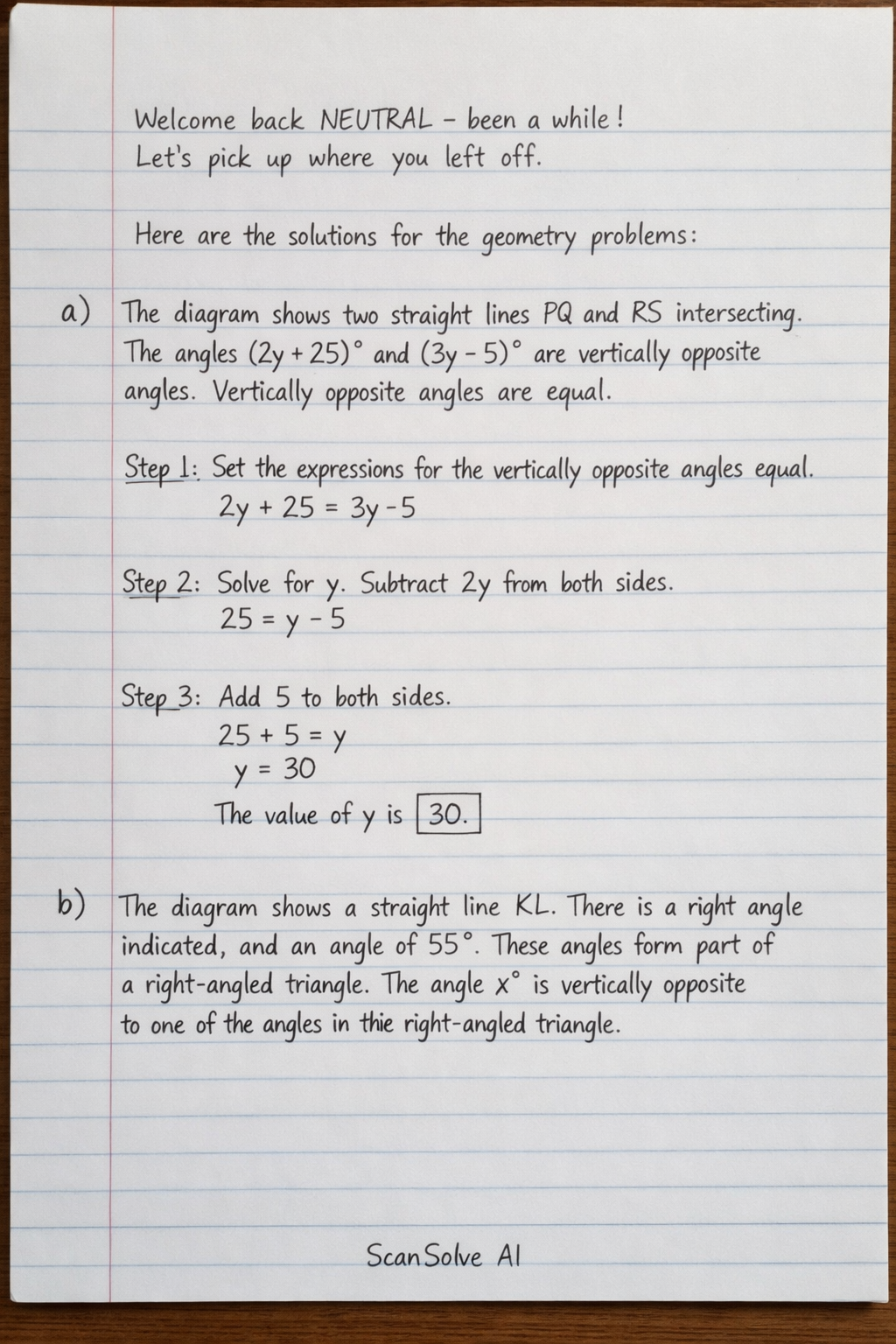
9 stepsHere are the solutions for the geometry problems:
Part a· 3 steps
The diagram shows two straight lines PQ and RS intersecting. The angles and are vertically opposite angles. Vertically opposite angles are equal.
Set the expressions for the vertically opposite angles equal to each other.
Solve for .
Subtract from both sides.
Add 5 to both sides.
The value of is .
Part b
The diagram shows a straight line KL. There is a right angle indicated, and an angle of . These angles form part of a right-angled triangle. The angle is vertically opposite to one of the angles in this right-angled triangle.
Identify the angles in the small right-angled triangle at the top.
One angle is (indicated by the square symbol), and another is . The third angle in this triangle is .
The angle is vertically opposite to this angle.
Vertically opposite angles are equal.
The size of angle is .
Part c
The diagram shows a triangle with angles , , and an exterior angle of . The angle is an interior angle of the triangle. The angle is also an interior angle. The angle is an exterior angle to the triangle at the third vertex. The exterior angle of a triangle is equal to the sum of the two opposite interior angles.
Identify the relationship between the angles.
The exterior angle is equal to the sum of the two opposite interior angles, and .
Solve for .
Subtract from both sides.
This result is not possible for an angle in a standard geometric context. Let's re-interpret the diagram.
Alternative Interpretation for c):
It is more likely that the angle is an interior angle of the triangle, and the angle is an exterior angle. Or, the is an interior angle, and the is an interior angle. Given the placement, it's common for the angle at the intersection of the two lines to be an interior angle of the triangle formed by the base.Let's assume the is an interior angle of the triangle, and the is an exterior angle to the triangle at the vertex B.
If is an exterior angle at B, then the interior angle at B is .
Then . This is still not possible.Let's assume the is an interior angle of the triangle, and the is also an interior angle of the triangle.
The sum of angles in a triangle is .Sum the interior angles of the triangle.
Simplify and solve for .
This interpretation yields a positive angle and is consistent with typical geometry problems. The way the is drawn, it's at the base, which often implies it's an interior angle.
The size of angle is .
Try one yourself
A new problem that tests the same skill.
Still stuck on this one?
Ask a follow-up, and the answer starts from this question.
More Mathematics Questions
Handwritten Step-by-Step Solution
Get this as a handwritten image on WhatsApp — like a tutor wrote it for you.
Try on WhatsApp