
This mathematics problem involves applying core mathematical principles and formulas. Below you will find a complete step-by-step solution with detailed explanations for each step, helping you understand not just the answer but the method behind it.
ScanSolve AI Answer
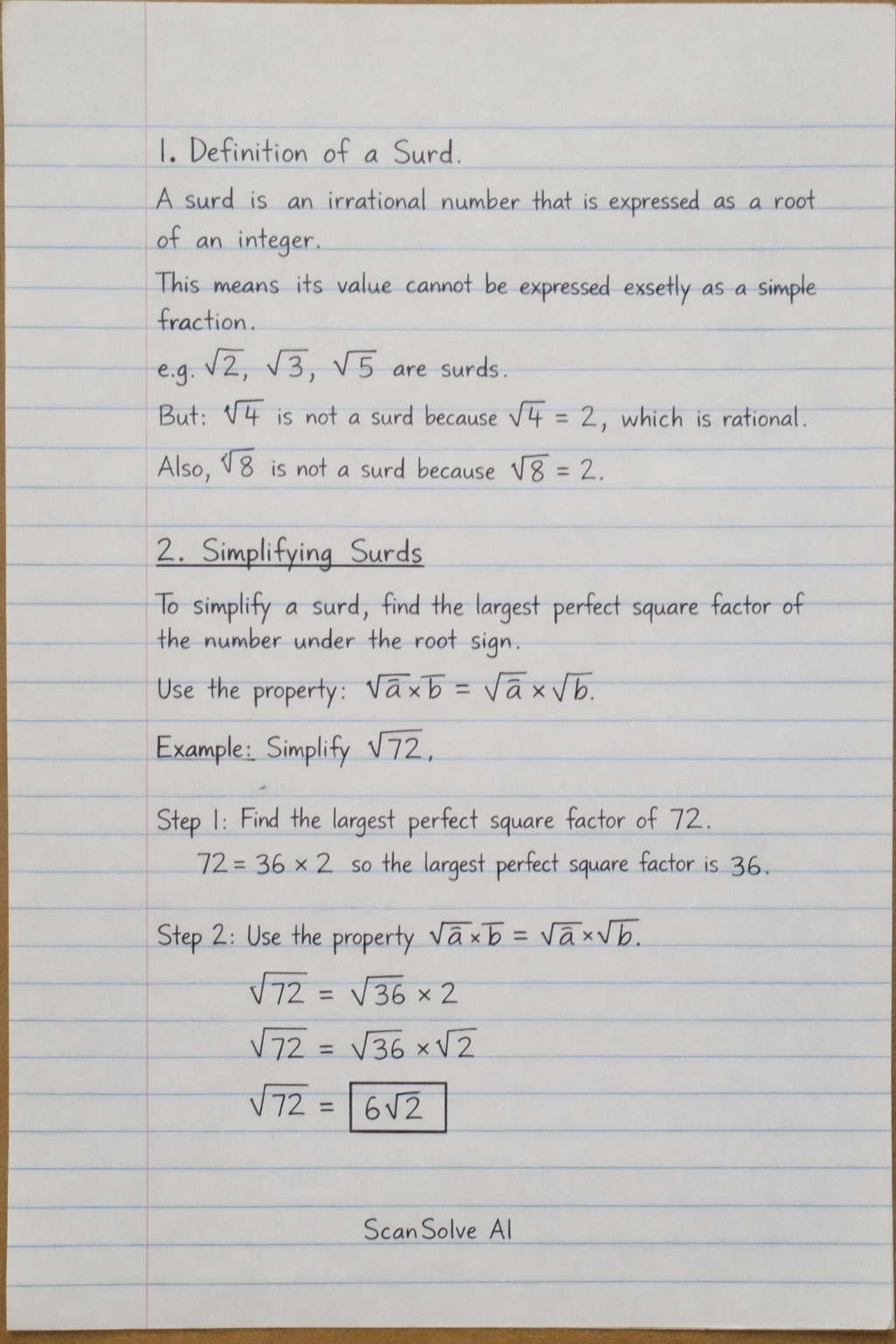
here are some key notes on surds, focusing on what's typically examinable at the UCE level: 1. Definition of a Surd A surd is an irrational number that is expressed as a root of an integer. This means its value cannot be expressed exactly as a simple fraction. For example, sqrt(2), sqrt(3), and sqrt(5) are surds. However, sqrt(4) is not a surd because it simplifies to 2, which is a rational number. Similarly, [3]8 is not a surd because it simplifies to 2. 2. Simplifying Surds To simplify a surd, find the largest perfect square factor of the number under the square root sign. Use the property sqrt(a × b) = sqrt(a) × sqrt(b). Example: Simplify sqrt(72). Step 1: Find the largest perfect square factor of 72. The largest perfect square factor of 72 is 36 (36 × 2 = 72). Step 2: Apply the property sqrt(a × b) = sqrt(a) × sqrt(b). sqrt(72) = sqrt(36 × 2) sqrt(72) = sqrt(36) × sqrt(2) sqrt(72) = 6sqrt(2) 3. Operations with Surds Addition and Subtraction: You can only add or subtract like surds* (surds with the same number under the root sign). If surds are not alike, simplify them first to see if they become like surds. Example: Simplify 3sqrt(5) + sqrt(20). Step 1: Simplify sqrt(20). sqrt(20) = sqrt(4 × 5) = sqrt(4) × sqrt(5) = 2sqrt(5) Step 2: Add the like surds. 3sqrt(5) + 2sqrt(5) = 5sqrt(5) Multiplication: Use the property sqrt(a) × sqrt(b) = sqrt(a × b). Example: Simplify sqrt(6) × sqrt(3). Step 1: Multiply the numbers under the root sign. sqrt(6) × sqrt(3) = sqrt(6 × 3) sqrt(6) × sqrt(3) = sqrt(18) Step 2: Simplify the resulting surd. sqrt(18) = sqrt(9 × 2) = sqrt(9) × sqrt(2) = 3sqrt(2) Division: Use the property sqrt(a)sqrt(b) = sqrt((a)/(b)). Example: Simplify sqrt(48)sqrt(3). Step 1: Divide the numbers under the root sign. sqrt(48)sqrt(3) = sqrt((48)/(3)) sqrt(48)sqrt(3) = sqrt(16) Step 2: Evaluate the square root. sqrt(16) = 4 4. Rationalizing the Denominator Rationalizing the denominator means removing any surds from the denominator of a fraction. This is done by multiplying both the numerator and the denominator by a suitable term. Single Term Denominator: If the denominator is of the form sqrt(a), multiply the numerator and denominator by sqrt(a). Example: Rationalize (5)/(sqrt(7)). Step 1: Multiply numerator and denominator by sqrt(7). (5)/(sqrt(7)) × sqrt(7)sqrt(7) Step 2: Perform the multiplication. 5sqrt(7)7 = 5sqrt(7)7 Binomial Denominator: If the denominator is of the form a + sqrt(b) or sqrt(a) + sqrt(b), multiply the numerator and denominator by its conjugate*. The conjugate of a + sqrt(b) is a - sqrt(b), and vice versa. This uses the difference of squares formula: (x+y)(x-y) = x^2 - y^2. Example: Rationalize (1)/(3 - sqrt(2)). Step 1: Identify the conjugate of the denominator. The conjugate of 3 - sqrt(2) is 3 + sqrt(2). Step 2: Multiply numerator and denominator by the conjugate. (1)/(3 - sqrt(2)) × 3 + sqrt(2)3 + sqrt(2) Step 3: Perform the multiplication. 1 × (3 + sqrt(2))(3 - sqrt(2))(3 + sqrt(2)) 3 + sqrt(2)3^2 - (sqrt(2))^2 3 + sqrt(2)9 - 2 3 + sqrt(2)7 = 3 + sqrt(2)7 Got more? Send 'em!